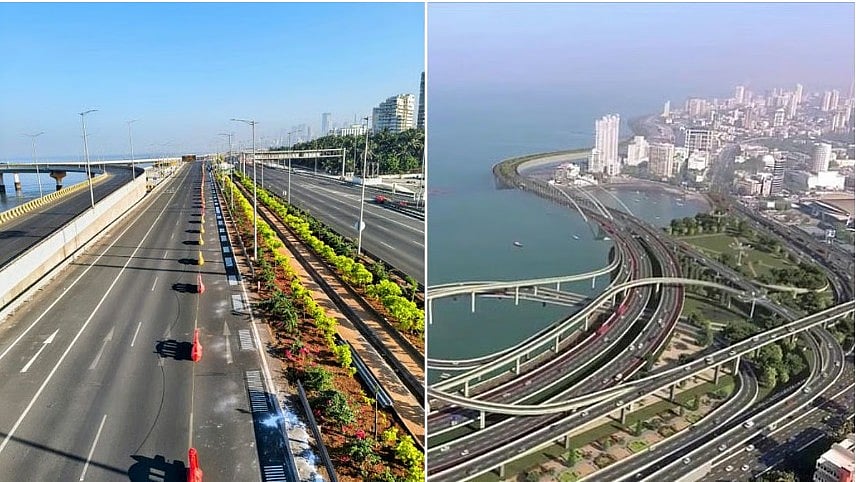
On Wednesday, February 11, Mumbai gave India its first ‘musical road’. A stretch of 500 metres of the coastal road on the northbound lane at Worli, after exiting the underground tunnel, has special grooves or rumble strips that play the notes of the famous Oscar-winning “Jai Ho” number from Slumdog Millionaire. When vehicles traverse at 70–80 kilometres per hour over these, strains of music can be heard inside them. This little nugget was inaugurated by Chief Minister Devendra Fadnavis. “Mumbai has added an unusual flourish to its infrastructure story,” gushed a headline.
Citizens seek substantive infrastructure
Millions of Mumbaikars would happily forego this “flourish” for the sake of substantive infrastructure they can use to make their daily life meaningful—walkable pavements, motorable roads with traffic discipline, protected open and green spaces accessible to all in every neighbourhood of the city, housing that does not require people to squeeze into cubbyholes or sign for life-long mortgages, and recreation facilities that make the best use of the city’s natural wealth of water bodies and wetlands.
Carter Road promenade controversy
On one such waterfront, at Bandra’s Carter Road, the 1.2-kilometre promenade saw digging this week to lay cables and other requirements for 35 commercial LED hoardings. Transformed from a former dump site by a citizens’ initiative and public funds led by the late Darryl D’Monte, Bandra West Residents’ Association, and architect-activist PK Das, it includes a jogging track, a skating park and an amphitheatre around the mangroves in the area.
The promenade draws thousands every day, not only from the tony Bandra suburb but also from across the city, to take in sea waves and the wind. It was maintained for over two decades by the Residents’ Association and recently handed over to the BMC. Former Bandra corporator Asif Zakaria wrote to the Municipal Commissioner, among others, that the installation of 35 LED hoardings amounted to “complete commercialisation of a public open space”.
Swift citizen response ensured that one erected billboard was taken down and work stopped on 34 others. But, honestly, would the BMC care if a natural waterfront with unparalleled views, made and maintained with citizens’ initiatives, was usurped for glitzy neon hoardings that would not only create visual clutter but also light pollution? Of course not, especially when its self-determined agenda is to ‘beautify’ Mumbai, which means hideous, cosmetic and obnoxious installations and projects while destroying the city’s natural wealth, such as hacking 45,675 of 60,000 mangroves for the Versova–Dahisar coastal road or unveiling the zonal master plan to open eco-sensitive zones around the Sanjay Gandhi National Park for construction.
The cost of cosmetic lighting
This ‘beautification’ includes the ‘I Love Mumbai’ lit installations at strategic points, with variations of the local area name at others. In the past three to four years, this also meant the installation of LED and fairy lights here, there and everywhere—from wrapping them around trees without a thought to the ecological disruption they cause to randomly putting them around traffic signals and other spots that the civic body decided needed colourful Diwali-style lights throughout the year. This did not come cheap; it was a part of the Rs 1,700 crore beautification plan rolled out in 2022.
Citizens and environmentalists like Rohit Joshi had to knock on the doors of the Bombay High Court to stall the plans and have the installed lights removed. No prizes for guessing that the contractors went home laughing—first to install the lights, then to take them down. This, in the BMC that routinely cries over lack of funds for critical and necessary infrastructure like pavements. In its 2025–26 budget of over Rs 74,000 crore, the roads and traffic division was allocated Rs 5,100 crore, from which a grand total of Rs 100 crore was earmarked for a city-wide footpath revamp project.
Pedestrian safety overlooked
On the ground, the Rs 100 crore was to cover pavements on 14 roads, covering 16.55 kilometres. In a city with pedestrian-friendly roads less than 20 per cent of the entire road length, in a city where nearly 45 per cent of all trips are made by foot, in a city that routinely records pedestrians as one of the most at-risk groups, forming an average of 40 per cent of all fatalities on roads, it is morally repugnant and legally untenable that fairy lights on trees or musical strips on the coastal road become more important for the BMC.
Lack of vision and accountability
These ‘beautification’ projects lack a clear objective and a cohesive and coherent strategy and display a wilful arbitrariness without a nod to the cultural character or heritage of the city or an area. They are random, poorly designed, made often with cheap materials, and say nothing meaningful about the city or enhance its best features. They enrich only the contractors and their friends in high places. No officer is held accountable for the spending. Such projects are a sheer misuse and waste of public funds. Remember, the BMC routinely says it has no funds to maintain neighbourhood gardens or to replace street lights.
Basic infrastructure must come first
Beautification projects do not—and cannot—replace basic, well-functioning and substantive infrastructure, which Mumbai sorely needs. It does not require a study or a panel of experts for the BMC to figure out what this infrastructure must include. The civic body—its senior officials and its minders in the state government—are well aware of what is needed for the good of millions of Mumbaikars; it chooses to direct its attention and funds into such superficial, cosmetic and wasteful ‘beautification’ projects or make money off public spaces that truly belong to the people. Now, after the civic election results, unfortunately, it can even claim the mandate to carry out this agenda.
Smruti Koppikar, an award-winning senior journalist and urban chronicler, writes extensively on cities, development, gender and the media. She is the Founder Editor of the award-winning online journal ‘Question of Cities’ and can be reached at smruti@questionofcities.org.

