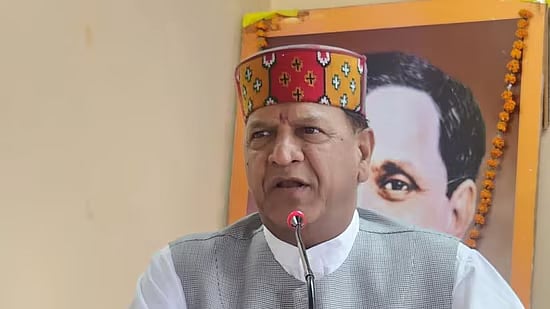
The Bharatiya Janata Party in Himachal Pradesh has entered a decisive phase of introspection and reinvention. Almost three years after losing power to the Congress, the party is undergoing a fundamental restructuring under its state president, Dr Rajeev Bindal, whose recent reconstitution of the BJP’s state executive marks the most comprehensive organisational overhaul. A physician-turned-politician having strong RSS links, Bindal has embarked on a mission to rebuild the BJP’s grassroots base, renew public faith, and prepare for a comeback in 2027.
This reconstitution is not routine it signals a strategic recalibration to restore the party’s connect with voters and resolve internal dissonance that contributed to the 2022 defeat. For Bindal, the task is twofold: rebuild from within and reconnect beyond.
The New Executive: Inclusivity and Balance as Tools of Revival
At the core of Bindal’s revival blueprint lies a huge 129-member state executive reflecting careful social and regional engineering. The new team includes eight vice-presidents, three general secretaries, eight secretaries, and dedicated in-charges for IT, media, and office management. Its hallmark is inclusivity — 35 women and 50 members from Scheduled Caste, Scheduled Tribe, and OBC communities — ensuring the organisation mirrors Himachal’s diverse social fabric.


Regional balance has been restored with representation from Kangra, Mandi, Shimla, Sirmaur, Kinnaur, and Lahaul-Spiti, effectively cooling factional tensions. By blending young activists with seasoned leaders, Bindal has struck a balance between renewal and experience energising cadres and replacing fatigue with purpose. The reconstituted executive now serves as a bridge between booth and ballot, grounding every decision in local realities rather than Delhi-centric assumptions.
Factionalism and Political Headwinds
Bindal’s leadership faces its own tests. Chief Minister, Sukhvinder Singh Sukhu has claimed the BJP is divided into five factions led by ambitious leaders vying for supremacy. The ongoing rivalry between former Chief Minister, Jai Ram Thakur and former Union Minister, Anurag Thakur has spilled into the open, both seen as aspiring for the top post if the BJP returns in 2027. For Bindal, maintaining cohesion amid competing egos will be as vital as countering the Congress on the ground.
The Sukhu-led Congress government projects the NDA at the Centre as “anti-Himachali,” citing step-motherly treatment in relief for victims of the 2023 and 2025 natural disasters. The BJP will have to counter this while exposing the government’s failures on unemployment, inflation, and rural distress.
Joblessness among youth has become the state’s most volatile issue. Closure of over 2,000 institutions, withdrawal of posts, and a debt exceeding ₹1 lakh crore have bred frustration. Bindal knows protest alone won’t work — the BJP plans to offer solutions, not slogans.
Disaster management remains another weak flank of the Congress. Monsoon devastations that caused heavy loss of lives and property exposed glaring administrative lapses. The BJP tactics may focus on contrasting it with its own record of coordinated relief and disciplined governance.
Bindal feels that equally serious is the rise of drug and mining mafias in border districts. The BJP aims to project itself as the party of accountability and order. Meanwhile, lakhs of women feel short-changed by the government’s failure to deliver the promised ₹1,500 monthly assistance — a constituency- Bindal hopes to convert into a decisive force in 2027.
Grassroots Reorganisation: A Bottom-Up Strategy
Parallel to the new executive, Bindal has launched the most ambitious booth-level reorganisation and the party has completed committees in 7,750 of 8,007 booths, inclusive of youth, women, farmers, and marginalised sections. The flagship “Ek Booth – Tees Voter Sampark Abhiyan” seeks to make every booth a micro-laboratory of outreach and feedback.
Bindal’s mantra — “Organisation first, election next” — underscores his belief that a sturdy structure precedes victory. Through the “Sampark Aur Samadhan” initiative, the BJP is collecting feedback from mandals and districts on local issues, governance failures, and people’s aspirations. This shift from a top-down command to bottom-up consultation marks a cultural transformation in the state unit.Mandals have been expanded from 74 to 171, each with a 45-member team including 25% women and 20% members from disadvantaged groups.
Synergy with Central Leadership
The revival enjoys strong backing from the central leadership. As BJP National President, J.P. Nadda — himself a Himachali — acts as a crucial link between the state and the Centre. Regular coordination meetings and digital monitoring have aligned Himachal’s revival plan with the party’s national strategy.
Prime Minister Narendra Modi’s focus on infrastructure, digital inclusion, and transparent governance provides a national framework that Bindal is adapting locally. He has instructed party units to connect central schemes like PM Kisan, Ayushman Bharat, and Ujjwala with beneficiaries to counter the Congress claim that welfare begins and ends with its “guarantees.”
Bindal’s message is clear: Himachal’s growth trajectory, built during the BJP’s tenure, has faltered under the current regime and can regain momentum only through a stable BJP government aligned with Modi’s vision.
Rebuilding Trust and the Road to 2027
Bindal understands that elections in Himachal are not just contests of arithmetic but of sentiment. His leadership seeks to bridge the trust gap with government employees, small traders, and women voters who drifted away in 2022.
Workshops and outreach drives aim to humanise the party’s image, replacing rallies with direct dialogue. Training camps for booth workers, digital literacy sessions, and professional outreach through farmers’ and professionals’ cells are part of this effort to make the BJP a “listening party.”
As Mission 2027 gathers momentum, the internal slogan — “Booth Majboot, Sangathan Sabse Upar” — captures the spirit of renewal. If Dr Bindal sustains unity, amplifies Modi’s appeal, and translates structural revival into public trust, 2027 could mark not just the chances of BJP’s comeback but its political redemption — turning defeat into disciplined resurgence.
(The writer is a senior political analyst based in Shimla.)