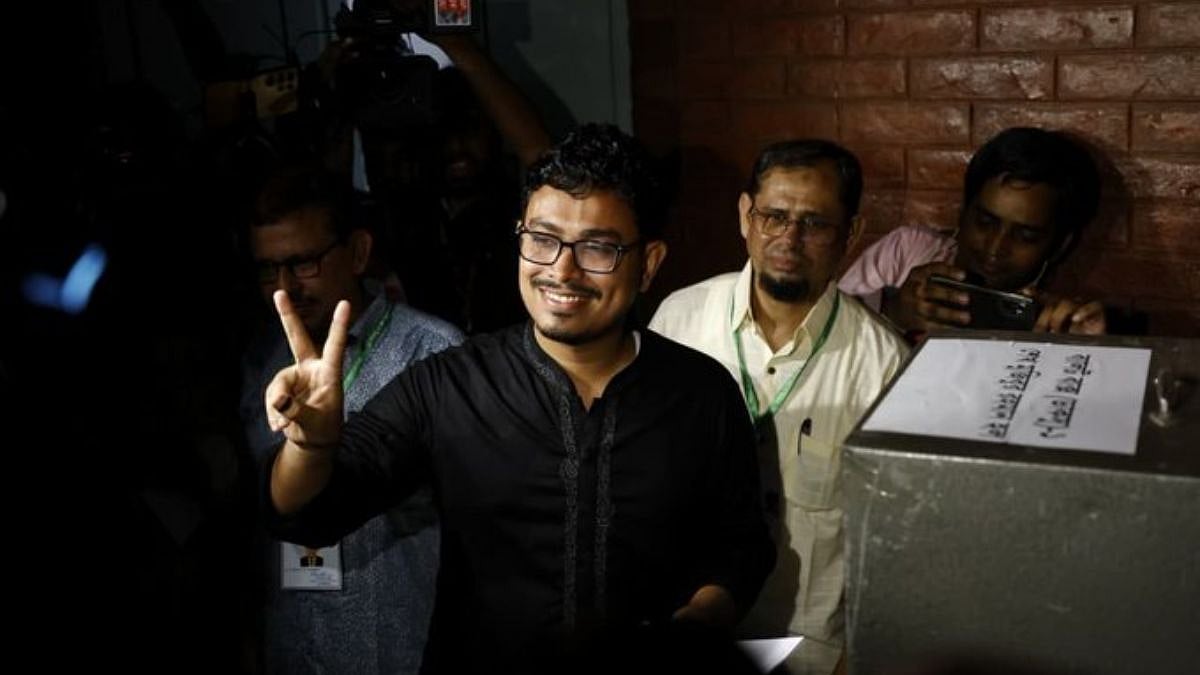
This week’s elections to Bangladesh’s National Assembly are less an exercise in democratic routine than a referendum on the country’s political and ideological future, something which world capitals are deeply interested in understanding.
What was once scheduled as a conventional transfer of power is now unfolding in an atmosphere of street violence, labour unrest, bureaucratic capture, and deep ideological polarisation, in what can best be described as the unstable aftermath of the dramatic collapse of Sheikh Hasina’s government in August 2024.
However, as Indian diplomats have said privately, any elected government is a better alternative than having a chaotic interim government continue to rule out of Dhaka—some form of a people’s mandate is better than an inimical power centre, which is pulled by many strings and belongs to none.
Disorder as the new normal
In recent days, disorder has ceased to be episodic and has instead become the background condition of politics. Last week, after Friday prayers in central Dhaka, activists linked to an Islamic party clashed with the police in running battles that left dozens injured and many detained.
Two forces dominate this fractured terrain. One is the BNP, which has governed intermittently whenever the Awami League has been out of power. The other is Jamaat-e-Islami, a party still haunted by its role in 1971, when it collaborated with the Pakistani army during Bangladesh’s war of independence—an episode that ended in mass atrocities and genocide.
Yet Jamaat never disappeared from the ballot box or from politics. It has consistently polled between 5 and 12 per cent in every election and now appears poised for its strongest showing yet.
BNP momentum and baggage
The presence of Tarique Rahman, the scion to the Zia legacy left behind by his parents—General Zia Ur Rahman and Begum Khaleda Zia—and the crowds he has been attracting would indicate that the BNP could sweep the polls.
However, the fact is that the BNP enters the race damaged by its own recent conduct. In the vacuum created by Hasina’s fall, party cadres were widely accused of engaging in chandabaji—systematic extortion targeting business owners, minorities, and those perceived to be Awami League loyalists. The accusations reinforced an old public suspicion: that the BNP’s politics, however nationalist in rhetoric, often devolves into predation in practice.
Jamaat’s calculated rise
Jamaat, by contrast, has largely escaped association with this post-transition extortion. That has allowed it to project an image of discipline and organisational coherence. But the party’s ideological commitments remain stark. Jamaat leaders have openly rejected gender equality, insisting that women are not meant to rule. They have reaffirmed their long-term ambition to introduce Sharia law, a move that would fundamentally recast Bangladesh’s constitutional order and place liberal Muslims, religious minorities, and heterodox Islamic traditions in an increasingly precarious position.
Awami League on the margins
The Awami League, barred from contesting the election, has tried to shape events from the margins. From exile, believed to be somewhere in India, Sheikh Hasina has urged supporters to boycott the vote under the slogan “No boat, no vote”, a reference to the party’s electoral symbol. The aim is simple: delegitimise the outcome by suppressing turnout.
On the ground, however, boycotts are hard to enforce in a climate of fear. Activists aligned with both Jamaat and the BNP have reportedly warned suspected Awami League supporters and members of minority communities that failure to vote could invite retaliation. In Bangladesh, such threats carry a familiar meaning of arson attacks, physical assaults, and, in some cases, lethal violence.
There will almost certainly be voting on February 12, but it is likely to occur in many places under conditions of coercion rather than consent.
Institutional capture and electoral leverage
More quietly, Jamaat has been consolidating influence over the state’s institutional machinery. One of its earliest moves after Hasina’s ouster was a sweeping reshuffle of lower-level administrative officials. District officers were pressured to resign or placed on leave; school and university administrators were systematically sidelined.
The effort was initially read as part of Jamaat’s long-standing project of Islamising education. Its electoral significance, however, may be even greater. In Bangladesh, where professional civil servants are scarce, elections are administered largely by schoolteachers and college lecturers.
High-stakes outcomes
Privately conducted surveys suggest that the BNP, led by Tarique Rahman, is still best placed to emerge as the single largest party. It could plausibly win an outright majority.
But Jamaat is unlikely to be marginal. Estimates suggest it may secure between 50 and 80 seats, with the potential for more if administrative leverage translates into electoral advantage. Jamaat’s goal is not necessarily to govern alone but to ensure that the BNP falls short of a majority and is forced to rely on Islamist support to form a government and, therefore, forced to adopt its manifesto.
India’s strategic dilemma
While both Jamaat and the BNP have been telling Indian officials that they have changed and will no longer allow any forces inimical to India to function out of Bangladesh, they are best believed with a pinch of salt. Unlike the Afghan Taliban, the Islamists in Bangladesh have had only one external enemy since their first evolution post-1947—and that is the land they refer to as Hindustan.
A long history of BNP-led governments having helped Pakistan’s ISI to foment trouble in the Northeast, and another of Jamaat and other assorted Islamists assisting the training and funding of radical terror groups which struck India in the early 2000s, can never be forgotten.
For India, Islamist militant networks remain a major concern, particularly after several militants arrested under Hasina were released following the 2024 upheaval. Indian security officials believe many have since regrouped in new dormant but operationally ready organisations.
For New Delhi, then, February 12 presents no really good options—only gradations of risk. A BNP majority might offer transactional stability, which will remain vulnerable to Islamist pressure as well as pressure from larger powers such as the US and China. A BNP-Jamaat coalition would raise sharper concerns about radicalisation and minority rights, besides links with Pakistan and Turkiye.
While a Jamaat-influenced order, even from the margins, could gradually reshape Bangladesh’s institutions in ways that are difficult to reverse and pose an ideological challenge to the Indian state.
This election, in other words, is not simply about who wins; it is about how power will be structured the day after, and whether Bangladesh’s fragile democratic and secular foundations can survive the forces now competing to redefine the state.
The writer is former head of PTI’s eastern region network.

