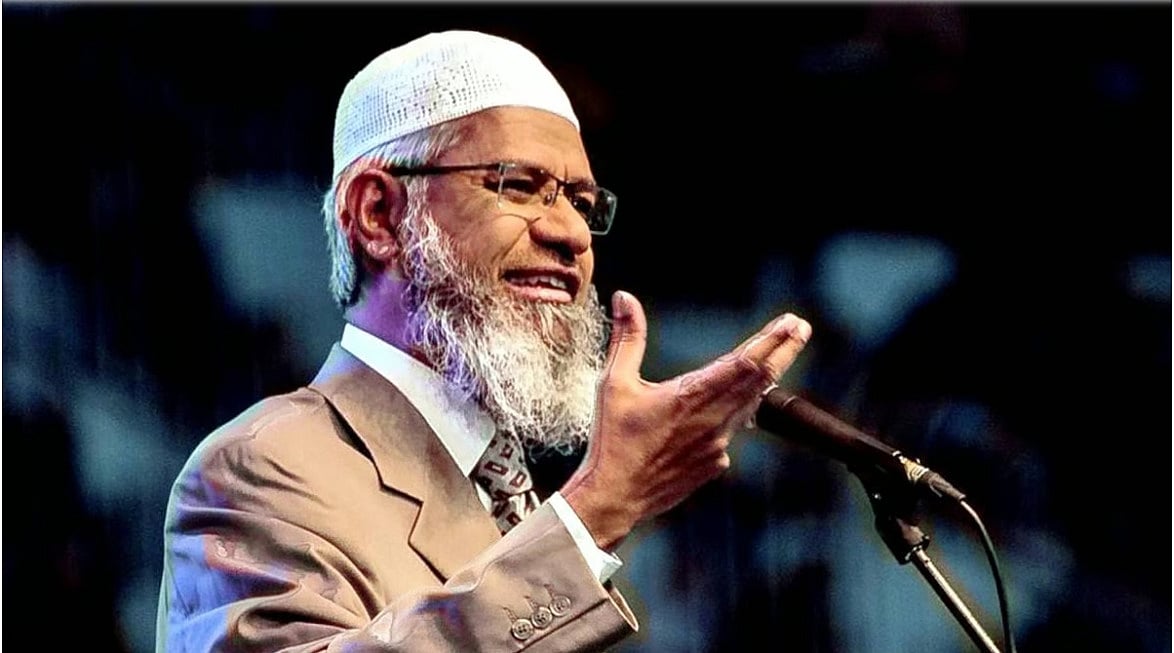
Controversial Islamic preacher Zakir Naik has come under sharp criticism from journalists, activists, academics and citizens in India, Pakistan and Afghanistan after defending the Taliban's restrictions on girls' education in Afghanistan.
In a video that has gained traction on social media, Naik accused the media of presenting a misleading picture of the situation in Afghanistan.
"Everything that comes in the media is not true", he claimed.
"So if someone delays the education till they have the right teacher, there is no problem at all", he added.

Defending the Taliban administration, Naik argued that the authorities had only deferred secondary and higher education for girls until adequate security arrangements could be made.
He claimed that girls were still allowed to pursue education up to Class 6, while further studies remained suspended because of concerns over safe learning environments and a shortage of female teachers. Naik also alleged that Afghan women continued to pursue master's degrees and PhDs in Islamic studies and Sharia.
Malala Yousafzai's father condemns Naik's remarks
The comments drew a strong response from the father of Pakistani education activist Malala Yousafzai, who described Naik's defence of the Taliban's policies as "deeply troubling and disappointing".
"It is deeply troubling and disappointing to see an Islamic scholar of such global prominence as Dr. @drzakiranaik rationalise the Taliban's systematic exclusion of girls from education", he said.

"Presenting an indefinite ban as a mere "postponement" and invoking a shortage of female teachers without explaining how that shortage can be addressed is not a credible defence", he added.
He warned that such remarks risk legitimising the Taliban's systematic restrictions on women, describing the situation as a "grave injustice".
Malala was shot by the Taliban after publicly advocating girls' right to education and opposing the extremist regime.
Afghan MP and Indian historian react to Naik's comments
Exiled Afghan Member of Parliament Mariam Solaimankhil took a sarcastic swipe at Naik's argument, calling it "brilliant".
"According to Zakir Naik, Afghan girls aren't banned from education. They're just waiting for female teachers. The same female teachers the Taliban banned from working?" she wrote on X.
"Brilliant logic, Doctor!" she added.

Indian historian Ruchika Sharma also criticised religious figures for not speaking out against the restrictions.
"Men of religion are deeply immoral creatures. Imagine not fighting hook line and sinker and using your influence among Muslims to condemn Afghanistan's ghastly ban on women's education. It is one of the grossest violations of human rights in the world!!", Sharma said.
UNICEF highlights the impact of Taliban restrictions on girls' education
According to UNICEF, more than 2.6 million Afghan girls have been deprived of secondary education since September 2021, when the Taliban returned to power.
"Afghanistan remains the only country in the world where secondary and higher education is effectively closed to girls and women", the press release states.
UNICEF Executive Director Catherine Russell highlighted the long-term consequences of the restrictions on young girls.
"Five years may be brief in a country's history, but it is a defining period in a girl's life," she said.

