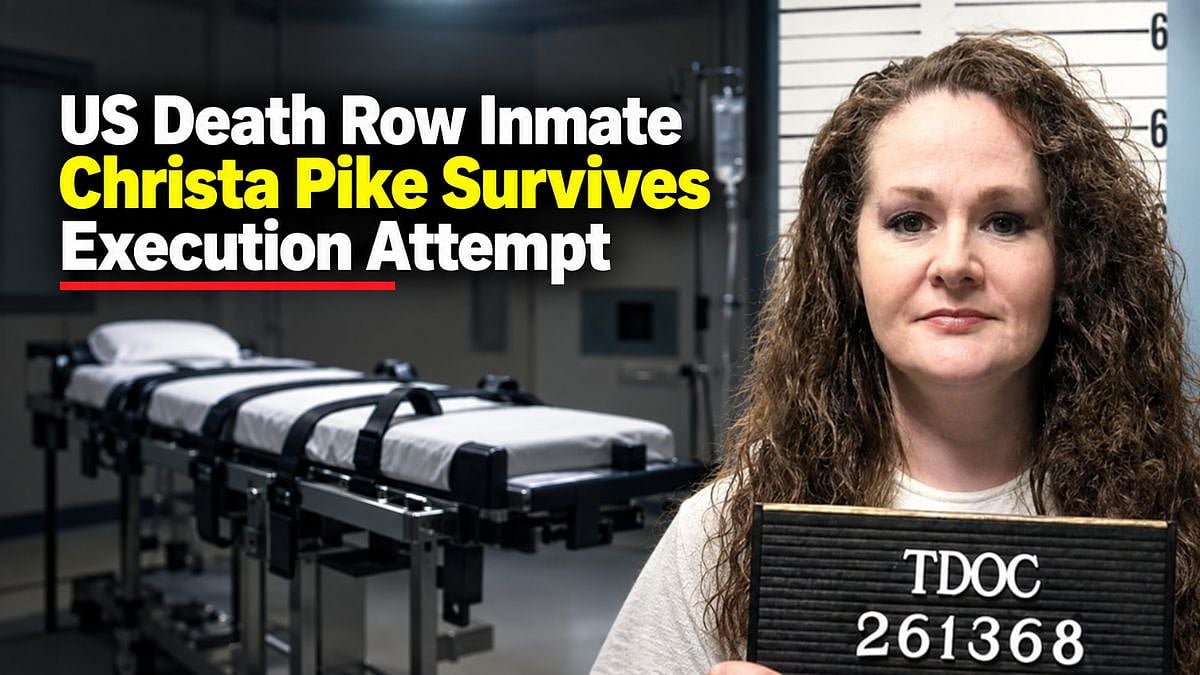
Nashville, October 1, 2026: A planned execution in Tennessee ended in extraordinary circumstances after death row inmate Christa Gail Pike survived two doses of the lethal injection drug pentobarbital and was taken to hospital for emergency medical treatment.
Pike, 50, was scheduled to be executed on Wednesday for the 1995 murder of 19-year-old Colleen Slemmer. She would have been the first woman executed in Tennessee in more than 200 years.
Instead, witnesses said she remained alive after both doses of the drug were administered, leaving authorities facing questions over what went wrong and what happens next.
Two Injections, But Pike Remained Alive
The attempted execution took place at Riverbend Maximum Security Institution in Nashville after a last-minute legal battle reached the US Supreme Court.
A federal court had temporarily stayed Pike’s execution earlier on Wednesday. However, the Supreme Court overturned the stay about an hour before the deadline for carrying out the sentence, allowing Tennessee authorities to proceed.
Pike was given two doses of pentobarbital, a sedative used under Tennessee’s lethal injection protocol.
Associated Press journalist Kim Chandler, who witnessed the procedure, said Pike initially appeared noticeably awake. Her mouth later fell open and she began snoring loudly and gasping.
The curtain to the execution chamber was eventually closed, but Pike could still be heard snoring. Media witnesses were later asked to leave.
Her lawyers filed an emergency motion while the execution was under way, seeking to stop the procedure and secure medical treatment for her. They said Pike still had a heartbeat and was audibly snoring after the chemicals had been administered.
District Judge Clifton L Corker later noted that medical personnel had begun providing the treatment sought by Pike’s lawyers.
She was subsequently taken to an off-site hospital, where her legal team said she was receiving “life-saving measures”.
What Went Wrong?
Tennessee authorities have not yet explained why the drugs failed to kill Pike.
The Tennessee Department of Correction maintained that officials followed the state’s approved execution protocol.
“The Tennessee Department of Correction followed every step of the State’s lawful, established execution protocol approved by the Attorney General’s Office,” department spokesperson Dorinda Carter said.
She added that the lethal injection chemical had “consistently been effective” and that the protocol did not permit procedures beyond those carried out that evening.
Pike’s lawyers, however, said the failed execution reflected concerns they had raised earlier, including difficulty accessing her veins and questions about the pentobarbital.
Human rights lawyer Clive Stafford Smith, who has represented death row inmates in the US, told Al Jazeera that possible explanations included problems with the drugs or difficulties administering them intravenously.
Dr Joel Zivot, a professor at Emory University School of Medicine who had been retained by Pike’s legal team as a medical expert, told the BBC that she may not have received a sufficient concentration of pentobarbital in her bloodstream to cause respiratory and cardiovascular failure, BBC reports.
Zivot also said there was a possibility that the delay before resuscitation could result in brain injury.
A Murder That Shocked Tennessee
Pike was 18 when Slemmer was killed in January 1995.
Pike, her then-boyfriend Tadaryl Shipp, 17, and Shadolla Peterson, 18, lured Slemmer to a wooded area in Knoxville. All four were students at a Job Corps vocational centre.
Slemmer was tortured and killed. The case attracted widespread attention after an inverted pentagram was found carved into her chest.
Pike delivered a fatal blow to Slemmer’s head and later kept a piece of her skull. Other residents at the centre testified that Pike had bragged about the killing and displayed the piece of skull.
Pike and Shipp were convicted of first-degree murder in 1996. Pike was sentenced to death. Shipp, who was 17 when the crime occurred, was not eligible for the death penalty under state law and received life imprisonment with the possibility of parole.
Pike later said she had intended to beat Slemmer but not kill her.
“I was a mentally ill 18-year-old kid,” she said in her clemency petition. “It took me numerous years to even realise the gravity of what I’d done.”
She said thinking about the killing now sickened her and acknowledged the devastating impact on Slemmer’s family and friends.
Last-Minute Battle Over Execution
Pike’s lawyers had repeatedly sought to stop the execution.
They argued that the jury that sentenced her to death had not been given a proper opportunity to consider mitigating evidence about her history of childhood sexual abuse.
According to her lawyers, Pike had suffered severe abuse as a child, including rape at the ages of 11 and 17.
The defence also raised concerns about lethal injection, arguing that Pike had “small veins” and that administering the drugs could cause severe suffering. Pike had sought execution by an all-female firing squad instead, but that request was denied.
Tennessee Governor Bill Lee rejected Pike’s clemency request before the planned execution.
Slemmer’s mother, May Martinez, supported carrying out the death sentence and had travelled to Tennessee to witness the execution.
After the failed attempt, she told NBC News: “It was a mess.”
Martinez has spoken about the lasting pain of losing her daughter, saying she thinks about Colleen constantly and finds holidays particularly difficult.
Governor Orders Review
Following the failed execution, Lee ordered a comprehensive third-party review to establish exactly what happened.
He also halted the remaining execution scheduled in Tennessee in 2026.
The incident was not Tennessee’s first execution problem this year. The planned execution of Tony Carruthers, convicted of kidnapping and murdering three people in 1994, was postponed in May after officials were unable to find a vein through which to administer the lethal drug.
What happens to Pike now remains unclear. She could eventually return to death row after leaving hospital, but the immediate focus is on her medical condition and the state’s investigation.
Botched Executions Are Not Unprecedented
Failed or prolonged executions have occurred before in the US.
Legal scholar Austin Sarat examined the issue in his 2014 book Gruesome Spectacles: Botched Executions and America’s Death Penalty. His research found that 8,776 people were executed in the US between 1890 and 2010 and that 276 executions, or 3.15%, encountered problems. Lethal injection had a botched execution rate of 7.2% during the period studied.
One case involved Alva Campbell in Ohio in November 2017. Execution staff struggled for an extended period to find a usable vein, and officials eventually abandoned the execution. Campbell later died on death row from medical conditions.
Since the US Supreme Court allowed capital punishment to resume in 1976, women have represented only a small proportion of those executed. According to the figures cited in the supplied reports, 18 women and 1,663 men had been executed, making women about 1% of executions.
Pike’s case is therefore unusual not only because she is the only woman on Tennessee’s death row, but because the state had not executed a woman for more than two centuries.
For critics of capital punishment, the failed procedure has renewed questions about whether lethal injection can be administered reliably and humanely. Stafford Smith described executions as far less clinical than they may appear and questioned whether capital punishment makes society “a better, more civilised place”.
Also Watch:

For Slemmer’s family, however, the case carries a different reality: more than three decades after the murder, they are still waiting for the sentence imposed on Pike to reach a conclusion.
The stark divide between those two perspectives is likely to remain at the centre of the debate as Tennessee investigates how an execution involving two doses of lethal drugs ended with the prisoner alive and in hospital.
To get details on exclusive and budget-friendly property deals in Mumbai & surrounding regions, do visit: https://budgetproperties.in/

