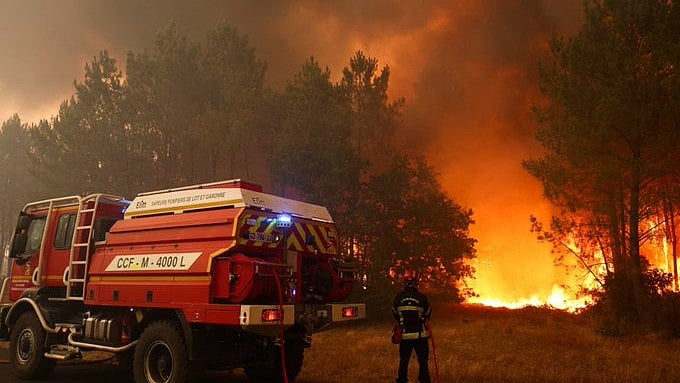
Spain declared a national emergency on Friday after wildfires forced the evacuation of around 20,000 people from villages near Madrid, while more than 60,000 residents were displaced by major blazes in southwestern France.
“We are experiencing a dramatic situation, not just in several Spanish regions but also in neighbouring countries,” Spanish Prime Minister Pedro Sánchez wrote on X.
“My solidarity with all the people who have been affected and forced to leave their homes.”
France’s Interior Minister Laurent Nunez said 40,000 people had been evacuated from the Gironde department and another 23,000 from Landes as authorities ordered more evacuations along the Atlantic coast.
Both Spain and France sought assistance from fellow European Union countries.
“We will soon be able to rely on reinforcements including two Croatian Canadair firefighting aircraft, two Portuguese Air Tractor aircraft, and two heavy-lift Black Hawk helicopters from the Czech Republic and Slovakia,” French President Emmanuel Macron said.
Spanish Interior Minister Fernando Grande-Marlaska said Italy and Greece were each sending two Canadair water-dumping aircraft.
Southern Europe has witnessed several major wildfires this summer. According to the European Union’s Copernicus Climate Change Service, Europe is the fastest-warming continent, with temperatures rising twice as fast as the global average since the 1980s. Scientists say climate change is increasing the frequency and intensity of heat and dry conditions, making the region more prone to wildfires.
Spain declares national emergency amid multiple fires
Spain’s national emergency places the Interior Ministry in charge of coordinating firefighting operations as regional authorities battle multiple blazes intensified by a severe heatwave. A separate large wildfire in the central province of Ávila also required national intervention.
“All around the town was smoke and fire; I was scared. Everything was fire and smoke, people were nervous,” 33-year-old Joaquin Espinosa told The Associated Press before he and his neighbours were evacuated from Chapinería, west of Madrid.
The Madrid regional government said around 18,000 people were evacuated from towns and villages west of the capital after multiple fires spread out of control late on Thursday.
“In my 60 years I have never seen something like this in my village; I have never seen fire of these dimensions,” Francisco Martínez, the mayor of Burgohondo in Ávila, told Spain’s national broadcaster TVE.
Spain’s military emergency units, national firefighting brigades and water-dumping aircraft have joined regional crews to combat the fires. Ecological Transition Minister Sara Aagesen said about 1,140 sq km (440 sq miles) had already burned in Spain this year, more than five times the area destroyed during the same period in 2025.
Grande-Marlaska said, besides the major fires near Madrid and in Ávila, authorities were dealing with nine other serious wildfires across the country.
Temperatures were forecast to exceed 39C in parts of Spain on Friday, with highs of 44C expected in Almeria. Strong winds and rugged terrain continued to hamper firefighting efforts.
Spain has also witnessed its second-largest recorded wildfire this year, which burned around 320 sq km in Guadalajara province. Earlier this month, 13 people died in a wildfire in southern Spain, the country's deadliest in recent memory.
Sánchez on Wednesday called for a political pact to tackle climate change, saying it was essential to adapting to increasingly fire-prone conditions. Authorities have not yet identified the cause of the fires near Madrid.
Also Watch:
France battles major coastal blazes
In France, a wildfire that has been burning since Wednesday near the Cap Ferret peninsula has scorched around 100 sq km.
Located about 60 km from Bordeaux, the peninsula is known for its beaches, oyster-farming villages and resorts.
More than 20,000 people had already been evacuated on Thursday, with further evacuations carried out by road and boat as the fires spread. Hundreds of firefighters, backed by additional ground and aerial resources, continued efforts to contain the blaze.
Another major wildfire further south near Biscarrosse and Parentis-en-Born remained out of control as strong winds complicated firefighting operations.

Italy also hit as Europe faces worsening fire risk
Wildfires also continued to burn across parts of Sicily, with Agrigento province among the worst affected.
Italy’s national fire department said it had carried out more than 1,400 firefighting operations since last weekend, including 240 in the Agrigento area. By Friday, seven of Sicily’s nine provinces remained under the highest wildfire alert, with only Messina and Catania at a lower risk level.
Driven by temperatures above 40C, low humidity and strong winds, the fires prompted scattered evacuations and claimed the life of a firefighter responding to a blaze in Caltanissetta.
Globally, 2025 was the third-hottest year on record, bringing severe heatwaves across Europe. Scientists warn that climate change is worsening heat and drought conditions, particularly in southeastern Europe, increasing the risk of wildfires and their impact on public health.

