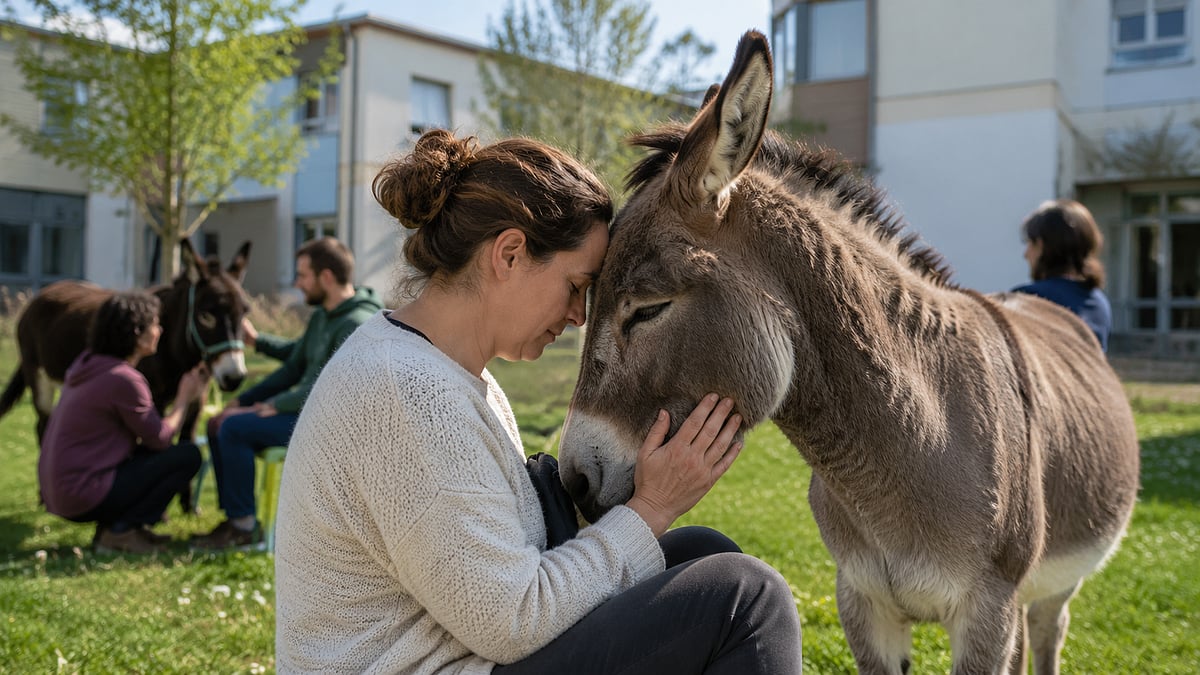
When donkeys become therapists
A psychiatric hospital near Paris is helping people with mental health conditions through a unique animal therapy programme centred on donkeys, the only initiative of its kind in France.
Located within the Ville-Evrard hospital complex in Neuilly-sur-Marne, the programme operates from a setting surrounded by 19th-century farm buildings and woodland. During regular sessions, patients walk, groom and care for five therapy donkeys. Many participants form close bonds with the animals, often ending sessions with a hug.
"When you take medication that helps you relax ... it's exactly the same,” said Nathalie, a 60-year-old patient. She and other participants were identified only by their first names to protect their privacy.
"I'd call it animal medicine,” she said. “It brings relief. You stop thinking about everything else."
The sessions are offered free as part of treatment funded through France’s public health system. Patients are typically paired with one of the donkeys, Nono, Pitou, Oscar, Manolo or Malraux, allowing them to gradually develop familiarity and trust.
Audrey Seffar, a nurse at the animal therapy unit, highlighted Nathalie’s improvement after only a few sessions.
“At first, she wouldn't get out of the cart (provided for people with physical difficulties). But little by little, with encouragement, she did," Seffar said. "The animal serves as a mediator. It's such an extraordinary one that today she was able to leave the cart and stand beside her donkey."
Another participant, Jerome, 52, said the programme helps ease feelings of isolation.
“Talking with people, taking part in activities I wouldn't normally do, it helps me in my daily life,” he said.
He added: “It helps you break away from the routine of treatment and medication. Staying at home isn't good for me.”
The project began in 2016 when Ermelinda Hadey, a psychiatric nurse, and her husband François Hadey introduced therapy donkeys to the hospital. Believing strongly in the benefits of animal-assisted care, Ermelinda considered donkeys ideal because of their calm and sociable temperament. François trained in preparing donkeys for therapeutic work. Some of the animals had previously been rescued from neglect or abuse through shelters.
“A donkey is very intelligent. It understands things very quickly, but you have to explain slowly,” Francois Hadey said. “Donkeys are calm, serene animals that are generally close to people. Once they're involved in these interactions, they connect very well with patients. They're emotional sponges.”
Since 2022, the programme has been officially recognised as a healthcare unit within the hospital, enabling it to employ three full-time nurses. Volunteers from a nonprofit organisation also assist with caring for the animals.
The initiative has since expanded to include guinea pigs, chickens, doves, goats, turtles and rabbits. Therapy sessions are adapted to individual needs, and smaller animals can even be taken directly to patients' rooms.
Alicia Fabi, an 18-year-old nursing student, said the programme offers patients a welcome change from the hospital environment.
“Every time we come back from the activity, they say they feel good, calm and relaxed, and that they enjoyed the outing. That's really positive,” she said.
The shared activities also help strengthen relationships between patients and healthcare workers.
“We talk about many different things, their illness, their lives and just about everything else. We don't focus only on the illness because we don't want them dwelling on it all the time,” Fabi said.
Hospital staff say the sessions support people living with conditions such as anxiety, depression, autism and schizophrenia. They believe the activities can improve emotional regulation, communication skills, social interaction and self-esteem.
“Everything we do with the animals allows us to work with the patient,” Ermelinda Hadey said. “We work on feeding the animal, which helps us address the patient's own eating habits. We work on the animal's hygiene, and by mirror effect, we work on the patient's hygiene as well.”

Hadey noted that many patients receive intensive treatments, including antipsychotic drugs and sedatives, which can reduce motivation to engage in activities. She said interaction with animals often helps overcome that barrier.
“It does not replace a doctor or a medical prescription, but it can help patients regain confidence and a sense of self-worth," Hadey said.
She added that further scientific research is needed before animal therapy can gain wider recognition within the psychiatric community as a complementary form of care.
“To do that, we need research. We have plenty of accounts from patients ... Caregivers who accompany them see the benefits every day as well. But doctors have so many other responsibilities that they don't necessarily witness it firsthand,” she said.
As Friday’s session concluded and patients chatted together, a nurse summed up the programme’s popularity with a simple observation: “Donkeys are my best colleagues.”
