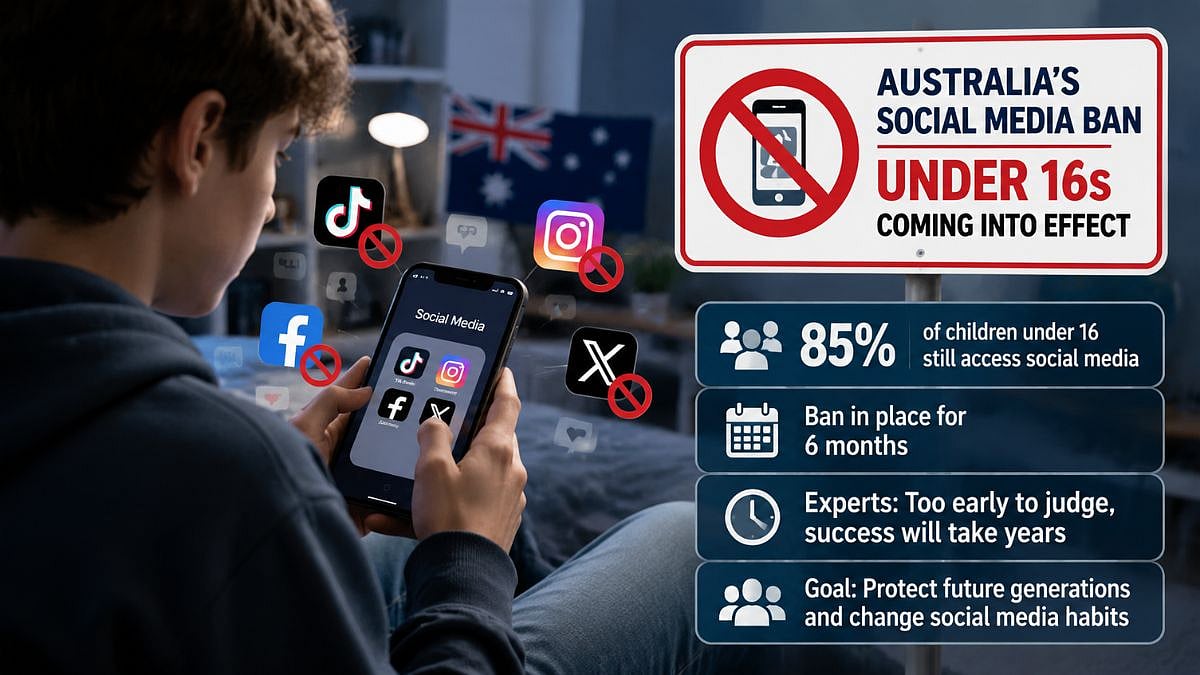
Australia, June 25: Six months after Australia introduced its landmark ban on social media for children under 16, early assessments suggest the law has had little immediate impact.
A new study published in the British Medical Journal found that most children continue to use restricted platforms, prompting criticism that the policy has failed. However, experts argue that judging the law solely on current usage overlooks its long-term objective of reshaping social media habits for future generations.
Most Under 16s Remain Online
The study, led by University of Newcastle public health researcher Courtney Barnes, tracked 408 adolescents aged 12 to 16. Participants were surveyed just before the law came into force in December 2025 and again three months later. Researchers compared teenagers just below the age threshold with those just above it to measure the law's impact.
More than 85% of children under 16 continued using restricted platforms, including TikTok, X, Facebook and Instagram, with most accessing them through their own accounts.
Around two-thirds encountered age verification, although the most common method was simply being asked to state their age. Only a small number used fake accounts or private browsing to bypass restrictions, while VPN use was rare.
Researchers found no meaningful difference in social media use between those below and above the age cut-off. They also acknowledged the study's limitations, including a relatively small sample size that may not have been large enough to detect measurable effects.
The findings are consistent with recent research by the eSafety Commissioner, which showed about seven in 10 children retained their social media accounts after the law took effect.
Long Term Policy Goals
Despite these findings, experts argue it is unrealistic to expect the ban to eliminate social media use among today's teenagers immediately. Instead, they say the law strengthens the government's ability to pressure social media companies to comply with regulations and should be assessed over a much longer period.
The approach has been compared with Britain's Tobacco and Vapes Act, which received royal assent in April 2026 and prohibits tobacco sales to anyone born on or after January 1, 2009. The goal is not to force existing smokers to quit but to ensure future generations never adopt the habit.
Australia's social media restrictions are based on a similar principle: delaying children's access long enough that social media loses its grip on childhood. Experts argue this, rather than the number of teenagers still using Instagram six months after the ban, is the appropriate measure of success.
Impact Still Being Assessed
The article notes that changing social norms is significantly more difficult for social media than for tobacco. Unlike cigarettes, social media is effectively "free", widely available and designed to maximise engagement. Sustained pressure on technology platforms over many years will be needed if attitudes are to change.
The author also points to research showing that social media encourages risk-taking and influences perceptions of what is normal, making behavioural change gradual rather than immediate.
At the same time, the study highlights potential unintended consequences. Some young people have turned to fake accounts, private browsing or messaging apps, while others may migrate to less visible parts of the internet that are harder to monitor.
Also Watch:
Researchers argue these developments should not be viewed as proof the policy has failed but rather as evidence that its impact cannot be measured over such a short period. They suggest the greatest benefit may be for children under eight who have not yet developed social media habits, estimating that the law's full effects may take a decade to become clear.
As the first country to introduce such nationwide age restrictions, Australia is effectively serving as a global test case. Experts argue the policy should be judged against its long-term goals rather than its immediate results.
To get details on exclusive and budget-friendly property deals in Mumbai & surrounding regions, do visit: https://budgetproperties.in/

