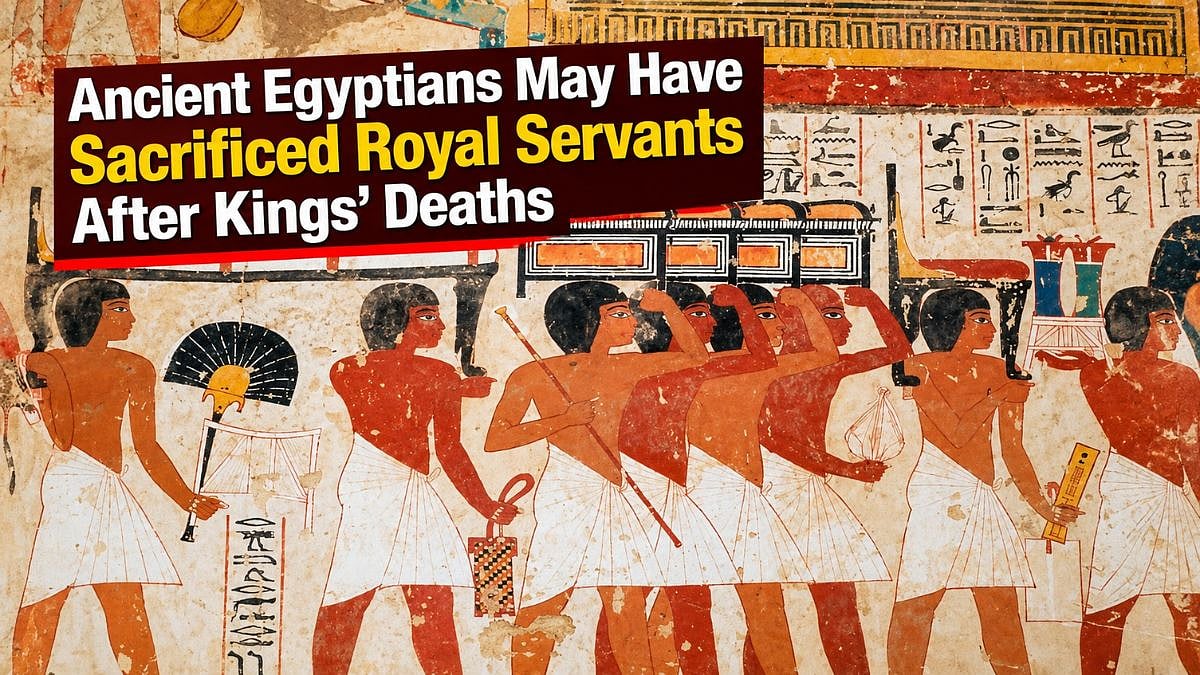
Cairo, October 8, 2026: A new forensic study of human remains discovered near the tombs of ancient Egyptian kings has found evidence suggesting that royal servants were killed and buried alongside their rulers around 3000 BC.
The findings support a long-standing archaeological theory that servants, also known as retainers, were sacrificed following the deaths of monarchs, possibly to serve them in the afterlife or demonstrate royal power, CNN reports.
The remains were originally excavated in the 1920s from royal funerary complexes at Abydos in eastern Egypt. Although archaeologists suspected human sacrifice at the time, they could not establish how the individuals had died.
Roselyn A Campbell, a postdoctoral researcher at Purdue University in Indiana and author of the new study, examined skulls preserved from the original excavation and identified injuries consistent with potentially fatal blows to the head.
“By consulting modern forensic studies and advances in our understanding of how human bodies react to injuries and to decay processes over time, I was able to identify clear evidence of head injuries in some of these individuals that occurred around the time of death,” Campbell told CNN.
“These injuries, combined with the archaeological context, strongly suggest that at least some of the retainers were killed and then buried around the tombs of these rulers,” she added.
Evidence From Preserved Skulls
British archaeologist Flinders Petrie, who excavated the remains in the early 20th century, first suspected human sacrifice because of the large number of graves surrounding the royal tombs.
Petrie photographed and documented the remains before reburying most of them. However, some skulls were preserved, and Campbell subsequently located 46 of them at Cambridge University.
Her examination revealed potentially lethal trauma in 18 of the 46 skulls, accounting for 39% of those studied.
“The injuries on the preserved crania are generally linear fractures, which would likely cause rapid unconsciousness, internal bleeding, and death,” Campbell said in a news release, adding that such fractures are generally caused by a flat, wide weapon.
Religious Beliefs And Royal Power
According to Campbell, the practice of sacrificing royal retainers may have been linked to religious beliefs about life after death as well as the display of a ruler’s authority.
“In many cultures, retainer sacrifice is practiced because of beliefs that the sacrificed individuals will continue to serve the ruler in some kind of afterlife, but retainer sacrifice can also be a visceral display of the ruler’s power,” she said.
“Some retainers might have volunteered to die to achieve eternal life or honour, others may have been chosen or even forced.”
However, Campbell cautioned that the findings do not establish that all the hundreds of individuals buried around the royal tombs were sacrificed.
“With such a small and incomplete data set, and so many millennia having passed since these people were buried, we simply can’t be entirely certain if all these individuals were sacrificed, or only some of them, or if there is some other explanation that has been lost over time,” she said.
She noted that some individuals could have died naturally, while others might have been killed through methods such as asphyxiation that would not leave visible evidence on the preserved skulls.
Forensic Evidence Supports Theory
Katherine Slinger, a lecturer in Egyptian archaeology at the University of Manchester in England who was not involved in the research, said scholars had long believed that royal retainers were sacrificed after a king’s death, but the circumstances surrounding their deaths remained uncertain.
“The manner in which these retainers were killed has previously remained unclear, with theories ranging from strangulation to poisoning,” Slinger told CNN.
“This is the first time that forensic evidence has supported this theory of human sacrifice and proved the manner in which at least some of these individuals were killed.”
Understanding Ancient Sacrifice
Campbell is preparing a book on the subject, scheduled for publication in 2027, that will explore the identities of the retainers, ancient Egyptian beliefs and society, and broader questions surrounding violence and sacrifice in historical cultures.
The book will examine “into who these retainers were, the context of Egyptian thought and society at this time, and more broadly how we study and understand violence and sacrifice in the past,” Campbell said.
Karl Harrison, a forensic archaeologist at the University of Exeter in England who was not involved in the study, described the findings as “genuinely really interesting.”
However, he cautioned against drawing definitive conclusions about the intentions behind the deaths.
“While forensic science can help to understand patterns of injury, care must be taken in assessing what this means in terms of intentionality,” Harrison said via email.
Also Watch:
“Ephemeral behaviours of past human cultures — especially those without written records or recorded in the writings of other peoples — offer a social complexity that defies our ability to comprehensively reconstruct,” he added.
The study was published on Monday in the journal Frontiers.
To get details on exclusive and budget-friendly property deals in Mumbai & surrounding regions, do visit: https://budgetproperties.in/

