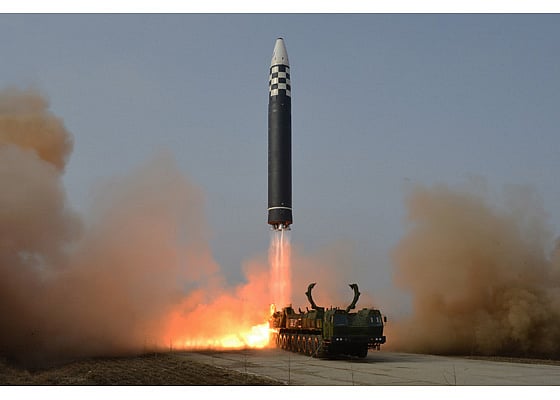
On Friday, North Korea said that it test-fired its biggest-yet intercontinental ballistic missile under the orders of leader Kim Jong Un, who vowed to expand the North’s “nuclear war deterrent” while preparing for a “long-standing confrontation” with the United States.
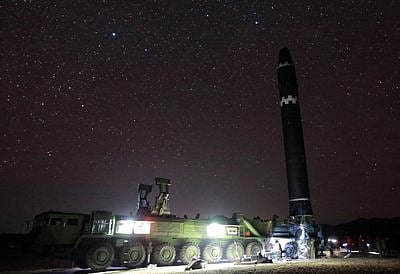
The Hwasong-17 is assumed to be a two-stage, liquid fuelled road-mobile ICBM carried by a 22-wheeled transporter erector launcher (TEL) vehicle. The missile itself is judged from images to be 26 m long with a diameter of 2.7 m.
The exact capabilities of the missile are as yet unconfirmed, though speculation by experts has fueled questions as to whether it could reach cities within the United States and potentially evade U.S. missile defenses too.
It also might have the capability of carrying multiple re-entry vehicles (MRVs), which would be a less expensive way to launch multiple warheads than deploying many ICBMs with single warhead payloads.
The size and configuration of the 11-axle TEL indicates North Korea has developed a domestic capacity to manufacture such vehicles, a matter of concern to observers as attempting to block procurement of foreign-built TELs was one limitation on the nation's ICBM force.
The country being able to produce their own launchers lifts that constraint and enables them to have the capacity to fire greater numbers of missiles.
North Korea already has two tested ICBMs. The Hwasong-14 was tested twice in 2017 and with a range of 10,000km (6,213 miles) can reach nearly all of western Europe and about half of the US mainland carrying a single nuclear warhead.
The Hwasong-15, also tested in 2017, has a range of 13,000km, meaning it can deliver a single nuclear warhead anywhere in the US mainland.
The new ICBM, which has yet to be tested, is also a two-stage liquid-fuelled missile, but with a greater length and diameter than the Hwasong-15.
Thursday’s test was North Korea’s 12th round of launches this year and the most provocative test since President Joe Biden took office.
North Korea’s resumption of nuclear brinkmanship reflects a determination to cement its status as a nuclear power and wrest badly needed economic concessions from Washington and others from a position of strength, analysts say. Kim may also feel a need to trumpet his military accomplishments to his domestic audience and drum up loyalty while the country faces economic difficulties.
On 1 January 2020, Mr Kim gave his annual New Year's address wherein he announced that North Korea was "developing the state-of-the-art weapons system possessed only by advanced countries".
He specifically referred to a "strategic" - meaning nuclear - weapons system under development.
Kim pointedly tied the weapon to the US, stating "in the future, the more the US stalls for time and hesitates in the settlement of DPRK-US relations, the more helpless it will find itself before the might of the Democratic People's Republic of Korea, which is growing stronger beyond prediction, and the deeper it will fall into an impasse".
This new ICBM is Mr Kim's promised strategic weapon. It absolutely targets the US, and is delivered as a fait accompli in the face of failed negotiations with the Trump administration.
The other tests included a purported hypersonic weapon, a long-range cruise missile and an intermediate-range missile that could reach Guam, a major U.S. military hub in the Pacific. The U.S. and South Korean militaries had expected a full-range test of the Hwasong-17 after concluding two of the recent midrange launches included components of the new ICBM.
After the tests on 5 and 10 January, Pyongyang claimed it has successfully tested something called a "hypersonic glide vehicle" (HGV) and a "manoeuvrable re-entry vehicle" (MARV).
These are systems whose purpose is to defeat an adversary's ballistic missile defence systems - it means North Korea is developing technology that can defeat the costly and complex missile defence systems that America and Japan have been deploying across this region.
Following its streak of nuclear explosive and ICBM tests in 2017, Kim suspended such testing in 2018 ahead of his first meeting with Trump. But the diplomacy derailed in 2019 when the Americans rejected North Korean demands for a major release of U.S.-led sanctions against the North in exchange for a limited surrender of its nuclear capabilities.
The ICBMs launched in three 2017 test flights demonstrated they could reach into the U.S. mainland. The larger Hwasong-17 may be intended to be armed with multiple warheads to overwhelm missile defenses.
North Korea’s ruling party in January had issued a veiled threat to end Kim’s moratorium on ICBM and nuclear tests, citing U.S. hostility.
South Korea’s military has also detected signs that North Korea may be restoring some of the nuclear-testing tunnels it detonated just before Kim’s first meeting with Trump in 2018.
Some experts say the North may resume nuclear testing in coming months to claim it has acquired an ability to build nuclear warheads small enough to fit on some of its new delivery systems, including the hypersonic missile.
(with inputs from AP)