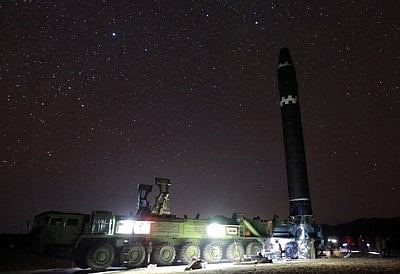
North Korea has tested a banned intercontinental missile (ICBM) for the first time since 2017, according to South Korea.
The missile, which fell in waters south of Japan, flew for more than an hour and reached an altitude of more than 6,000km (3,700 miles).
Japanese officials estimated it had a range of 11,000km - which meant it could theoretically reach the US.
Japan’s Vice Defense Minister Makoto Oniki said the missile, which reached a maximum altitude of 6,000 kilometers (3,728 miles), was possibly a new type of ICBM.
Japan’s coast guard, which warned vessels in nearby waters about the potential for falling objects, said it believed the missile flew about an hour before landing in waters outside the country’s exclusive economic zone.
It was North Korea’s 12th round of weapons launches this year and came after it fired suspected artillery pieces into the sea on Sunday. Experts say the North’s unusually fast pace in testing activity underscores its dual goal of advancing its weaponry and applying pressure on Washington over a deepening freeze in nuclear negotiations.
"Our current analysis indicates that the ballistic missile flew for 71 minutes and around 15:44 (0644 GMT), it landed in waters within Japan's exclusive economic zone in the Sea of Japan about 150 kilometres west of Hokkaido's Oshima peninsula," said Makoto Oniki, Japan's state minister for defence.
"Given the ballistic missile this time around flew at an altitude of over 6,000 km, which was much higher than the Hwasong-15 ICBM that was launched in November 2017, the one today is believed to be a new ICBM," he added.
In 2017, Pyongyang put in place a moratorium on testing long-range ballistic missiles and nuclear tests, following talks with then US President Donald Trump. But in 2020, North Korean leader Kim Jong-un announced he was no longer bound by this promise.
The North’s previous ICBMs demonstrated potential range to reach the American homeland during three flight tests in 2017. Its development of the larger Hwasong-17, which was first revealed in a military parade in October 2020, possibly indicates an aim to arm it with multiple warheads to overwhelm missile defenses, experts say.
North Korea’s slew of weapons tests this year, which comes amid a prolonged stalemate in diplomacy, reflects a determination to cement its status as a nuclear and badly needed economic concessions from Washington and other rivals from a position of strength, analysts say.
(with inputs from AP)

