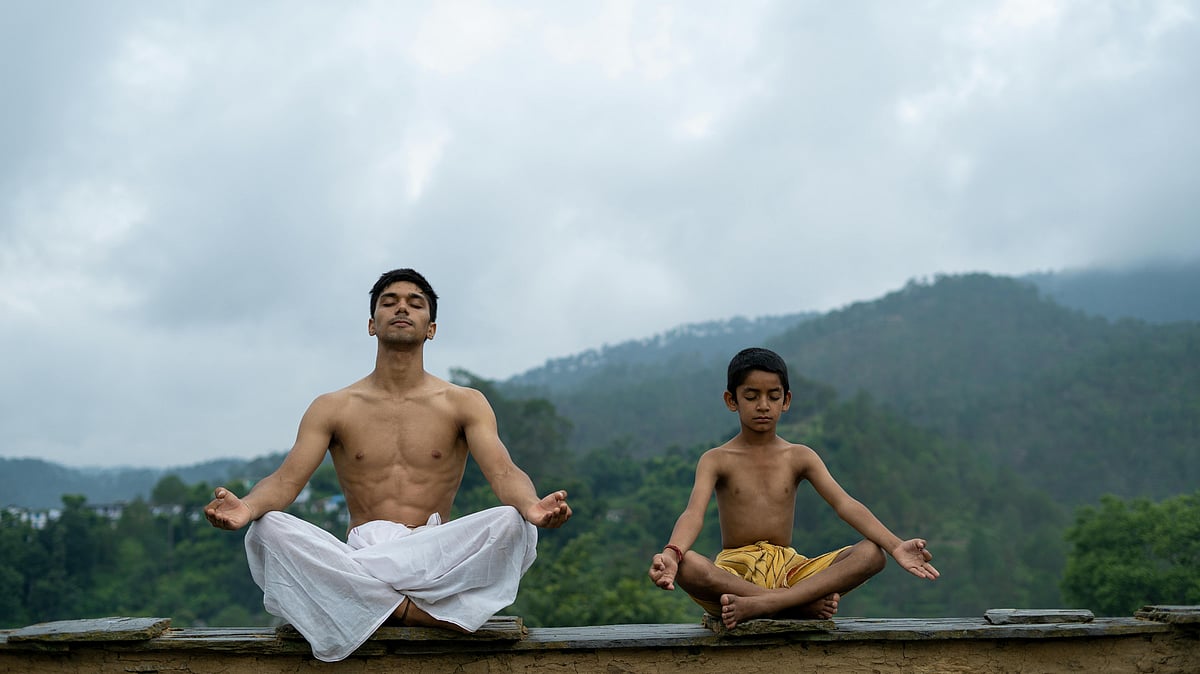
If you are a frequent visitor to Premanand Ji Maharaj’s Ashram in Keli Kunj, Vrindavan, or have been watching his satsangs online, you would know the number of young children turning up to his darshan every week. They sit cross-legged beside their parents, sandalwood tilaks flashing on their foreheads as they chant Radhe Radhe. Not far away, in the courtyard of an ISKON temple, you will spot a group of teenagers and youngsters swaying devotional songs humming the rhythm of Hare Rama Hare Krishna. They participate with genuine enthusiasm, just the way they would enjoy a party with their friends. It is part prayer, part playtime, and to their parents, perhaps, something deeper.
Across Indian cities, this quiet change is underway. Parents are introducing their children to spirituality, not as a ritual, but as a way of life. From yoga and meditation to chanting, storytelling, and mindfulness practices, families are reimagining what it means to raise emotionally balanced children in an age of screens, competition, and social distraction.
Quiet cultural shift
“Spirituality has become a new tuition except this one is for the soul. But unlike tuition, this doesn’t stress him out. It actually calms him,” says Ruchika Seth, a 38-year-old marketing professional from Delhi. She takes her 10-year-old son Vihaan, to a weekly chanting circle all the way to Gurugram.
For Ruchika, who juggles a demanding corporate job, spirituality is less about religion and more about emotional hygiene. “I want him to grow up thinking that peace is something you look for inside when you burn out at 40. It should be a natural state,” she adds. Her son follows a five minute deep breathing and short ‘thank you’ round every morning, which he has learned in his teachings. “He is less reactive now. He pauses before responding when something doesn’t go his way.”
Jyoti Dhanjani, a homemaker in Mumbai ensures to take her 15 year-old daughter and 13 year-old son to satsang every Sunday in Santacruz. They follow a clan based in Delhi. “This is non-negotiable for both of us. My children were reluctant at the beginning but it’s been six years and they now wait for Sunday. My husband and I don’t want to influence them with a certain ideology or belief systems but we want to ensure they have a routine and no distractions,” says Dhanjani.
Parents like Ruchika and Jyoti are part of a broader trend. They are slowly guiding their children toward inner grounding in the middle of modern chaos. According to yoga instructors, wellness coaches, and spiritual educators, the number of children attending meditation and mindfulness workshops has doubled in the past five years. These parents aren’t pushing dogma, they are seeking tools to help their children manage stress, anxiety, and social pressure.

Age of overstimulation
While children growing up in tier two cities and in a joint family, have been exposed to spiritual practices in some way or the other, nuclear families have struggled to introduce mindful practices to their teenagers. But the pandemic was a turning point for many families. As children became glued to screens and socially withdrawn, parents began searching for practices that could anchor them. “Post-COVID, we have seen more parents reach out for non-medical, non-academic ways to build emotional resilience in kids,” says Aayush Sharma, a child psychologist and counsellor based in Mumbai.
He adds, “When children learn mindfulness or chanting, they start recognizing their emotions instead of being controlled by them. It helps reduce impulsivity, enhances empathy, and builds a sense of belonging. These are the traits that every child needs to have in today’s hyperconnected but emotionally distant world,” says Sharma.
He also cautions against turning spirituality into another checkbox on the parenting list. “The idea is not to turn children into miniature monks. Let them be kids but with tools to process what they feel.”
Tradition meets wellness
Pune resident Pawan Nagpal shares that he rediscovered his cultural roots through his eight-year-old daughter. “I had stopped visiting temples years ago. But when she started asking about the chants my mother used to say, I realized I had nothing to tell her,” he admits. “We began reading short verses from the Bhagavad Gita for Children. Now we read mythological stories for her and it’s a bedtime routine. It feels great that she takes more interest in spirituality than Instagram,” shares the techie. He feels his daughter is connecting with something more powerful and will grow up as a resilient person. “When I see her close her eyes during chanting and smile, I feel like I am giving her a compass where she can return to when life gets noisy,” he expresses.
Apart from parents’ awareness, social media has also amplified this cultural renewal. From Instagram yoginis teaching mindful breathing for kids to influencing sharing videos of family meditation routines, spirituality has been reframed as a form of mental fitness. “We might call it mindfulness, but what our grandparents practiced as pranayama or maun vrat was the same thing. It’s just that science now validates it so people are listening again,” says Nandini Krishna, who runs a Bhagwad Gita path community for children and adults alike in Rishikesh.

What children say
Interestingly, children are responding with curiosity and openness as long as it doesn’t feel like another rule for them. “I used to think meditation was only for adults but then my teachers said it helps you focus better and manage anxiety before exams,” says 14-year-old Arohi Agarwal from Delhi Public School.
Veer Joshi, 12, from Mumbai says meditation is a game. “I imagine I am sitting on a mountain and watching my thoughts like clouds. Sometimes funny thoughts come and I laugh. Sometimes I feel calm,” says the Oxford school student.
Parents, on the other hand, say these practices are reshaping their family dynamics. “Earlier, the evenings were about TV or phones, now we all sit and pray or talk about stories of gods. This is giving my children knowledge about our culture and religion,| says Swati Parashar, a 40-year-old homemaker from Jaipur.
Psychological payoff
Experts say early exposure to spiritual habits can have benefits as mindfulness training enhances executive functions, attention, memory, and emotional control,” says Dr Deepika Sethi, child development expert in Delhi. “Children learn to observe before reacting, which reduces aggression and social anxiety.” However, she emphasises moderation. “If parents force the child to meditate or any other practice that the child is not comfortable with, it won’t bring peace but pressure. Parents should model and mandate,” she suggests.

