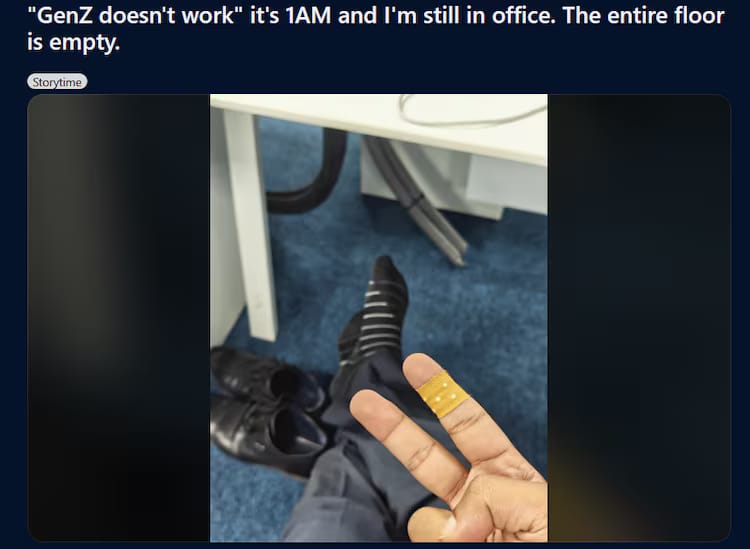
A young professional’s late-night experience during his notice period has triggered widespread discussion online, challenging the popular stereotype that Gen Z employees lack dedication at work.
In a post shared on the r/IndianWorkplace forum, the employee revealed that he found himself alone in an empty office at 1 AM while completing critical month-end tasks. Despite officially serving his notice period, he said responsibilities continued to pile up, leaving him with no option but to stay back after hours.
According to the employee, he was the only person on his floor capable of handling certain financial closing activities. What initially seemed like professional reliability eventually turned into a burden. He reflected that becoming “too important” in an organisation can sometimes backfire when proper team support or backup systems are missing.
No overtime pay despite extra hours
One of the main concerns raised in the post was the absence of overtime compensation. Management allegedly maintained that the employee was not explicitly instructed to work late, even though deadlines and workload expectations made extended hours unavoidable.
The situation exposed a common workplace issue in many corporate environments, employees informally expected to stretch beyond working hours without formal recognition or compensation.
Notice period pressure and knowledge transfer stress
Even as he prepared to leave the company, the employee said he was tasked with documenting his entire workflow in detail. He described being asked to compile extensive Excel sheets and manuals explaining processes end-to-end, while new hires underestimated the complexity of the role.
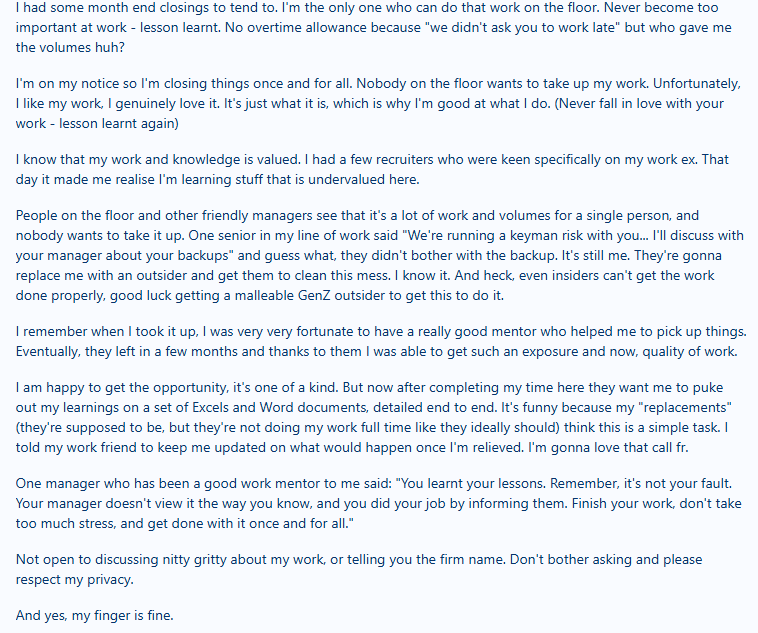
This scenario reflects what professionals often call “key person risk,” where organisations rely heavily on one employee without creating succession plans or cross-training systems.
Passion for work vs professional boundaries
Interestingly, the employee admitted that genuine interest in his work kept him motivated despite the stress. However, the experience led to an important personal realisation, loving one’s job should not come at the cost of personal well-being or fair treatment.
Career experts frequently warn that high performers can unintentionally become overburdened when managers rely excessively on their efficiency, leading to burnout rather than recognition.

Mentor advice offers perspective
Amid frustration, the employee credited an early mentor for offering grounding advice. The mentor encouraged him to complete pending responsibilities calmly without internalising organisational problems, reminding him that he had already raised concerns appropriately.
Mentorship and workplace guidance often play a crucial role in helping early-career professionals navigate high-pressure corporate environments.
