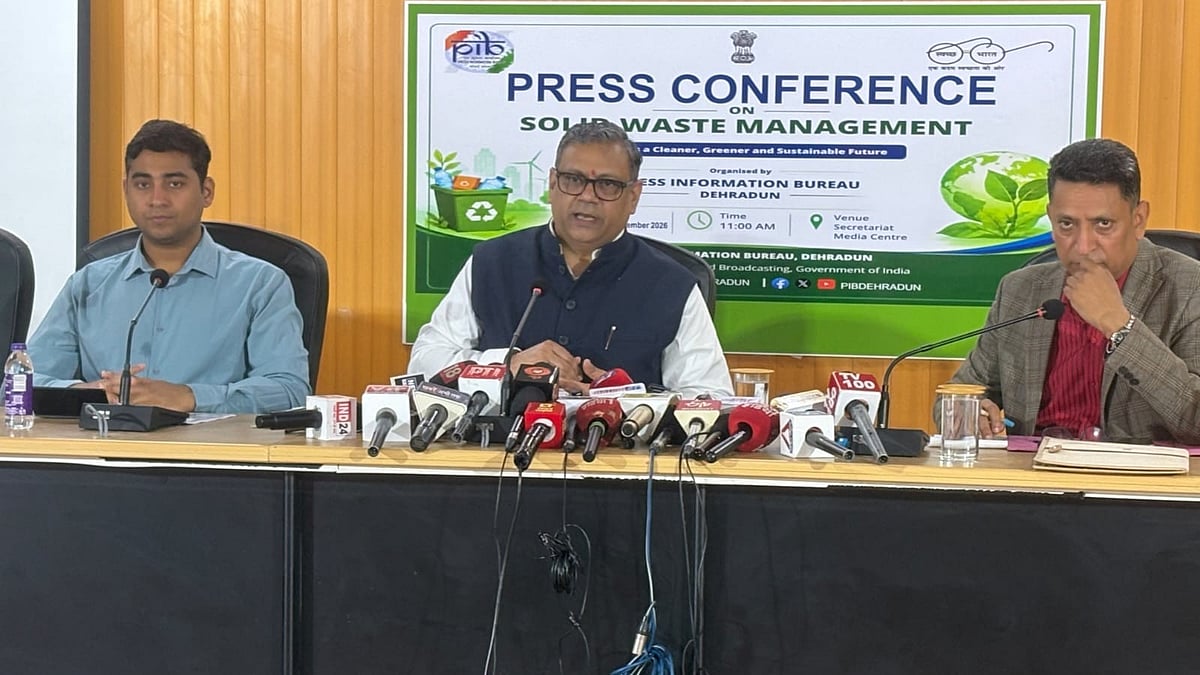
A press conference on ‘Solid Waste Management’ was organised by the Press Information Bureau (PIB), Dehradun, under the Ministry of Information and Broadcasting, Government of India, at the Secretariat Media Centre on Wednesday. Detailed information was shared on the Solid Waste Management Rules, 2026, dumpsite remediation, waste segregation, air pollution control and the role of local bodies.
Dr Parag Madhukar Dhakate, Member Secretary, Pollution Control Board, said that the quantity of waste is increasing with rapid urbanisation. In this context, it is essential to take scientific and data-driven approaches to the grassroots level and ensure the active participation of public representatives and citizens. The goals of effective solid waste management and clean air can be achieved not through government efforts alone, but through collective participation.
He said that under the Solid Waste Management Rules, 2026, which came into effect from 1 April 2026, emphasis has been placed on segregating waste into four streams—wet, dry, sanitary and special-care waste. The responsibilities of Bulk Waste Generators (BWGs) have also been strengthened, with a provision for Extended Bulk Waste Generators Responsibility (EBWGR). The Rules provide for online monitoring of waste collection, transportation, processing and disposal, along with digital registration and reporting. The objective is to enhance transparency and accountability, promote the use of waste as a resource and strengthen the circular economy. Recycling and reuse have been prioritised, while landfill has been kept as the last resort.
Dr Dhakate emphasised that 100 per cent door-to-door waste collection is being provided across 1,314 wards under 108 Urban Local Bodies in Uttarakhand. Around 1,515 vehicles are currently available, while procurement of additional vehicles is underway. New vehicles are being equipped with four compartments for four-stream segregation. Source segregation has already been initiated in 1,225 wards. Approximately 1,930.85 metric tonnes of waste is generated daily in the state, of which 1,804.59 metric tonnes (93.46 per cent) is processed every day. A total of 61 legacy waste/dumpsites have been identified. Of the approximately 23.34 lakh metric tonnes of legacy waste, treatment of 12.70 lakh metric tonnes (54.41 per cent) has been completed. The state aims to accelerate legacy waste treatment and dumpsite remediation by December 2026. The state currently has 85 Material Recovery Facilities (MRFs), 663 NADEP/compost pits and 87 plastic compactors in operation, while 1,058 Bulk Waste Generators have been identified. A Vehicle Location Tracking System (VLTS) is being implemented to monitor waste collection and transportation, with all municipal corporations being covered in the first phase.
Shri Praveen Kumar, Additional Director, Urban Development, referred to the directions of the Supreme Court regarding effective implementation of the Solid Waste Management Rules. The Court has emphasised compliance, accountability of BWGs, digital registration, monitoring and effective action against unauthorised dumping. India is moving towards the goal of ‘Zero Dumpsite’. Through dumpsite remediation, legacy waste is being scientifically treated and converted into useful resources such as road construction material, filling material, recyclable materials and RDF. This helps reduce air and groundwater pollution as well as incidents of fires at dumpsites.
He said that mayors, councillors and other public representatives have been urged to motivate citizens to undertake four-stream waste segregation at source, responsible use of plastic and compliance with sanitation norms. Special attention is also required for proper waste management by RWAs, hotels, restaurants and other Bulk Waste Generators. In view of increasing pilgrimage and tourism activities in Char Dham and other tourism areas, emphasis was laid on preparing a special plan for proper waste collection, segregation, transportation and scientific processing in these areas. Collective participation of the government, local bodies, public representatives, institutions, commercial establishments and citizens is essential for clean air and effective solid waste management.
Shri Kumar said that special provisions have been introduced for solid waste management in hilly areas and islands. These include collection of user fees from tourists and regulation of tourist arrivals by local bodies based on the availability of waste management facilities. Special collection centres will be established for non-biodegradable waste in these areas. Local residents will be encouraged to hand over waste to local bodies and prevented from littering. Hotels and restaurants will undertake decentralised processing of wet waste in accordance with norms prescribed by the SPCB or PCC.
The Rules also provide for the establishment of central and state-level committees for effective implementation. At the state or Union Territory level, a committee headed by the Chief Secretary of the state or the head of the UT administration will recommend measures to the Central Pollution Control Board for effective implementation of the Rules.
PIB Dehradun
Government of India
PRESS RELEASE, Dated: 09/09/2026

