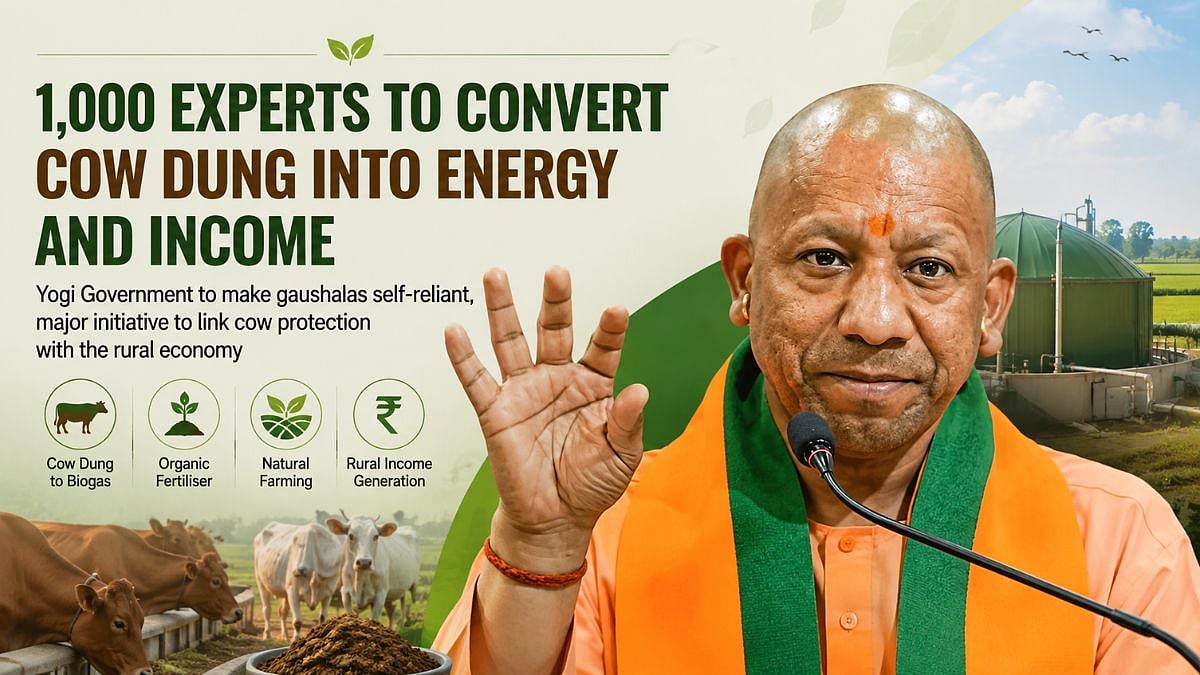
Lucknow, September 3, 2026: Under the leadership of Chief Minister Yogi Adityanath, significant steps are continuously being taken in Uttar Pradesh to ensure that cow protection is not limited merely to the shelter and care of cattle, but is also linked to the rural economy and self-reliance.
In this direction, a technical cooperation MoU has been signed between the Uttar Pradesh Goseva Aayog and ‘Partners in Prosperity’ (PNP) to convert cow dung available in gaushalas into clean energy, organic fertiliser, natural farming inputs, and a source of income.
Under this arrangement, technical support will be provided to the Deenbandhu Model Biogas Plants already established in the state, while a strong technical framework will also be developed for plants to be established in the future.
1,000-Expert Technical Network
As part of this initiative, a network of 1,000 technical experts will be created. The objective is to make gaushalas self-reliant through the scientific and economic utilisation of cow dung and to develop them as strong centres of the rural economy.
The most important aspect of the agreement is the creation of a technical mechanism at the grassroots level. A network of approximately 1,000 technical personnel will be developed in a phased manner.
This network will support the installation, operation, maintenance, technical training, and field monitoring of Deenbandhu Biogas Plants. This will ensure the availability of local technical assistance for the regular and effective operation of biogas plants after their installation.
The organisation has already constructed more than 3,900 Deenbandhu Biogas Units in Uttar Pradesh and Uttarakhand. The organisation will provide complete technical support ranging from biogas project development to technical design, feedstock and cow dung assessment, plant construction, operation and maintenance, beneficiary training, and field monitoring.
Biogas Value Chain Planned
The significance of the new initiative is not limited to producing biogas from cow dung. It envisages the development of an entire value chain encompassing biogas, bio-slurry, organic fertiliser/bio-inputs, natural and regenerative agriculture, and carbon benefits.
In other words, cow dung from gaushalas will first become a source of energy, and the bio-slurry generated by biogas plants can then be linked to agriculture as organic fertiliser and bio-inputs.
This will also enhance the possibilities of reducing dependence on chemical fertilisers and promoting natural and regenerative agriculture. The possibilities of linking this model with environmental benefits and carbon projects in the future will also be explored.
Circular Economy For Gaushalas
Chairman of the Uttar Pradesh Goseva Aayog, Shyam Bihari Gupta, stated that cow dung should be viewed not merely as waste but as an important resource for energy, organic agriculture, and rural income.
Technically strengthening and implementing the Deenbandhu Biogas Model on a large scale can become the foundation for multidimensional benefits for gaushalas, farmers, and rural families.
The objective of this initiative is to develop a circular economy by linking the cow dung resources available in the state with clean energy, organic fertilisers, and sustainable agriculture, in which employment generation, energy savings, agricultural productivity, and environmental benefits are achieved alongside cattle protection.
The on-ground implementation of this programme will be ensured in collaboration with farmers and rural communities across the state. The combination of a technical network and local experience can play an important role in making the biogas model in gaushalas sustainable.
Linking Cattle Protection To Economy
This initiative is also significant within the Yogi Government’s cow protection model because it seeks to link cattle protection with an economic cycle.
If cow dung is converted into energy and organic fertiliser and then returned to agriculture, it can create economic opportunities for farmers and rural families while ensuring productive utilisation of gaushala resources.
In this way, the initiative is set to become an important step towards translating into reality the concept of “energy from cow dung, organic agriculture through energy, and a prosperous rural economy through organic agriculture” across the state.

