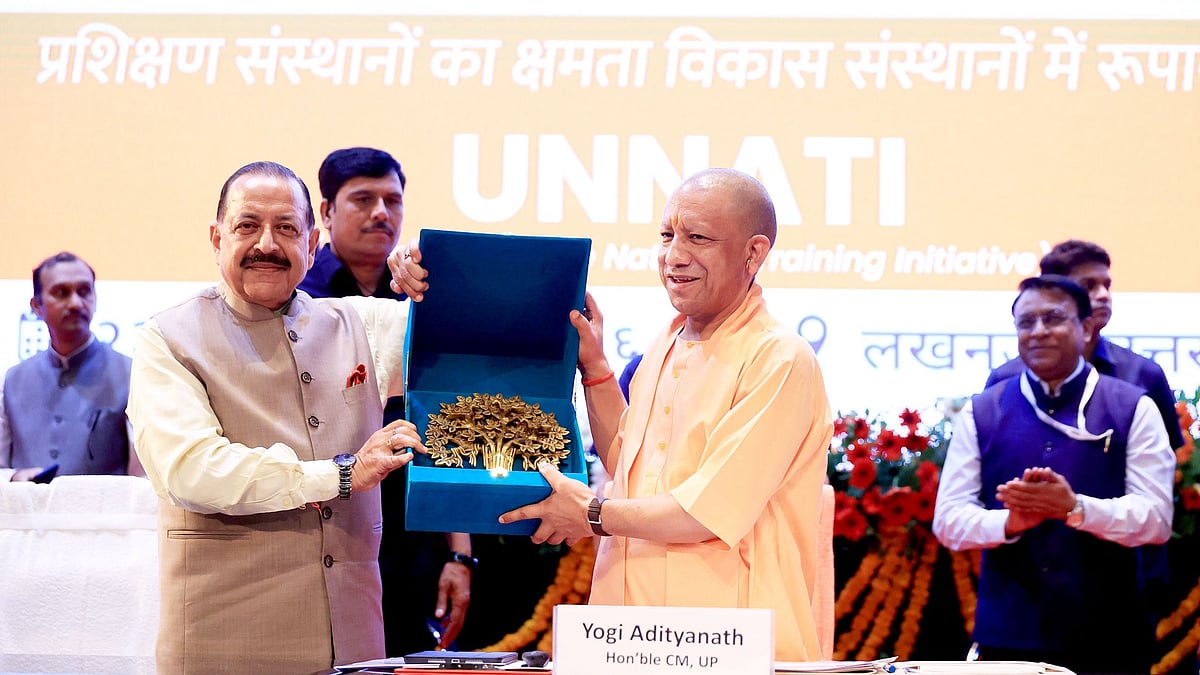
Lucknow, October 23: Union Minister Dr Jitendra Singh said, "Since 2014, under the leadership of Prime Minister Narendra Modi, administrative reforms have been accorded priority to develop a system that strengthens citizens’ trust while making government services simpler, more transparent and accountable. Uttar Pradesh has set an example for the country through its remarkable performance in adopting these reforms and promoting capacity building. The state’s top position under Mission Karmayogi and its achievement of completing the highest number of training courses on the iGOT Karmayogi platform are significant milestones."
Expressing gratitude to Chief Minister Yogi Adityanath during the North Regional Workshop held in Lucknow, Dr Singh said, "The support extended by the state administration and the Chief Minister’s personal interest in organising programmes in Uttar Pradesh play an important role in ensuring their smooth execution."
Dr Singh added, "After the formation of the Central Government in 2014, several steps were taken, including ending the requirement for gazetted officers to attest documents and making recruitment to government jobs more transparent. Following the Prime Minister’s call, initiatives were undertaken to abolish interviews in recruitment processes to minimise the possibility of discrimination in selection."
He also highlighted initiatives such as Rojgar Melas, the Centralised Public Grievance Redress and Monitoring System (CPGRAMS), and Digital Life Certificates. The use of biometric and facial recognition technologies for Digital Life Certificates has made the process more convenient for pensioners.
The Union Minister added, "Administration must move beyond a ‘rule-based’ approach and adopt a ‘role-based’ working system. Mission Karmayogi and the iGOT Karmayogi platform are advancing this vision. With approximately 1.70 crore personnel registered on the iGOT Karmayogi platform nationwide, Uttar Pradesh’s registration of more than 19 lakh users is a significant achievement. The state has also recorded a large number of completed training courses in subjects such as yoga and artificial intelligence. More than 350 training institutions and training units from Uttar Pradesh have been registered on the UNNATI portal."
Under the leadership of Chief Minister Yogi Adityanath, Uttar Pradesh would continue to serve as a national role model in good governance and administrative capacity building. Appreciating the efforts of the state government, officials and training institutions, he said that Uttar Pradesh’s experience could also prove inspirational for other states.
Addressing the inaugural session of the North Regional Workshop, Chief Secretary S.P. Goyal said, "The success of government schemes should not be measured by their number, but by how effectively, transparently and equitably their benefits reach ordinary citizens."
He informed that more than 19 lakh personnel had been registered on the e-portal in the state so far. Approximately 3.75 crore courses had been completed through the platform, with more than 47 crore learning hours recorded. He appreciated the contributions of all departments, officers and employees in achieving this milestone.
The Chief Secretary said, "More than 350 training institutions and training units from Uttar Pradesh had been registered on the UNNATI portal, the highest number among all states. In accordance with Chief Minister Yogi Adityanath’s directions, the use of artificial intelligence and emerging technologies in administration was being encouraged."
S. Radha Chauhan, Chairperson of the Capacity Building Commission, said, "The building of capable, efficient and citizen-centric civil services was essential to achieving the goal of Viksit Bharat. To this end, the role-based training framework under Mission Karmayogi must be transformed into a competency-based system. Initiatives such as the UNNATI Abhiyan, Karmayogi Kartavya Programme and Karmayogi Quality Framework were launched during Sadhana Saptah held in April. The Karmayogi Kartavya Programme focuses particularly on fostering a spirit of service among frontline employees, while the Quality Framework aims to ensure the quality of training."
With participation from eight states and four Union Territories, the North Regional Workshop emphasised strengthening the capacity of training institutions and adopting modern training methodologies to develop an efficient administrative system capable of addressing future challenges.

