Lucknow: A job is not merely about receiving a salary every month. Along with a job, an employee has concerns about the future, family responsibilities, and needs assurance that their work record is secure, their salary will be paid on time, and a system is in place to uphold their rights and address grievances when needed.
These have long been the biggest concerns faced by employees working under the outsourcing system. There was also uncertainty regarding salaries, EPF, ESIC and other service-related benefits. Now, the Yogi Adityanath government has taken a major step towards bringing the entire system under an institutional and digital framework.
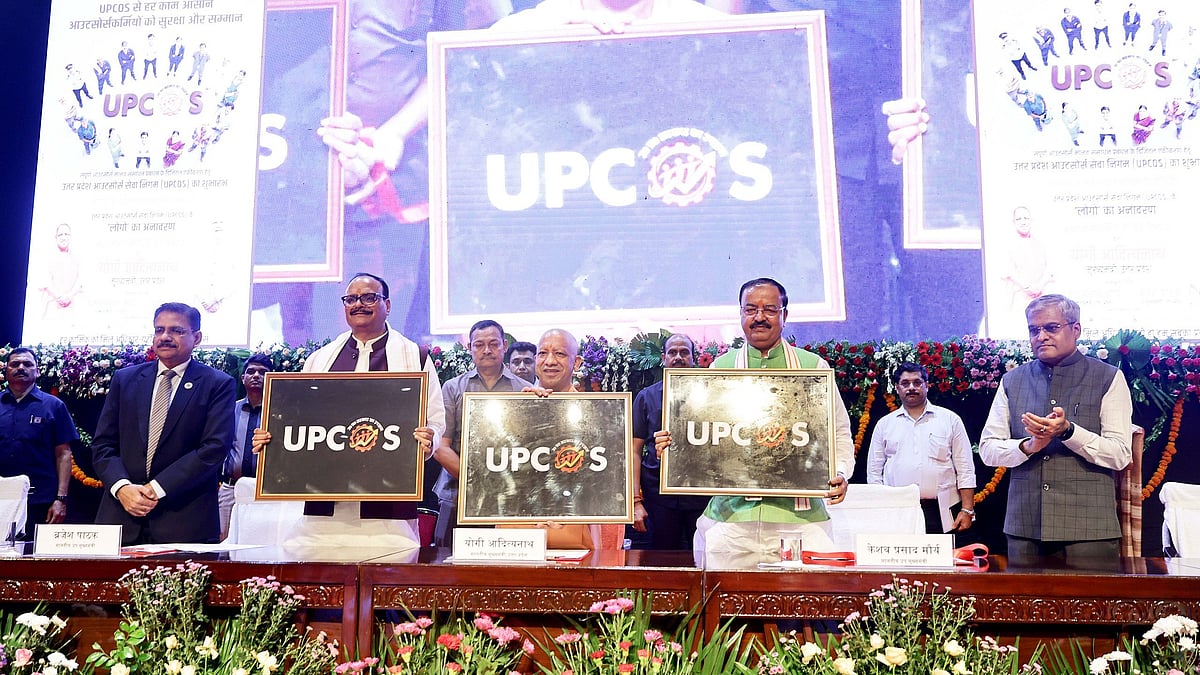
On Wednesday, Chief Minister Yogi Adityanath launched the Uttar Pradesh Outsource Service Corporation, or UPCOS. With this, the process of bringing arrangements related to the recruitment, deployment, attendance, salaries, social security and grievance redressal of outsourced employees under an organized framework has begun.
Through UPCOS, government departments, outsourcing agencies, and employees will be connected through a modern, transparent, technology-based system. Workforce requirements will be assessed, vacancies will be forecast, and human resource planning will be undertaken accordingly.
The recruitment process will be online, transparent, qualification- and merit-based, and will follow the state government's reservation policy. Reservation for SC, ST, OBC, persons with disabilities, women, EWS, dependents of freedom fighters and veterans will be ensured as per the rules.
Employees will be able to view their service details, bank account, attendance, payments, and other information in one place. They will also be able to register complaints, track their status, and use a time-bound resolution mechanism.
The most important aspect of the new system is timely remuneration. A system has been put in place to pay outsourced employees between the 1st and 5th of every month. A provision has been made for the payment to be credited directly to the employee's bank account.
Opening accounts for employees covered under EPF and ESIC and ensuring regular deposit of contributions will also be part of the system. Agencies will also have to provide proof of this to the Corporation within the prescribed time. This means responsibilities related to employees' salaries and social security are now under a clearer, more accountable framework.
One of the biggest concerns of outsourced employees has also been job insecurity. Under the new system, arbitrary removal of an employee has been prohibited. An outsourcing agency cannot remove an employee on its own. Even in cases of indiscipline or a punishable offense, action can be taken only with the consent of the concerned department or institution and the Corporation.
The new system is not limited to providing employment. Arrangements have also been made to provide training to employees from time to time to enhance their work efficiency and skills. Candidates will be selected through the Employment Department portal. We will use a transparent selection process based on qualifications, efficiency, and the prescribed standards. There will be no interview for Category-3 and Category-4 posts. There is also a provision to give preference to widows, divorced women, and abandoned women in the selection process.
The new system does not focus only on salaries and jobs for outsourced employees. An effective mechanism has also been put in place to ensure the availability of other statutory service benefits, including maternity leave. Responsibility has also been assigned for providing employees with permissible benefits related to EPF, ESIC, and banking.
The scope of social security has also been expanded with UPCOS. Through the MoU signed with the State Bank of India, comprehensive social security facilities are being provided to outsourced employees. As per the prescribed salary categories, an employee will receive personal accident insurance of up to approximately ₹40 lakh. Prescribed insurance protection will also be available in case of permanent partial disability.
In addition, the facilities include up to ₹10 lakh for plastic surgery in case of burns, up to ₹5 lakh for emergency medicines, and up to ₹10 lakh for air ambulance services in an emergency.
The most distinctive aspect of this arrangement is that the scope of social security has not been limited to the employee alone. In the event of a major mishap, we have also arranged financial assistance for the employee's family. A provision has been made for assistance of up to ₹8 lakh for the education of an employee's son and up to ₹10 lakh for the education of a daughter. Assistance of ₹8 lakh to ₹10 lakh has been provided for the marriage of two daughters, along with up to ₹50,000 for the employee's last rites.
The employee and their family will also have access to a zero-balance bank account facility. Through the salary account, arrangements have also been made to provide special scheme benefits to up to four family members.
One of UPCOS's major objectives is to clearly define responsibilities among employees, agencies, and departments within the outsourcing system. Agencies will be selected and impaneled through a prescribed process. We will establish accountability through a tripartite arrangement among the department, Corporation, and agency.
We will manage and monitor recruitment, postings, attendance, salaries, gratuity, insurance, and other service facilities. This means that employees will no longer have to depend on different offices and individuals for information related to their service.
Following this decision of the Yogi government, around 3.50 lakh outsourced employees working in various departments across the state will benefit directly. These employees will now receive timely salaries and a guarantee of security for their future.

