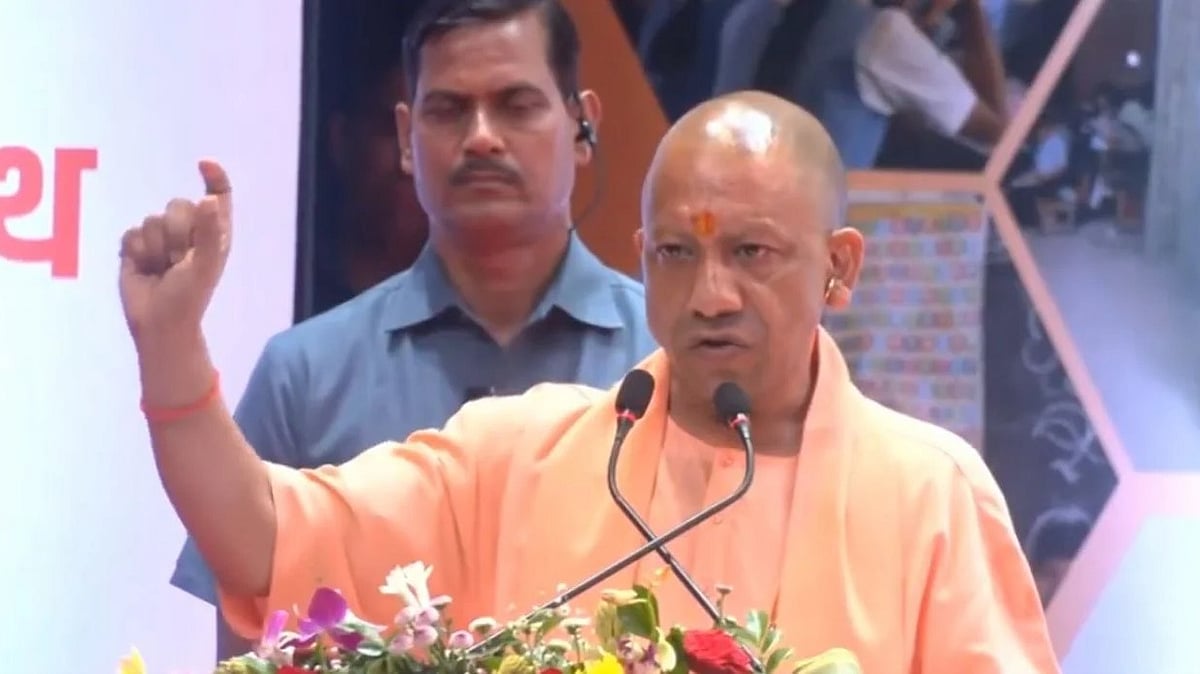
Ayodhya: Chief Minister Yogi Adityanath on Friday attended the Bhagwan Munisuvratanath Panchkalyanak Pratishtha Mahotsav organized at the Digambar Jain Temple. During the event, he inaugurated the Rishabhdev Janmabhoomi Gate and the complex of 101 Bhagwan Jin temples. Addressing the gathering, he said, "Ayodhya has a glorious history and that its kings have always protected both the tradition of knowledge and Gau Mata."
The Chief Minister also urged devotees to contribute towards cow protection. He noted that Indian tradition has long taught that the first morsel of food should be offered to the cow and the last to a dog. He added, "People also feed flour and sugar to ants while lighting lamps in the evening."
Promoting the welfare of all living beings, he said, reflects the spirit of 'Live and Let Live.'
Gorakshpeethadhishwar Yogi Adityanath said, "The cow is a divine manifestation and that everyone should work for its protection, conservation, and welfare."
He appealed to Jain families to adopt a cowshed if possible or provide annual support for a few cows. At the very least, he urged them to bear the expenses of one cow each year. He also encouraged them to visit cowsheds regularly and monitor the health of the animals.
He stated that if Gau Mata remains healthy, Indian culture, Jainism, and Vedic Sanatan Dharma will remain secure. He added, "The protection of one is intrinsically linked to the protection of the others. While paths to the destination may differ, the underlying tradition remains the same"
The Chief Minister appealed to devotees to actively participate in cleanliness drives, plantation campaigns, environmental conservation efforts, and all initiatives that contribute to India's security and sovereignty while preserving the sanctity of pilgrimage sites.
Referring to Prime Minister Narendra Modi's emphasis on civic responsibility, he said, "If citizens remain mindful of their duties toward the nation and society, India and its civilizational values will remain eternal."
He expressed confidence that the Jain community would continue to play a vital role in guiding society toward virtuous conduct.
The Chief Minister said, "The tradition that began with Adinath originated in Ayodhya itself. Bhagwan Rishabhdev, the first Tirthankara, is associated with the sacred land of Ayodhya and is regarded as the first king of the earth."
Referring to an episode from the Ramayana involving Bhagwan Ram and Bali, he said, "When Bali accused Ram of killing him unfairly and questioned his authority, Ram replied that Bali's own actions had led to his downfall."
The Chief Minister said, "According to tradition, the kings of Ayodhya were considered rulers of the entire earth, encompassing oceans and forests alike. Bhagwan Jad Bharat, the son of Bhagwan Rishabhdev, gave his name to the nation, which came to be known as Bharat."
The Chief Minister added, "Uttar Pradesh is blessed to have witnessed the largest number of the Tirthankaras among the 24. Five of them, namely the First Tirthankara Bhagwan Rishabhdev, the Second Tirthankara Bhagwan Ajitnath, the Fourth Tirthankara Bhagwan Abhinandannath, the Fifth Tirthankara Bhagwan Sumatinath, and the Fourteenth Tirthankara Bhagwan Anantnath, manifested in Ayodhya itself."
He added, "Four Tirthankaras are associated with Kashi, one with Shravasti, and that Hastinapur also has a long Jain tradition. The 24th Tirthankara, Bhagwan Mahavira, delivered his final sermon in Kushinagar, sanctifying the place."
Referring to the area's historical nomenclature, he remarked that it had been renamed Fazilnagar during a later period but should rightfully be known as Pavagarh.
CM Yogi said, "Rulers are expected to protect, nurture, and guide society through discipline. The message of 'Live and Let Live' can only be imparted by those who practice self-discipline."
Negative forces, he said, cannot sustain themselves within the framework of self-discipline.
"One who lacks discipline over oneself cannot govern others," he remarked, adding that this sacred tradition has offered the world a timeless message and inspiration. By following these principles, humanity can pave the way not only for human welfare but also for the well-being of all living beings and the entire world.
He said, "Jain Tirthankaras, through their spiritual practices and teachings, inspired humanity toward universal welfare."
The event began with a welcome address by Peethadhishwar Ravindra Kirti Swami. The Chief Minister felicitated him with a bouquet and extended birthday greetings. Jain Sadhvi Ganini Pramukh Gyanmati Mata Ji, Chandanamati Mata Ji, Agriculture Minister Surya Pratap Shahi, Mayor Mahant Girish Pati Tripathi, MLAs Ved Prakash Gupta, Amit Singh Chauhan and Abhay Singh, District Panchayat Chairperson Roli Singh, Pushpdant Jain, Amarchand Jain, Kailash Chand Jain, and several other dignitaries were also present on the occasion.

