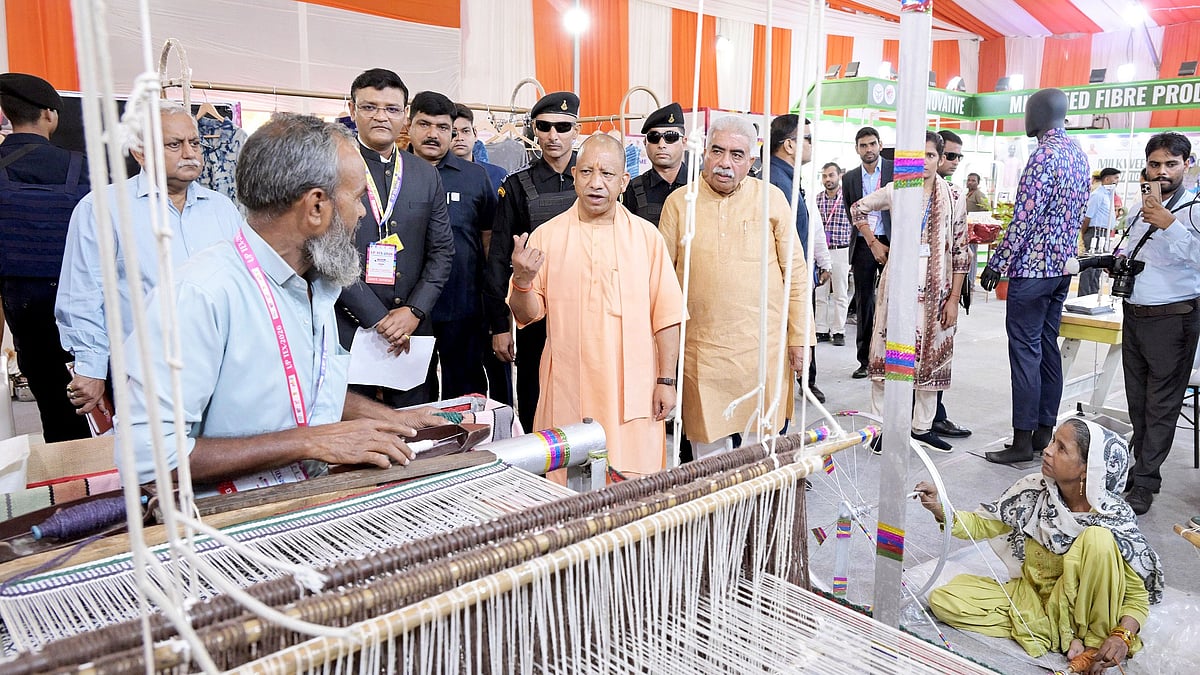
Lucknow, September 8: The industry is excited about making large-scale investments to make Uttar Pradesh the leading state in the country in the textile industry sector. At the inaugural ceremony of the 'UP Textile Conclave-2026', former Rajya Sabha member, industrialist, social worker, and founder and chairman of Ramky Group Alla Ayodhya Rami Reddy strongly praised the favorable environment for investment in Uttar Pradesh.
Praising the rapid development under Chief Minister Yogi Adityanath and the improved industrial environment, he said, "Uttar Pradesh has now emerged as an important destination offering investment and development opportunities for industries."
Rami Reddy said, "Just as the country is progressing at the pace under the leadership of Prime Minister Narendra Modi, Chief Minister Yogi Adityanath is also taking Uttar Pradesh forward in the same direction with new thinking, discipline and control. The environment of discipline, control and security in the state instills confidence among industrialists to invest. Industrialists want to invest their money only where they get a stable and reliable environment along with security."
He further added, "Uttar Pradesh is not only the largest state in the country but is also rich in resources. Strong political and administrative leadership in the state is giving the industry confidence that investment can be made here and businesses can be expanded. This has further strengthened the possibilities of large-scale industrial investment in the state."
Mr Reddy stated, "The textile industry is one of the oldest and most important industries in the country. This sector is developing in different parts of the country, but Tamil Nadu has made remarkable progress in the textile industry. To make Uttar Pradesh the number one state in the country in this sector, it will have to learn from the successful experiences of states such as Tamil Nadu and prepare a concrete vision and action plan suited to its own circumstances. For this, the state government and the industry will have to move forward together."
He said the textile industry centers and parks being developed at four to five locations around Lucknow and across the state are an important first step in this direction. This makes it clear that the Yogi government is working seriously on the textile industry and is preparing for the long-term development of this sector. The state government's assurance of a stable environment, better infrastructure, and affordable essential services is important for the industry.
He added that bringing the best private-sector industrial units to these centers with the 'walk to work' concept will benefit both industry and workers and help the textile industry progress rapidly.
Rami Reddy said large-scale investment is needed in Uttar Pradesh's textile sector, and the industry is committed to it. The industry across the country is hopeful about the development taking place in Uttar Pradesh's textile sector and is eager to be part of this development journey.
He expressed confidence that in the coming time, Uttar Pradesh will establish a strong identity not only on the country's textile industry map but also on the global textile industry map.
On this occasion, Precot Limited Chairman and Managing Director and Vice President of the Confederation of Indian Textile Industry (CITI) Ashwin Chandran stated, "The Indian textile and apparel industry is entering a period of significant transformation. Amid changes in the global supply chain, buyers are now prioritizing quality, technology, sustainability, productivity, and timely supply along with cost."
He said India has the entire textile value chain, from raw materials to finished products, as well as a vast domestic market. Over the next 5 years, the target is to increase the Indian textile and apparel market from the current approximately $180 billion to around $350 billion and exports from around $37 billion to $100 billion. This will require large-scale expansion, an integrated industrial ecosystem, technological upgradation, and increased use of artificial intelligence and robotics.
Chandran stated, "Uttar Pradesh has a young workforce, a strong MSME base, textile and apparel clusters, a rich tradition of handloom and handicrafts, and a vast domestic market. The state can play a major role in technical textiles, sustainable and recycled products, and high-value home textiles. Stable policies, ready infrastructure, electricity and water at competitive rates, better transportation, skilled human resources and speedy approvals are essential for the expansion of the industry."
He added that, to compete in the global market, special attention will also have to be paid to quality, productivity, sustainability, supply monitoring and compliance.
Referring to various initiatives of the Uttar Pradesh Skill Development Mission, he stated, "CITI is working on skill development in the textile sector under the Samarth Scheme with the Government of India. Based on this experience, the organization is ready to work with the Uttar Pradesh government to help prepare a skilled workforce in line with future requirements for existing industrial clusters and new investment projects."

