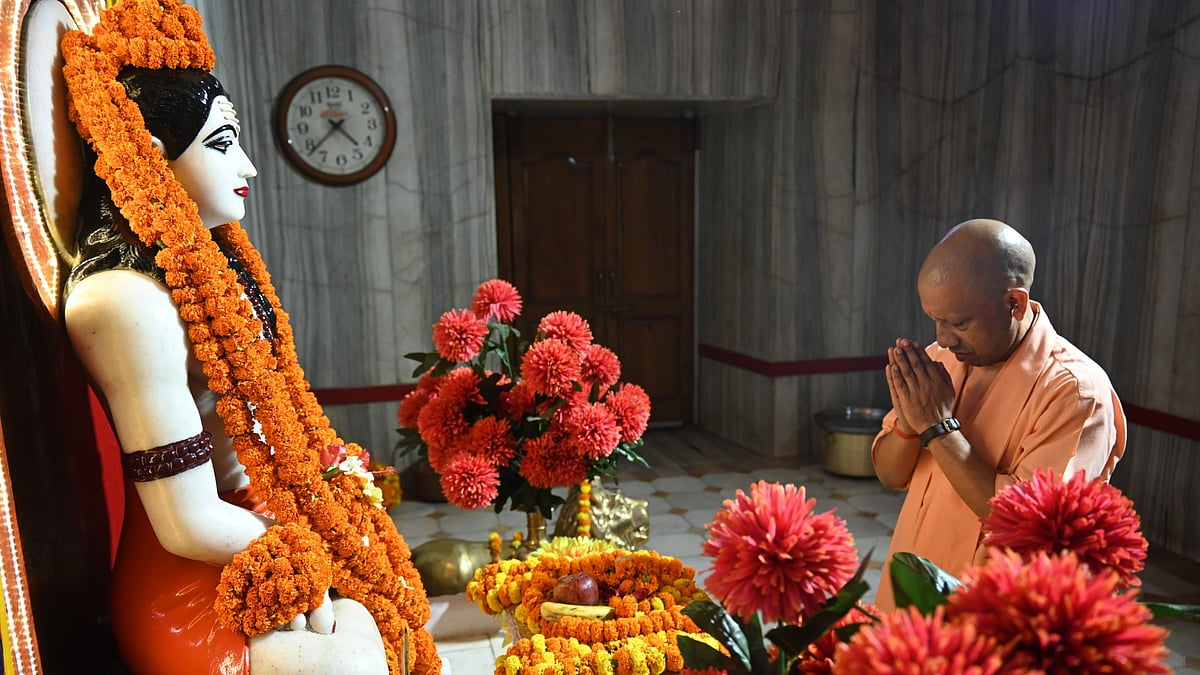
Gorakhpur, September 28: As in previous years, the Goraksha Peeth, a spiritual institution rooted in nationalism, gratitude, cultural pride, and unwavering devotion to the guru tradition, is once again resonating with the spirit of spirituality and national consciousness in memory of revered ancestors. The occasion is the week-long tribute programme being organized in remembrance of Yugpurush Brahmaleen Mahant Digvijaynath Ji Maharaj and Rashtrasant Brahmaleen Mahant Avaidyanath Ji Maharaj.
A recital of the Shrimad Bhagavata Mahapurana has been underway at the Goraksha Peeth since September 23, while conferences on contemporary issues have been taking place since September 24. As part of these events, a grand tribute meeting will be held on Ashwin Krishna Tritiya (Tuesday, September 29) on the occasion of the 57th death anniversary of Brahmaleen Mahant Digvijaynath Ji Maharaj. The programme will be chaired by Goraksha Peethadheeshwar and Chief Minister Yogi Adityanath at the Mahant Digvijaynath Memorial Auditorium in Gorakhnath Temple and will be attended by saints and spiritual leaders from across the country.
Remembered by history as a “Yugpurush” (man of the era), Mahant Digvijaynath Ji Maharaj served as the Peethadheeshwar of the globally renowned Goraksha Peeth of the Nath tradition from 1935 to 1969. Even after his passing, his ideals, resolve, and work continue to guide future generations. He was not only the architect of the present form of Gorakhnath Temple but also dedicated his entire life to public welfare through service to the nation, religion, spirituality, culture, education, and society.
From a young age, he actively participated in India’s freedom movement and, after Independence, devoted himself to social unity and upliftment. Educational awakening remained one of his foremost priorities.
Mahant Digvijaynath was born in 1894 on the day of Vaishakh Purnima in Kakarhawa, Chittor, Mewar (present-day Rajasthan). His childhood name was Nanhu Singh. At the age of five, in 1899, he arrived at the Goraksha Peeth in Gorakhpur.
The spirit of Mewar, his birthplace, instilled in him strong determination and an uncompromising sense of self-respect from an early age. He received his education in Gorakhpur and was also deeply interested in sports. He received Yog Diksha at Gorakhnath Temple on August 15, 1933, and became the Peethadheeshwar of the Goraksha Peeth on August 15, 1935.
He remained actively involved in the struggle for India's independence from his youth. Driven by a passion to see the nation free, he left school in 1920 in support of the Non-Cooperation Movement launched by Mahatma Gandhi. The British administration repeatedly accused him of sheltering and assisting revolutionaries. His name also came up in the events of the Chauri Chaura incident of 1922, but the British authorities had to bow before his intelligence, and he was released.
The significant role played by the Goraksha Peeth in the movement for the construction of the Shri Ram Temple in Ayodhya is widely acknowledged. Brahmaleen Mahant Digvijaynath Ji Maharaj is regarded as one of the foundational figures of this movement.
Between 1934 and 1949, he continuously led campaigns that strengthened and expanded the movement. In 1949, he emerged as one of the principal leaders of the Shri Ram Janmabhoomi liberation movement.
Nine days before the appearance of the idol of Ram Lalla in Ayodhya on December 22-23, 1949, an Akhanda Ramayana recitation had already commenced under his leadership. Mahant Digvijaynath himself was present when Ram Lalla appeared.
After a wait of five hundred years, Lord Shri Ram is now enshrined in the temple at his birthplace in Ayodhya. The movement for the construction of the temple of Lord Ramlala was made decisive by his disciple, Mahant Avaidyanath Ji, after him. It is also a happy coincidence that after the court's decision, when the auspicious hour for the construction of the temple arrived, the leadership of the state's government was in the hands of Yogi Adityanath, the Peethadheeshwar of the Goraksha Peeth.
As a result, whenever the Shri Ram Temple in Ayodhya is discussed, the memory of Brahmaleen Mahant Digvijaynath Ji Maharaj, the Dadaguru of the current Peethadheeshwar, naturally comes to the forefront.
The educational awakening initiated by Mahant Digvijaynath Ji transformed Gorakhpur and the surrounding region, and its impact continues to illuminate eastern Uttar Pradesh.
In 1932, he established the Maharana Pratap Shiksha Parishad to promote educational advancement. Under the Parishad, Maharana Pratap Kshatriya School was initially started in a rented building. It received recognition as a junior high school in 1935, and high school classes began in 1936, after which it became known as Maharana Pratap High School.
Through his efforts, the Maharana Pratap Shiksha Parishad acquired five acres of land in Gorakhpur’s Civil Lines area, where the institution was subsequently relocated. By the time India attained Independence, it had evolved into Maharana Pratap Intermediate College.
During 1949-50, Maharana Pratap Degree College was established on the same campus under his leadership.
His vision for education was farsighted and free from personal interests. This was evident when, in 1958, he donated two of his institutions, namely Maharana Pratap Degree College and Maharana Pratap Mahila Mahavidyalaya, to facilitate the establishment of Gorakhpur University.
Later, the Parishad established Mahant Digvijaynath Postgraduate College in his memory. Today, the Maharana Pratap Shiksha Parishad operates more than four dozen educational institutions in the Gorakhpur region, ranging from primary schools to institutions of higher education, medical education, and technical education.
Mahant Digvijaynath Ji also regarded politics as an instrument for public welfare, in keeping with the traditions of the Goraksha Peeth.
He formally entered public life by joining the Hindu Mahasabha in 1937. In 1944, he organized a major provincial conference of the Hindu Mahasabha in Gorakhpur. Because of his political association with the organization, he was arrested in 1948 on false allegations linked to the assassination of Mahatma Gandhi. However, the government was compelled to honourably acquit him in 1949, after ten months.
In 1956, he played a significant role in ending Master Tara Singh’s indefinite fast for a separate Punjabi state through dialogue and persuasion. In 1961, he was elected national president of the Akhil Bharatiya Hindu Mahasabha.
His contributions to religion and social unity were equally significant. In 1939, he established the Akhil Bharatiya Avadhoot Bhesh Barahpanth Yogi Mahasabha, an initiative aimed at uniting saints from across the country for public welfare and national interest.
Among his notable achievements were presiding over the Akhil Bharatiya Shaddarshan Sabha Conference in Haridwar in 1960, organizing the Akhil Bharatiya Hindu Conference in Delhi in 1961, and organizing the Akhil Vishva Hindu Conference in Delhi in 1965.
Mahant Digvijaynath was elected to the Lok Sabha from Gorakhpur in 1967. He attained Brahmaleen status in 1969, but the legacy of his life and work remains enduring. His ideals, educational institutions, and national vision continue to guide and inspire society, providing direction and momentum for future generations.

