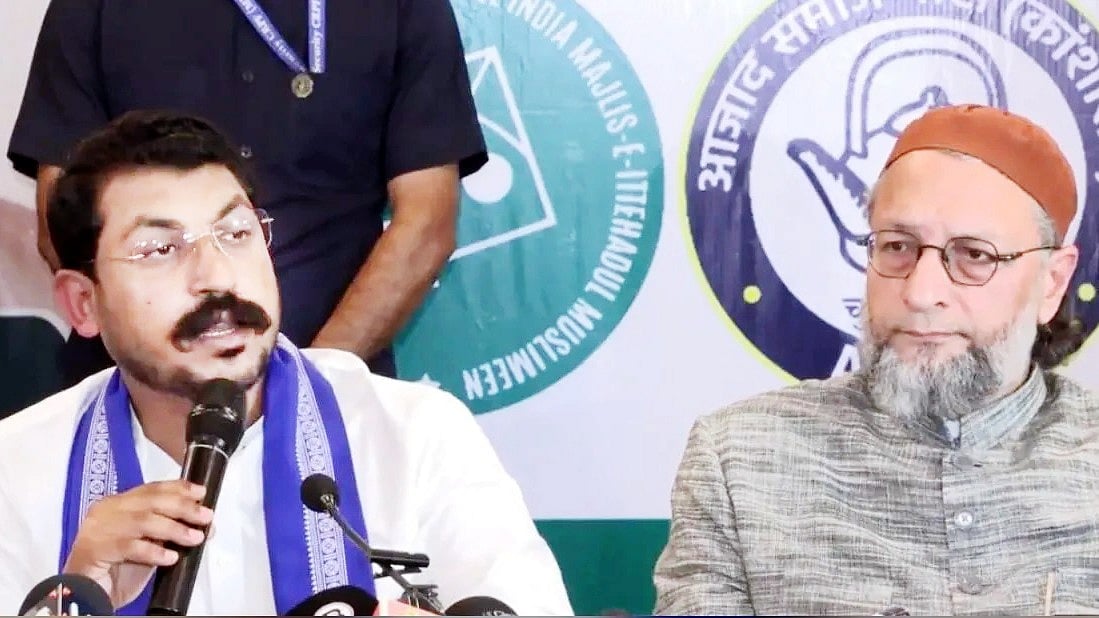
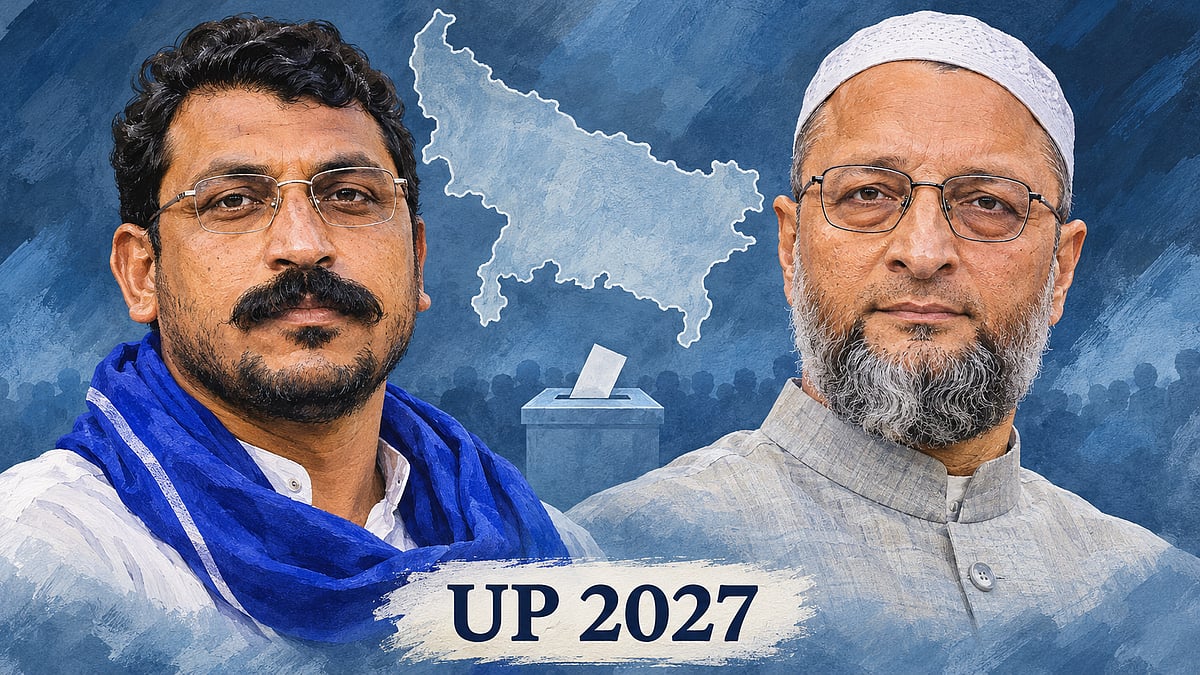
Lucknow: The alliance between the Azad Samaj Party (ASP) led by Chandrashekhar Azad and the All India Majlis-e-Ittehadul Muslimeen (AIMIM) headed by Asaduddin Owaisi has introduced a new dimension to Uttar Pradesh's political battle ahead of the 2027 Assembly elections.
The emerging combine could pose a challenge not only to the BJP but, more significantly, to the Samajwadi Party, which has been seeking to consolidate Muslim, backward and Dalit voters against the ruling party.
By bringing Dalit and Muslim leadership under one political umbrella, Chandrashekhar and Owaisi are seeking to project an alternative platform for two significant sections of the state's electorate. While the BJP will be watching the alliance's impact on its electoral calculations, the immediate political concern for the SP could be a possible erosion of its support base.
Muslims constitute around 19 per cent of Uttar Pradesh's population, while Dalits account for nearly 21 per cent. Both communities have considerable electoral influence, particularly in constituencies where the contest between the BJP and Opposition parties is closely fought.
The SP has traditionally relied on Muslim support while attempting to expand its reach among backward and Dalit communities. Owaisi has been trying to establish AIMIM as an independent political force among Muslim voters, while Chandrashekhar has sought to emerge as a prominent face of Dalit politics. Their coming together could force the SP to fight on two fronts, defending its Muslim support base against AIMIM and its efforts to attract Dalit voters against the ASP.
Vote division could benefit BJP
The electoral impact of the alliance will largely depend on its ability to transfer its political appeal into votes. Even a limited shift of Muslim and Dalit voters could complicate the SP's prospects in constituencies where the margin of victory is narrow.
In closely contested seats, a division of Opposition votes could give the BJP an advantage without necessarily requiring it to expand its own support base. The possibility of such a split is likely to concern the SP, which remains the principal Opposition force in the state.
The Congress could also face competition from AIMIM for Muslim voters. The party has been attempting to regain political ground in Uttar Pradesh, and Owaisi's presence could complicate its efforts to consolidate minority support.
However, the SP appears more vulnerable because its electoral strategy depends heavily on maintaining a broad coalition of communities opposed to the BJP.
Despite the political significance of the alliance, translating the Dalit-Muslim combination into a consolidated electoral bloc will be a major challenge.
Muslim voters have often preferred candidates perceived to have the strongest chance of defeating the BJP, making electoral viability an important factor in their voting decisions. Similarly, Dalit voters are not a homogeneous group, and the Bahujan Samaj Party continues to retain an independent political base among sections of the community.
The alliance will also have to demonstrate organisational strength beyond its leadership, identify winnable constituencies and field candidates capable of mounting serious challenges to established parties.
Also Watch:
Poor electoral record in 2022
Both parties have struggled to convert their political presence into Assembly seats. In the 2022 Uttar Pradesh Assembly elections, AIMIM contested 95 constituencies and secured around 0.49 per cent of the total votes, approximately 4.5 lakh, but failed to win a single seat.
The Azad Samaj Party contested 111 seats and received 1,19,564 votes. It, too, failed to open its account.
The alliance will therefore have to overcome its limited electoral footprint and establish itself as a credible political alternative.
Its real test in 2027 will not merely be the ability to attract Dalit and Muslim voters to its platform, but whether it can build a viable electoral organisation and win constituencies. Until then, the alliance may be a potential spoiler in the BJP-SP contest, with the SP facing the greater immediate political challenge.

