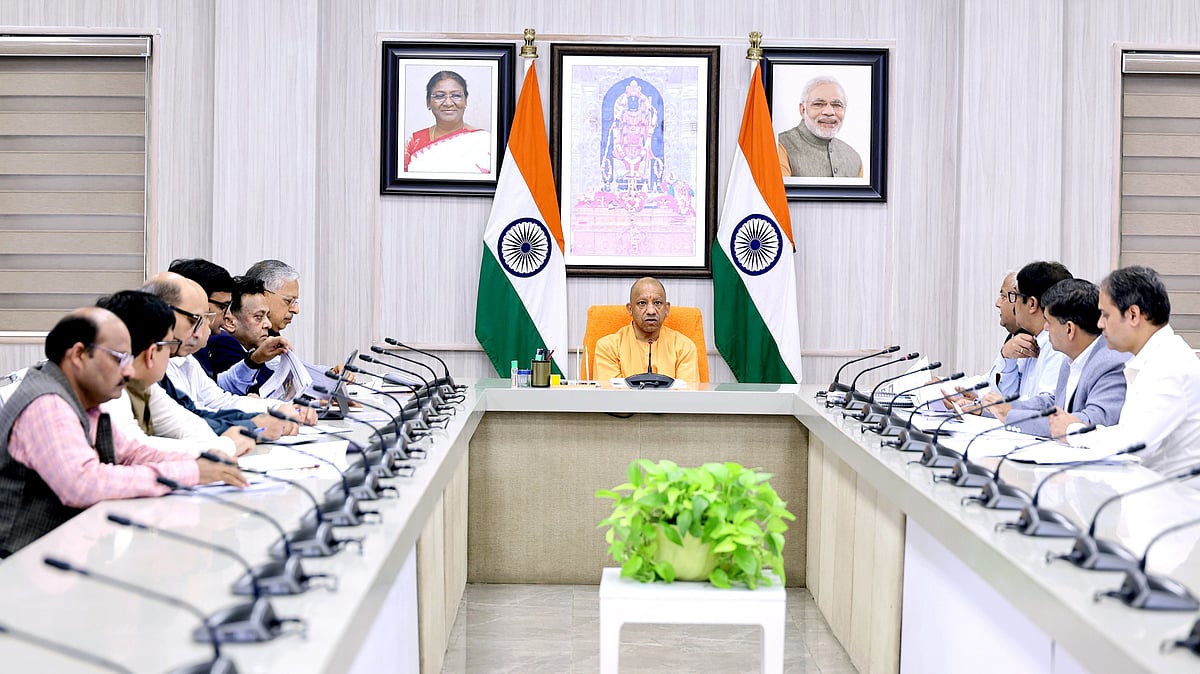
Lucknow: Chief Minister Yogi Adityanath has emphasised the need to expand the jurisdiction of the Lucknow Development Authority (LDA) to cover the entire Lucknow district to ensure its planned and comprehensive development. During a review meeting of the Housing and Urban Planning Department on Tuesday, he directed officials to prepare the necessary proposal in this regard. He also asked them to prepare a detailed proposal for expediting the process of setting up a new development authority in Barabanki. In addition, officials were directed to submit concrete proposals for expanding the boundaries of other development authorities across the state, wherever required.
Discussing the proposed expansion of the LDA's jurisdiction, the Chief Minister said, "Lucknow district has the fastest-growing population in the State Capital Region. Expanding the LDA's jurisdiction is essential not only to meet the growing residential, commercial and community needs of the population but also to effectively regulate illegal and unplanned construction in the peripheral areas of the state capital."
Officials informed the Chief Minister that the LDA, established in 1974, had undergone expansion in 1999, 2009 and 2014. At present, its jurisdiction covers the Municipal Corporation area and 306 revenue villages, spanning a total area of 1,051 square kilometres.
Considering the rapid urban expansion, growing industrial activities and increasing residential pressure in Barabanki, which borders Lucknow, the Chief Minister also stressed the need to establish a new development authority there. He said, "Owing to its proximity to the state capital, land-use changes and construction activities in Barabanki were increasing rapidly. It is therefore essential to guide development in a planned manner from the outset to prevent future problems related to infrastructure, drainage and civic amenities." The Chief Minister directed officials to prepare a detailed proposal for the formation of the Barabanki Development Authority at the earliest.
Reviewing the development of the Lucknow-Kanpur Expressway corridor, the Chief Minister directed that work on corridor-oriented development be expedited by bringing it under the Unnao-Shuklaganj Development Authority. Officials informed him that the area between the UPSIDA boundary and a stretch extending three kilometres south of the Lucknow-Kanpur Expressway covers approximately 470 square kilometres and includes 171 villages and Achalganj Nagar Panchayat. The built-up area in this region has more than doubled over the past decade. It stood at 1,962 hectares (4.19 percent) in 2015, increased to 2,656 hectares (5.67 percent) in 2020 and reached 3,902 hectares (8.33 percent) in 2025. The Chief Minister said, "The strategically important corridor should be developed through integrated planning, while harnessing its potential for economic growth."
During the meeting, the Chief Minister directed officials to prepare an action plan for constructing an international cricket stadium in Ghaziabad. He added, "An international-standard stadium with a seating capacity of 35,000 to 40,000 spectators should be developed in the city. The Ghaziabad Development Authority (GDA) and the Uttar Pradesh Cricket Association (UPCA) should jointly explore the feasibility of undertaking the project under a revenue-sharing model and submit a detailed action plan."
The meeting also reviewed the progress of the GIS-based Regional Plan-2051 for the Uttar Pradesh State Capital Region and the proposed projects under it. Officials informed the Chief Minister that the preliminary stages, including surveys, preparation of the base map and formulation of the regional development vision, had been completed. The draft regional plan is now being prepared for inviting objections and suggestions from the public, with November 30 set as the target for its completion.
The Chief Minister directed officials to finalise the draft plan within the stipulated timeframe and ensure transparent resolution of objections and suggestions received from the public. He also called for expediting the preparation of Detailed Project Reports (DPRs) for short-term projects to be implemented over the next five years, following final approval of the plan.
Presenting the geographical and economic profile of the State Capital Region, officials informed the Chief Minister that it comprises Lucknow (population: 45,89,838), Sitapur (44,74,446), Hardoi (40,92,845), Barabanki (32,60,699), Unnao (31,08,367) and Rae Bareli (29,03,507), covering a total area of 27,826 square kilometres. The region currently has a population of 2.92 crore, which is projected to reach 4.9 crore by 2051. During the same period, the level of urbanisation is expected to rise from 29 percent to 46 percent. Officials further informed that with a nominal GDP of ₹3.58 lakh crore in 2025 and an annual growth rate of 6.7 percent, the region contributes 12 percent to the state's economy.
The Chief Minister directed that the specific strengths and economic potential of each district be prioritised while preparing the development plan for the State Capital Region. He called for region-specific planning with a focus on urban resilience in Lucknow; manufacturing and defence engineering in Rae Bareli; industrial expansion in Unnao; agro-industries and eco-tourism in Barabanki; the Sandila Industrial Corridor in Hardoi; and tourism development centred on Naimisharanya in Sitapur.
During the meeting, the Chief Minister also reviewed the cadre structure and availability of human resources in development authorities. He said, "Adequate and qualified manpower was essential for effective implementation of projects and quality urban planning." He directed officials to expedite the recruitment and appointment process against vacant posts across various categories in all development authorities in the state. He also called for ensuring the appointment of permanent town planners in every development authority to strengthen and improve the effectiveness of urban planning.

