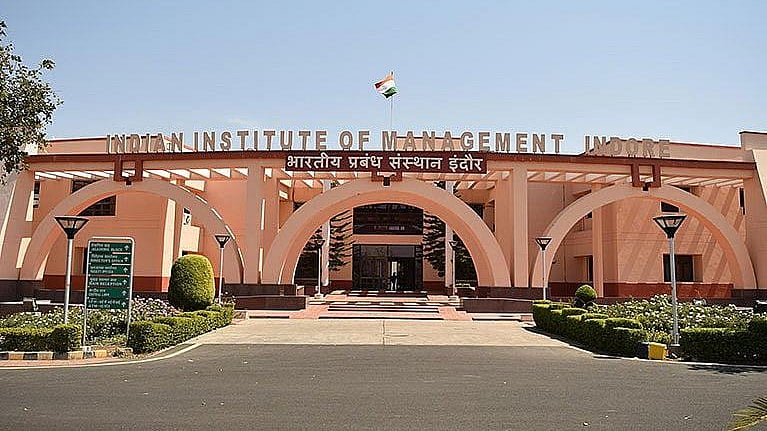
Indore (Madhya Pradesh): A study by researchers at the Indian Institute of Management Indore has challenged the conventional view that volatility in emerging-market currencies is largely driven by the US dollar, finding instead that investor behaviour in BRICS currency markets can transmit volatility back to the dollar.
The study, titled Investor Fear, Behavioural Contagion, and the Global Dollar Cycle: Evidence from BRICS Currency Markets, has been published in Economics Letters.
It was authored by Prof Kiran Kumar Kotha and DPM participant Sainandan Kandikattu of IIM Indore.
The researchers examined daily foreign exchange data from Jan 1, 2004, to Dec 31, 2024, focusing on whether fear and behavioural patterns among investors in BRICS currency markets could influence dollar volatility.
Unlike the conventional international-finance framework, which largely treats the US dollar as the source of volatility transmitted to emerging markets, the study identifies a reverse spillover channel.
It found that anti-herding behaviour in BRICS currency markets can transmit volatility to the US dollar, while the reverse channel was not observed.
The study describes anti-herding as a situation in which investors deliberately move away from the market consensus and rely more heavily on their private signals.
The researchers found that rising global financial stress tends to intensify anti-herding in BRICS currency markets, contrasting with the stronger herding behaviour often observed in equity markets during periods of fear.
To investigate these relationships, the researchers used the Cross-Sectional Absolute Deviation (CSAD) methodology to measure herding behaviour.
Global investor fear was primarily captured through the US Office of Financial Research's Financial Stress Index (FSI), with the VIX used as a robustness measure.
The researchers also employed Wavelet Coherence Analysis to examine relationships across different investment horizons, short term (0–64 days), medium term (64–256 days) and long term (more than 256 days), along with a Stochastic Volatility GARCH model to assess currency-market volatility.
The findings show that short- and medium-term spillovers were associated with major episodes of global stress, including the 2008 global financial crisis, the Covid pandemic and the Russia-Ukraine war.
However, the researchers found that long-term spillovers persisted beyond individual crises, indicating a structural component in the global dollar cycle.
Among BRICS currencies, the Chinese renminbi (CNY) exerted the strongest overall influence on dollar volatility identified in the study.
The researchers said the findings provide a behavioural perspective on global financial contagion, suggesting that instability in the world's reserve currency can be partly influenced by investor behaviour in emerging markets.
The study also has implications for policymakers and market participants. It suggests that indicators of investor behaviour in emerging-market currencies could be incorporated into macroprudential monitoring and international stress-testing frameworks.
For investors, measures such as CSAD could potentially serve as early-warning indicators of increasing market stress and help inform hedging and portfolio-allocation decisions during periods of heightened uncertainty.