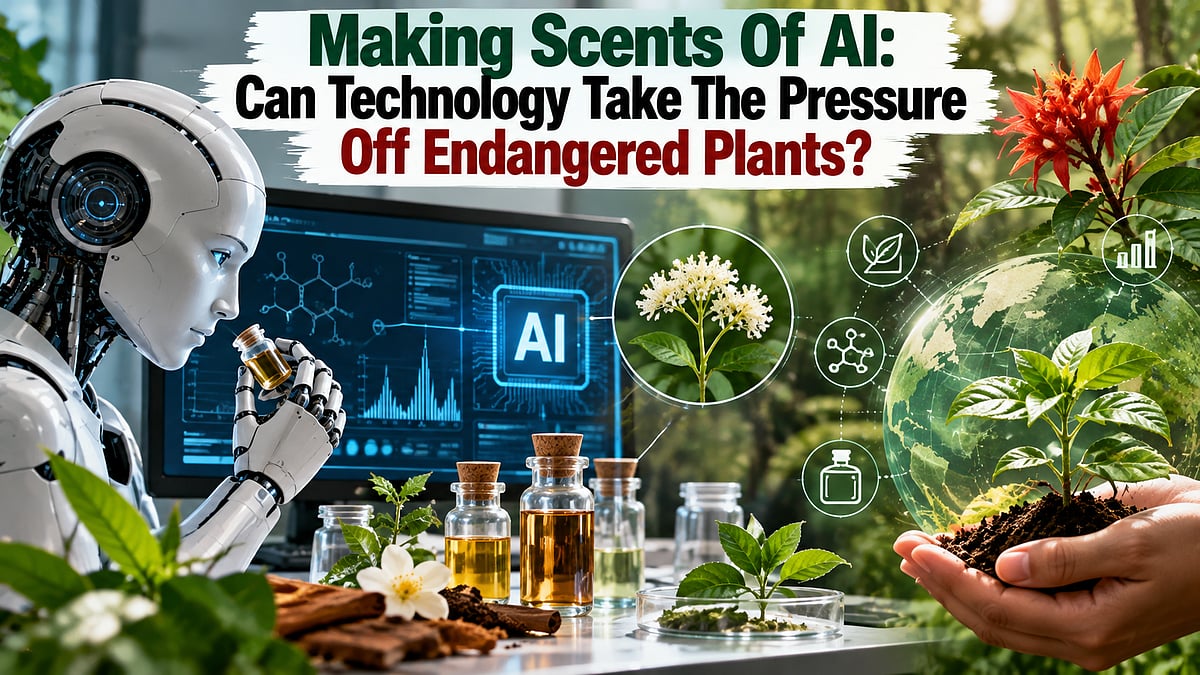
Many of the world’s most expensive perfumes depend on ingredients derived from plants facing intense pressure in the wild. Agarwood, or oudh, is one example. It comes from the dark, fragrant resin produced when some Aquilaria trees are damaged, and its high value has fuelled illegal felling of wild trees.
Now, scientists and biotechnology companies are exploring whether artificial intelligence (AI) and other technologies could recreate such scents and compounds without repeatedly harvesting endangered plants.
Researchers are using AI to predict how molecules that have never been produced might smell, while other scientists have reconstructed scent-producing genes from flowers believed to be extinct. Some have even collected microbes from clouds to develop new fragrances, The Guardian reports.
AI Opens New Possibilities For Fragrance Industry
Alex Wiltschko, founder of Osmo, a Google Brain spin-off that has raised $130 million to develop AI capable of predicting and recreating smells, believes the technology could benefit both businesses and the environment.
“Being able to recreate the scent of an endangered plant would be a huge win for both the environment but also the brands,” Wiltschko said.
According to Wiltschko, Osmo recreated the scent of a rare tree using a piece of bark “the size of a finger”. A spectrometer analysed the sample, after which AI reconstructed the chemical formula and the scent was reproduced in the laboratory.
BioHarvest Sciences, meanwhile, says it has developed a stable cell culture from an endangered south-east Asian fragrance plant, allowing valuable compounds to be produced without cultivating or harvesting the original plant.
The company has not identified the plant for commercial reasons. However, it has announced an agreement anticipating production of 20 tonnes of the fragrance composition, with limited production potentially beginning in 2027.
“The challenge is that human demand can be effectively unlimited while biological supply is not,” BioHarvest Chief Executive Zaki Rakib said. “We believe biotechnology can help close that gap, not by replacing nature but by allowing us to use what nature has given us without continually putting the source under pressure.”
Conservationists Question Environmental Claims
Conservationists and perfumers, however, warn against presenting technological alternatives as a solution to the threats facing endangered species.
“Calling this conservation is greenwashing,” natural perfumer, author and Aftel Archive of Curious Scents founder Mandy Aftel said. “Making a synthetic version of an endangered plant’s smell doesn’t save the plant.”
Aftel argued that creating a substitute does not necessarily prevent consumers from buying the original product or tackle other factors contributing to the decline of a species.
Rhian Smith of the Royal Botanic Gardens, Kew, expressed similar concerns. While AI could help develop an alternative to oudh, she said material sourced from wild Aquilaria trees would remain highly valued.
“It doesn’t completely take the pressure off wild plant species,” Smith said.
Wiltschko also acknowledged that conservation was not “an explicit priority” of Osmo’s work.

AI Can Predict How Molecules May Smell
Synthetic ingredients have been used extensively by the perfume industry for more than a century, while machines have long been capable of identifying molecules within scents. Wiltschko said the significant advance lies in what AI can do with that information.
“What’s changed is what happens after the data comes off the machine,” he said. “What’s new is prediction.”
Wiltschko said Osmo had trained its AI on more than five million human responses to smells.
“That means it can predict how combinations of molecules will be perceived,” he said.
Other researchers are exploring different ways of developing fragrances. Christina Agapakis has reconstructed genes from preserved flowers to produce fragrance compounds that perfumers can use to create new scents.
Perfumer Future Society took another approach, conducting two flights in a small plane to collect living microbes from clouds. Thirteen microbes were identified and found to produce 57 scent molecules. These became the starting point for Cloud Reverie, a perfume launched in 2026.
Also Watch:
Technology Cannot Fully Recreate Nature
Despite the advances, AI still faces significant limitations. A flower’s scent can contain hundreds of molecules and can vary depending on the part of the plant from which they originate and the conditions in which the plant grows.
For some researchers and perfumers, recreating a chemical composition cannot reproduce the full complexity of a living organism and its environment.
“The smell we got was this ghostly fragment of what had been lost,” Agapakis said of her project.
She said it was impossible to recreate the living organism or the combination of soil, climate, season and ecology responsible for producing its scent.
“What we have to remember is, ultimately, however powerful AI is, a smell is not simply a formula or dataset.”

