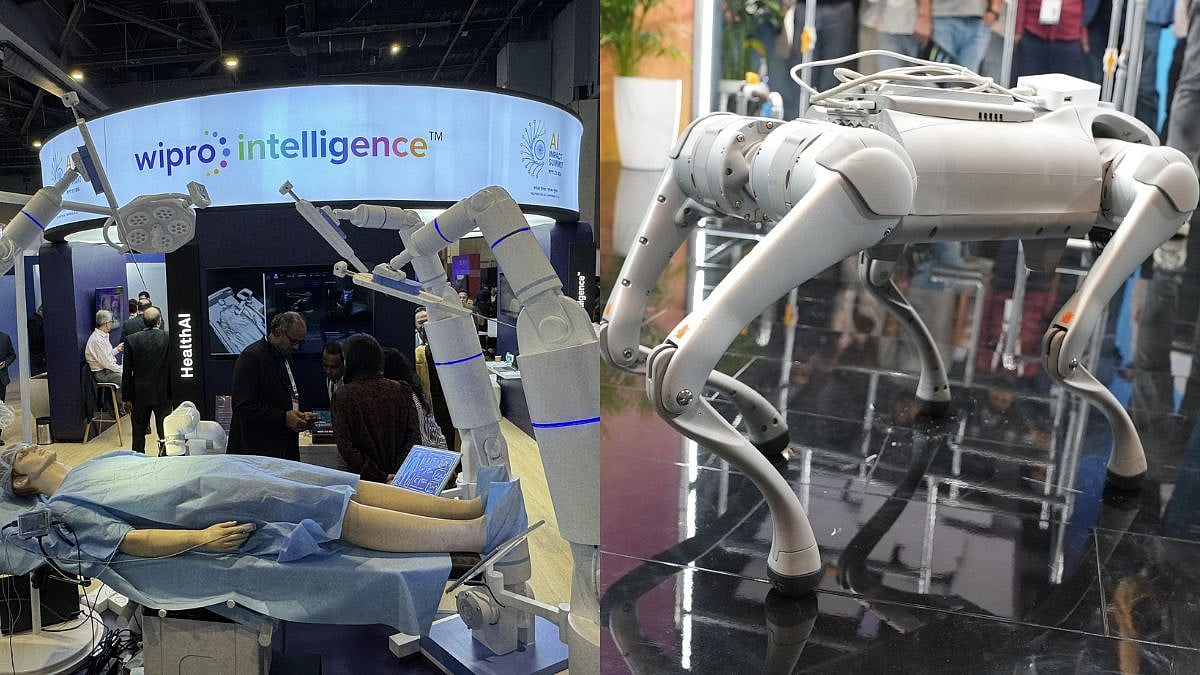
The India AI Impact Summit 2026 is one of the biggest event happening in Delhi right now. Top tech leaders and ministers have flown in to share insight, offer investments, and trade policy soundbites. Apart from the session, there is also an exhibit area - called the India AI Expo - wherein big tech leaders and AI startups are showcasing their latest innovations.
Walk through the sprawling expo halls at Bharat Mandapam and you'll find electric motorcycles that can see danger before you do, glasses that speak your language - literally - and a robot that can inspect an oil rig without a human in sight. The summit's exhibition floor, open until February 20, spans multiple pavilions covering everything from healthcare and education to manufacturing and consumer tech.
Here are some of the top innovations being showcased at the India AI Impact Summit 2026:
1. Sarvam Kaze: The AI Smart Glasses Prime Minister Modi Tried On (India Pavilion)
The most talked-about wearable at the summit isn't from Silicon Valley or Shenzhen - it's from an Indian startup, and it already has the Prime Minister's seal of approval. Sarvam AI's Kaze smart glasses, fully designed and built in India, were inaugurated at the summit when Narendra Modi became the first person to try them on at the Bharat Mandapam expo. Co-founder Pratyush Kumar announced the launch on X, "Launching Sarvam Kaze, our foray into getting our models into your hands with our devices." The glasses respond to voice commands, capture visuals through embedded cameras, and run on Sarvam's own foundational AI models trained specifically for Indian languages — making them a direct challenger to Meta's Ray-Ban smart glasses, which remain largely English-first. Kaze goes on sale in May 2026. For anyone walking the expo floor this week, the Sarvam booth offers the rare chance to try the glasses before they hit the market.
2. Ultraviolette X-47 Crossover: The Electric Motorcycle That Can See the Road Ahead (Mobility & Future Transport Pavilion)
Two-wheeler safety in India has long been an afterthought. Ultraviolette wants to change that with the X-47 Crossover, billed as the world's first electric motorcycle to come with integrated radar and camera systems as standard equipment for crash prevention - not as an expensive add-on, but built in from the factory floor. The system processes real-time data to detect potential collisions and alert the rider before impact, bringing technology previously reserved for premium automobiles into the everyday motorcycle. For a country where road accidents claim over 150,000 lives annually, the X-47 is less a luxury product and more a statement of intent about what Indian EV engineering can deliver.
3. Qualcomm Dragonwing IQ-10: The Chip Powering the Next Generation of Humanoid Robots (Semiconductor & Hardware Pavilion)
Humanoid robots are coming - and Qualcomm wants to be the brain inside them. The American chip giant is showcasing the Dragonwing IQ-10 at the summit, a processor purpose-built for humanoid and industrial robots. The chip is designed to handle the intense computational demands of physical AI - enabling robots to perceive, process, and act in real time without being tethered to a cloud server. As India positions itself as a future hub for robotics manufacturing, Qualcomm's presence at the summit signals that global semiconductor players are taking India's ambitions seriously and competing to be part of the supply chain that makes them real.
4. Scout: The Autonomous Inspection Robot That's Stealing the Show (EY Booth, Hall 1)
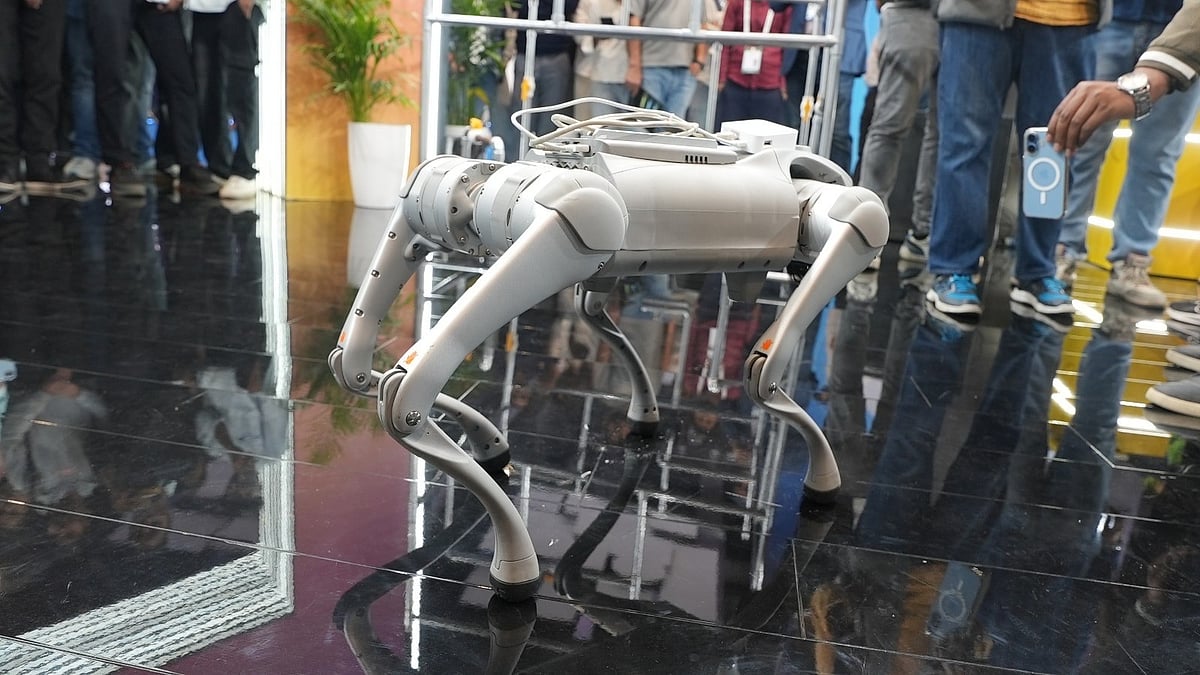
Among the many robots on display across the expo, one has emerged as a firm delegate favourite. Scout, showcased at the EY booth in Hall 1, is not designed to entertain - it's designed to work. The robot demonstrates how digital twins, advanced edge intelligence, and physical AI can be combined to create a fully autonomous inspection system for complex industrial environments like oil refineries, power plants, and manufacturing facilities. Where human inspectors might take days and face safety risks, Scout can navigate hazardous environments independently, detect anomalies, and predict maintenance needs before something breaks. EY's demo at the summit has drawn consistently large crowds, with delegates lining up to see the robot in action.
5. The AI-Designed Saree: How TCS Is Saving India's Handloom Industry (India Innovation & Culture Pavilion)
India's handloom industry supports millions of families, but it has long been held back by a painfully slow design process. Finalising a pattern can take weeks, a single manual error can mean massive rework, and up to 40 per cent of products are returned due to design mismatches. TCS's Intelligent Design Platform is built to fix all of that. The system understands voice commands, sketches, or images and instantly generates loom-ready designs, complete with 3D and Augmented Reality previews so a customer can see exactly how the fabric will drape before a single thread is woven. A complementary tool, Smart Weaver Assist, projects LED guidance directly onto the loom, helping even less experienced artisans follow intricate patterns with precision. The practical impact is significant: a customer can walk in, ask for a fusion of a contemporary geometric pattern with a traditional Kanchipuram border, and walk out minutes later with a design approved and queued for the loom - no weeks of back-and-forth, no costly errors.
6. Wipro Health AI: An AI-Powered Robotic Diagnosis Solution (Healthcare & Life Sciences Pavilion)
In rural India, the absence of specialist doctors is not a policy statistic - it is a daily reality that costs lives. Wipro Health AI is attempting to bridge that gap in real time. As a technician performs a scan in a small-town clinic, the AI analyses the incoming data simultaneously, identifying potential diseases, flagging possible causes, and suggesting treatment pathways - essentially acting as a highly informed second opinion before the data ever reaches a doctor. The system is designed to support, not replace, medical professionals: a specialist in a city hospital can review AI-annotated scan data remotely, enabling faster and more accurate diagnoses than either the technician or the AI could achieve alone. In a country where millions live hours from the nearest specialist, the difference between a good AI-assisted diagnosis and a delayed one can be a matter of survival.
7. Extramarks Extra Intelligence: Keeping Exams Honest Without Punishing Students (Education Technology Pavilion(
Academic dishonesty in large classrooms and online exams is a problem that has only grown harder to manage with scale. Extramarks' Extra Intelligence system takes a measured approach to solving it. Rather than automating punishment, the AI monitors patterns - flagging, for instance, when multiple students submit nearly identical long-form answers within seconds of each other, or when suspicious screen-switching behaviour occurs during an online test. Critically, the system does not disqualify anyone. It simply alerts the teacher, leaving the final judgement to a human. The result is a fairer classroom: honest students are protected from the disadvantage of unchecked cheating, while no student is penalised by an algorithm alone.
8. GenAI Virtual Try-On Kiosk: The End of the Changing Room Queue (Retail & Consumer Tech Pavilion)
Anyone who has navigated a crowded trial room during a sale knows the particular misery of carrying six outfits into a cramped cubicle. The GenAI Virtual Try-On Kiosk makes that ritual optional. The kiosk securely captures your image, lets you browse and select outfits digitally, and instantly renders a realistic preview of how each garment will look on your body. Styles can be customised on-screen, and your final shortlisted looks can be downloaded via QR code to revisit or share later. The technology is already well-established in premium retail internationally, but its presence at the AI Summit signals a push to bring it into mainstream Indian retail - a market where the shopping experience has historically lagged behind the country's appetite for fashion.
The India AI Impact Summit 2026 Expo at Bharat Mandapam, New Delhi, is open to visitors until February 21. It will remain closed on Thursday due to the atendance of global tech leaders and PM Narendra Modi.

