Union Minister Nitin Gadkari has moved the Bombay High Court against Meta, X, Google and YouTube over deepfake videos and posts that falsely claim he and his family have personally profited from India's E20 ethanol blending programme. The court has granted him leave to file the civil suit, but the more revealing story is why the minister has been pushed to court in the first place, and what is fuelling the anger behind the E20 backlash he is now fighting on two fronts.
What is Gadkari alleging exactly?
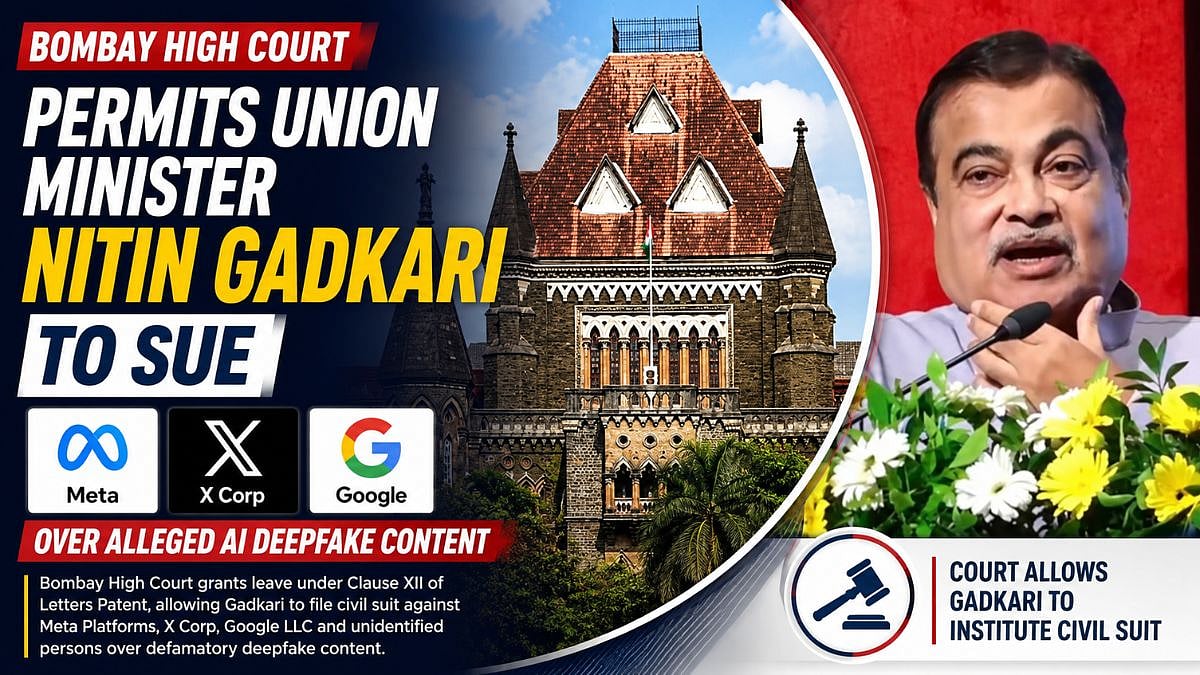
According to Gadkari's petition, unidentified persons have circulated AI-generated deepfake videos and social media posts portraying him as personally responsible for the E20 programme, with some content further alleging that he and his family have financially benefited from it. The suit, filed under clause XII of the Letters Patent, names Meta, X Corp, Google, YouTube and unidentified 'John Doe'' entities as defendants, and also lists the Ministry of Electronics and Information Technology and the Department of Telecommunications. Justice Abhay Ahuja granted leave to file the suit after hearing submissions from Gadkari's counsel, Advocate Sandeep S. Ladda.
Central to Gadkari's argument is a jurisdictional correction - the plea states that the E20 ethanol blending programme is administered by the Ministry of Petroleum and Natural Gas, not the Ministry of Road Transport and Highways, which he heads. The petition calls the claims linking him and his family to E20 profits 'false, malicious and grossly defamatory,' and argues they are designed to create a misleading impression that he has misused public office for private gain.
The E20 programme Gadkari is being blamed for
The E20 programme blends 20 percent ethanol with petrol and was rolled out nationally from April 2023, part of a policy that has been in motion since 2013-14, when ethanol blending stood at under 1.5 percent. The Ministry of Petroleum and Natural Gas told the Lok Sabha in a written reply that the programme has saved more than Rs. 1.97 lakh crore in foreign exchange, substituted nearly 316 lakh metric tonnes of crude oil, and transferred over Rs. 1.66 lakh crore to farmers since ESY 2014-15. The 20 percent blending target itself was met in 2025-26, five years ahead of the original 2030 deadline.

On vehicle safety, the government's position, repeated most recently by Minister of State Suresh Gopi, is that more than 20 crore two-wheelers and over three crore petrol cars have run on E19-E20 blends without verified evidence of widespread engine failure, and that manufacturers continue to honour warranties on E20-run vehicles.
Why the backlash has grown despite the government's numbers
The gap between the government's data and public sentiment is where this story actually lives. Complaints about reduced mileage, engine wear and compatibility issues in vehicles built before 2023 have been circulating among motorists for months, and last week they crystallised into an organised digital movement calling itself the E20 Janta Party, which emerged within days of the Cockroach Janta Party's NEET protests winding down. The campaign has demanded that pump operators offer ethanol-free petrol alongside E20, and has explicitly called for Gadkari's resignation, despite the ministry pointing out that road transport has no administrative control over the fuel-blending policy.
That online pressure is now feeding into street action. A citizens' initiative called Team Bharat has announced a 'Gaadi March' in Delhi on July 31, routed past Gadkari's and Petroleum Minister Hardeep Singh Puri's residences before ending at Parliament Street, while transporters' associations have separately planned a march to Parliament on August 4. Their core demands include restoring the option to buy E10 or ethanol-free petrol, more transparent fuel labelling, and an independent technical assessment of E20's impact on older engines.
Where does the deepfake complaint fit in?
The Bombay High Court suit is not Gadkari's first legal move on this. It follows a criminal complaint filed roughly two weeks earlier by the BJP's social media unit in Nagpur, naming several influencers accused of running what the party described as an organised digital campaign around the ethanol issue. Taken together, the criminal complaint and the civil suit suggest the BJP views at least part of the online backlash as coordinated rather than purely organic public frustration, a framing that puts the party at odds with the E20 Janta Party's insistence that it is an independent, apolitical consumer movement.

