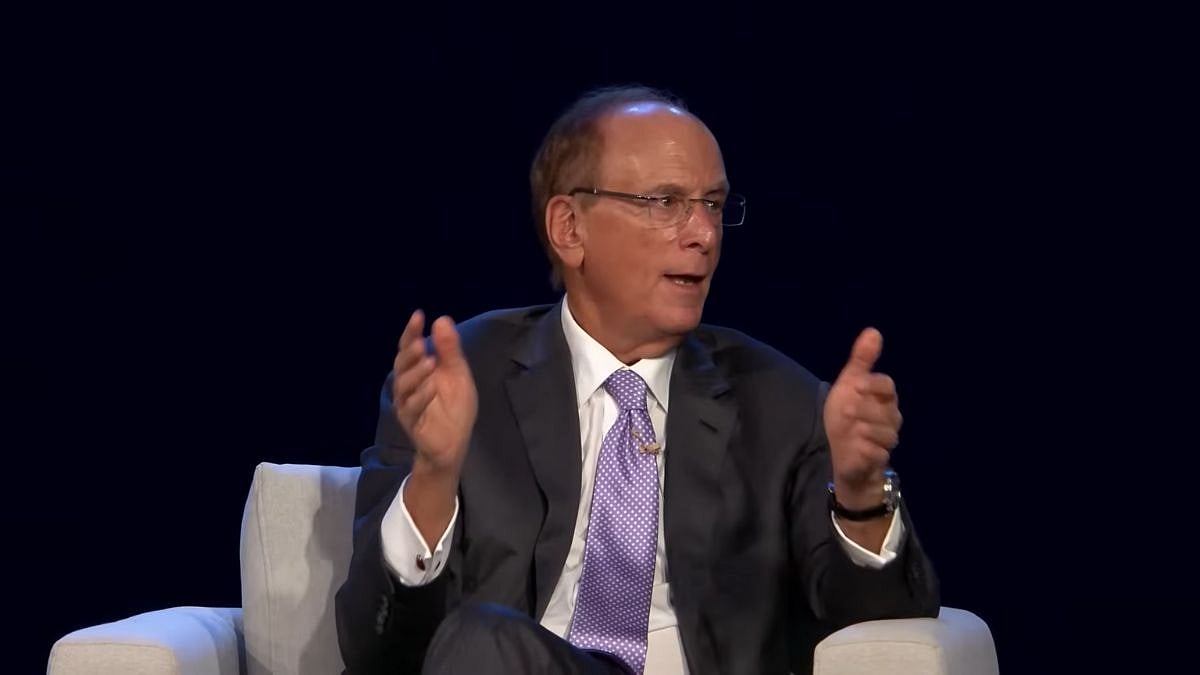
In a striking endorsement of India's digital revolution, BlackRock CEO Larry Fink has lauded the Modi government's digitisation of the rupee, warning that even the United States is lagging behind India's rapid technological transformation.
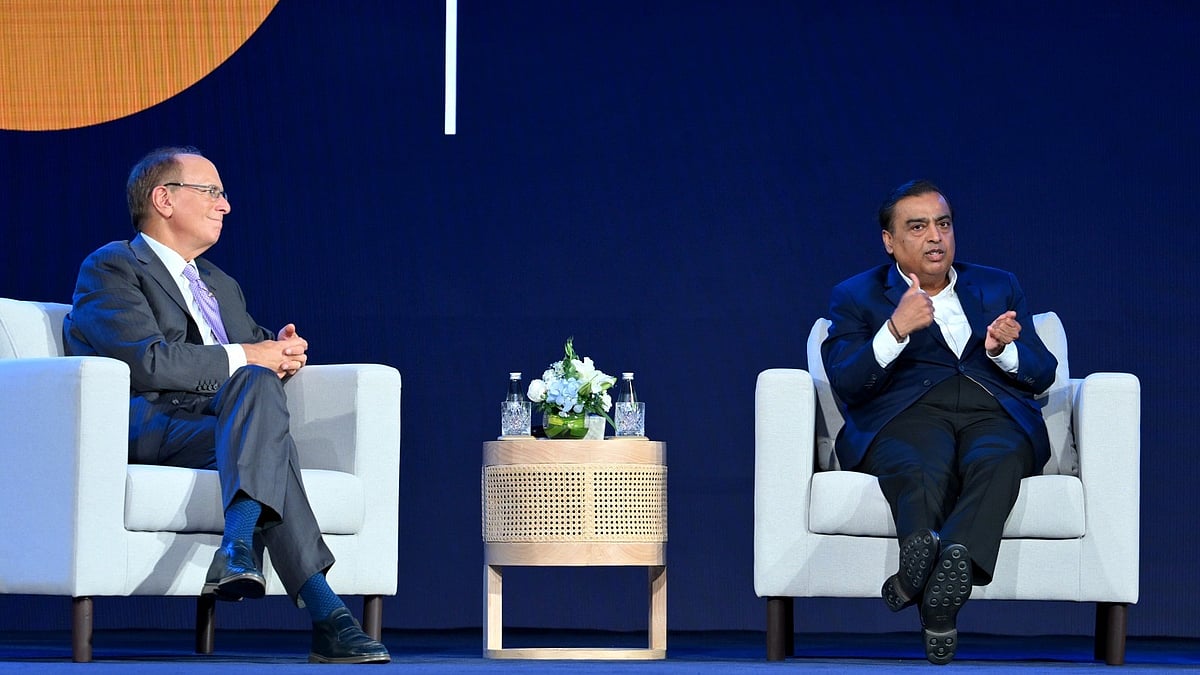
Speaking at JioBlackRock's 'Investing for a New Era' event in Mumbai on Tuesday, Fink singled out India's digital payment infrastructure as a game-changer that has fundamentally transformed commerce across the nation.
Fink's remarks come as India continues to lead globally in digital payments adoption, with UPI transactions crossing record volumes and the country emerging as a laboratory for fintech innovation.
"When you think about how the Modi administration digitized the rupee and how it transformed commerce in India across the board, I am very worried about other countries. Even the United States is falling behind. We need to be digitized. We need to be thinking about how this all plays out. I think this is part of the democratisation of India," Fink said.
Smartphone era as pivotal point
The BlackRock chief identified 2012 and the advent of the smartphone as a pivotal moment in India's transformation. "Think about your life before the smartphone here in India, but the beginning of the smartphone, the rollout of 5G and how that transformed India in so many ways," he remarked.
Fink said the "dispersion of that technology in India is really what is so inspiring, and the utilisation of the new technology for more and more people and how that transforms commerce, consumption, information, education, all of that is ripe for real solid growth."
He declared the next 20-25 years as "the era of India", projecting growth rates of 8-12 percent over the next decade.
Ambani highlights execution record
Reliance Industries Chairman Mukesh Ambani, who shared the stage with Fink, highlighted India's execution capabilities over the past 15 years, attributing the success to stable economic leadership.
"Stable economic leadership defines a country. And I think that we have to be thankful to Prime Minister Modi for giving us this stability. By 2029, it will be 15 years," Ambani said.
He noted that India has built infrastructure at an unprecedented pace. "We made more roads in the last 15 years…multiple times than any other country, including the United States at its peak. We are now the leading renewable power producer in the world," the Reliance chairman stated.
On digital infrastructure, Ambani added, "We have built digital capacities, including 5G. That is better than most people in the world and cheaper than most people in the world in terms of pricing power. And now every Indian village has got 5G."
India's technology adoption edge
Fink praised India's openness to technological change, contrasting it with developed economies. "India is more accepting of technologies than many of the developed countries. India is more accepting about change than most developed economies," he observed.
He called the digitisation of the rupee "a wonder to watch", adding that this willingness to embrace technology positions India advantageously for the AI revolution.
"Because of the large scale population AI is going to have, it is going to create jobs and disrupt jobs. But for those economies that are willing to accept change and rapidly deploy that change in a positive way. And I think about India, the way it rapidly transformed its economy with the digitization of the rupee," Fink said.
AI as next frontier
Ambani said India must embrace AI to solve problems in education, healthcare, and security at costs far below global norms. "We see young Indians as a common subset of old Indians. Right? India just adapts to technology faster than everybody. We've seen it first hand over the last five years," he noted.
The Reliance chairman urged India to leverage its technological advantage: "We should use that to our competitive advantage. Embrace this, get the productivity advantage, get the earnings advantage, build a better society in terms of and use tomorrow's technology before anybody else so that we catch up from our $4,000 or a few thousand dollars per capita to double digit per capita."
