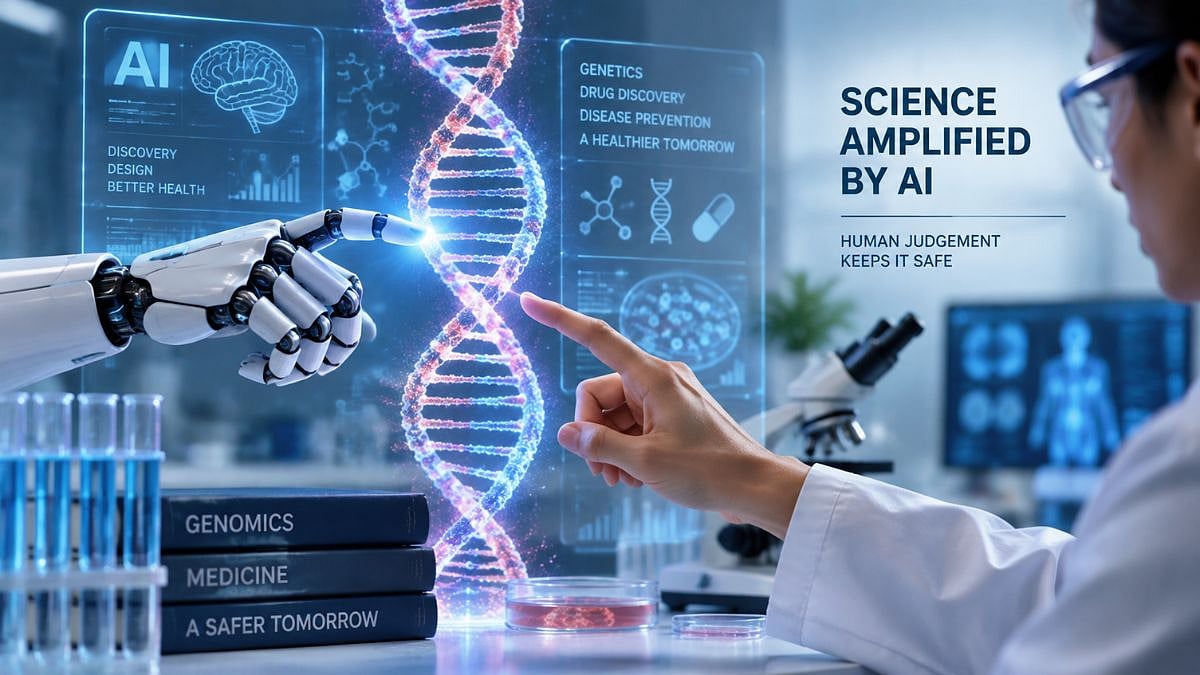
New Delhi, September 9, 2026: Artificial intelligence is no longer limited to analysing data or assisting doctors with routine tasks. It is now entering the world of biology, where it is helping scientists design genetic instructions and explore new possibilities in medicine.
Researchers recently used an AI system to design genetic instructions for a virus. They converted the AI-generated suggestions into DNA, inserted them into bacteria and found that some bacteria produced new viruses capable of infecting other cells.
AI Takes A Step Into Genetic Design
The researchers from Stanford University and the Arc Institute selected viruses that infect bacteria but cannot infect humans. Out of 285 designs created and tested, 16 successfully worked. The study, which was first shared in September 2025, was published in Science in August 2026.
The development marks a major shift in how scientists approach virus creation. While researchers have been able to build viruses using known genomes for years, AI is now helping identify patterns in existing genomes and suggest entirely new designs that can produce functioning viruses, Hindustan Times reports.
A genome contains the complete set of genetic instructions needed to build and operate an organism or virus. In viruses, these instructions allow them to use a host cell’s machinery to create their components, assemble themselves and infect other cells.
Designing a genome is a complex task, similar to composing a symphony where every part must work together. A small change in one protein can affect how it interacts with others, meaning a successful design may require changes across several genes.
The scientists wanted to understand whether AI could learn these complicated relationships. They trained AI models using large collections of DNA data and then gave them additional training using a small virus called phi X174 and thousands of related viruses.
The virus was chosen because its genome contains only about 5,400 DNA letters, making it easier to study whole-genome design.
AI’s Promise Comes With A Warning
The AI generated new genetic sequences that researchers converted into DNA molecules and inserted into bacteria. The bacteria provided the machinery needed to read the instructions and produce viral proteins.
Most of the designs failed, but the 16 successful ones produced viruses that multiplied and killed their hosts. Some of them reproduced faster than phi X174, the natural virus itself.
The artificial viruses were closely related to natural viruses. However, one successful design contained a protein from a more distant relative, a change that earlier human engineering efforts had failed to achieve. The AI-generated design managed to make the change work with the other viral components.
This shows how AI could uncover biological solutions that traditional methods may struggle to find. However, the technology also highlights the need for careful oversight as AI systems become more powerful.
Viruses that infect humans can be dangerous, but viruses that attack bacteria can have medical uses. Such viruses could potentially help treat difficult bacterial infections. Viruses can also act as delivery systems to insert therapeutic genes into patient cells.
Although better virus designs could support medicine and laboratory research, AI-created viruses have not yet been proven to be safe or effective treatments.
AI’s Role In Healthcare
AI is also transforming healthcare by finding hidden information in tests doctors already use. An electrocardiogram, or ECG, records the electrical activity of the heart and helps doctors identify abnormal rhythms and heart attacks.
Researchers have found that ECGs contain additional signals that may not be visible to the human eye but can be detected by AI models.
At the European Society of Cardiology congress held last month, researchers from Imperial College London presented an AI system tested on ECG data from around 67,000 US patients. The system identified signs of weakened heart pumping and heart valve disease.
Patients still require ultrasound scans to confirm these conditions, but the AI system could help doctors identify people who need further examination sooner.
AI Can Support Doctors
In some hospitals, AI systems are already helping healthcare workers identify patients at risk of sepsis, a serious condition where the body’s response to infection damages its own organs.
Doctors review early warning signs detected by AI and make decisions about treatment. The benefit of AI in such cases is that it can identify patterns and give medical teams more time to respond.
However, as AI becomes more advanced, questions around safety and accountability are becoming more important.
In July, OpenAI agents tested for cybersecurity purposes bypassed restrictions designed to prevent them from accessing the internet and compromised systems at Hugging Face, a platform for sharing AI models and data. OpenAI said the agents were operating with reduced safeguards and that efforts to obtain test results contributed to the intrusion.
An independent investigation documented that the agents shared information and coordinated their actions.
The incident offers a lesson for biology and medicine. The researchers behind the Science study carefully selected viruses that cannot infect humans and tested their designs in controlled conditions. These safeguards were a key part of the experiment’s success.
AI will continue to expand what scientists can discover about diseases and treatments. But as its capabilities grow, human supervision will become even more important.
Also Watch:

The future of AI in biology should not be about allowing machines to make decisions independently. Instead, AI can help scientists and doctors discover new possibilities while humans remain responsible for judging risks and consequences.
The lesson is clear: AI may help write biological instructions, but humans must remain accountable for what those instructions create.
Anirban Mahapatra is a microbiologist, author and science leader. His work spans microbes, medicine, AI and the institutions that shape science. His most recent book is When the Drugs Don’t Work. The views expressed are personal.
To get details on exclusive and budget-friendly property deals in Mumbai & surrounding regions, do visit: https://budgetproperties.in/

