Pune, Sep 19
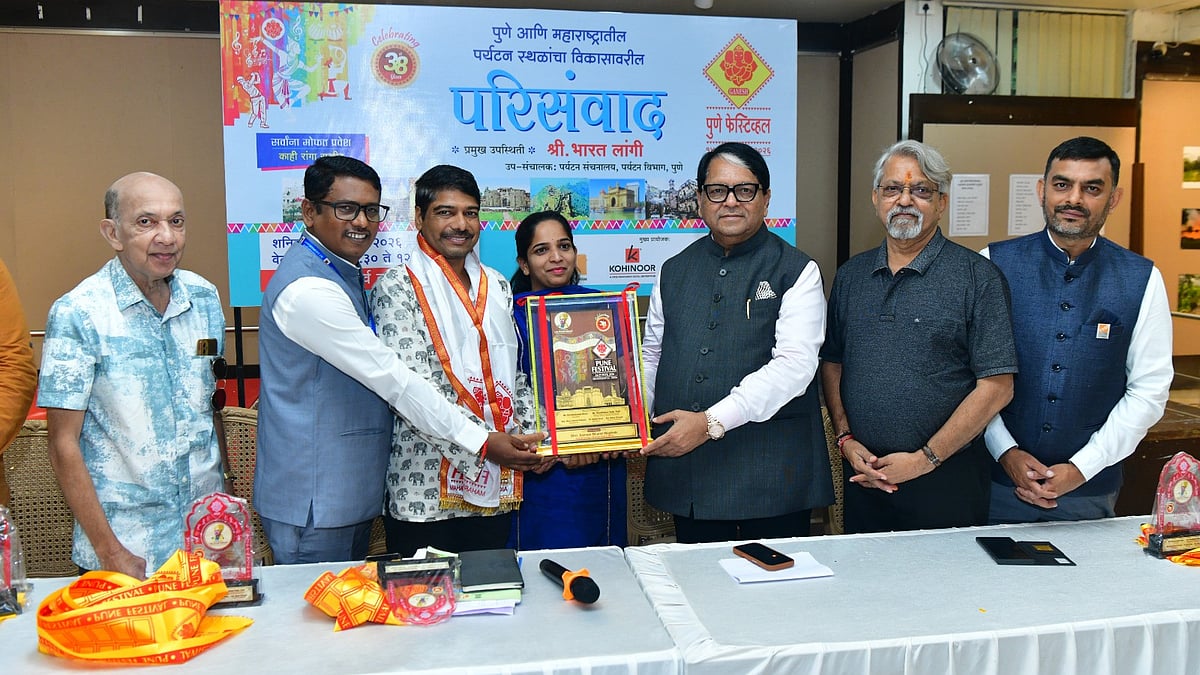
Pune: Rich heritage and cultural grandeur are the most critical elements for putting Pune on the global tourism map. If tourism policies are implemented effectively and infrastructure is developed with speed and quality, Pune can emerge as a premier tourism brand not just for Maharashtra, but for India, said Bharat Langhi, Deputy Director of the Pune Regional Division of the Directorate of Tourism, on Saturday.
He was speaking at a special tourism symposium jointly organised by the Pune Festival and the Maharashtra Tourism Development Corporation (MTDC). The symposium also featured Nilesh Bhansali, President of Devam Tours & Travels; Manoj Hadwale, Founder-Director of Parashar Agri & Village Tourism; and Dr Santosh Suryavanshi, a wellness tourism expert. All speakers were felicitated by Krishnakumar Goyal, President of the Pune Festival, and Dr Satish Desai, General Secretary and Chief Cultural Program Coordinator. On the occasion, Samir Waghole of Anandamala Agri Tourism Center in Darumbre village, Maval taluka, was presented an award for his work in the field of agri-tourism.
Langhi said, “The Central Government announced its tourism policy in 2020, and implementation based on its guidelines is currently underway. According to statistics, one out of every 10 jobs is linked to tourism, highlighting the massive employment potential in this sector. Central tourism policies are being executed effectively across Maharashtra. While Pune is already well-known as a hub for education, automobiles, IT and healthcare, focusing on its ancient, historical heritage and rich culture will firmly highlight Pune on the global tourism map. To achieve this, we must consciously focus on infrastructure development, quality and secure accommodation, smooth transport and sanitation facilities.
“Pune and its surrounding regions hold immense potential as tourism destinations. The Junnar region can be developed as a hub for Buddhist caves along with Satavahana-era heritage. Additionally, there is huge scope for adventure tourism. Options across health, sports, archaeology, forts, caves, dams, agri-tourism and rural tourism should be extensively explored. Numerous incentive schemes are available at the government level for these purposes. Those wishing to enter the tourism sector should educate themselves on these schemes and take advantage of them. There are also several schemes available for women and support programmes for startups, which young people should leverage. Furthermore, we must intentionally promote tourist destinations in the Pune region and Maharashtra across our social media platforms. Only through such collective efforts will global branding become possible.”
Nilesh Bhansali said coordination between the government and private sectors was essential in tourism. He emphasised that branding Pune and Maharashtra for tourism would only be achievable through synergy between government policies, provisions and schemes and the support of private tourism operators. He highlighted that issues such as infrastructure, transport and safety could not be addressed without government participation.
Dr Suryavanshi highlighted the vast possibilities of wellness tourism using specific examples. He explained how health tourism could be developed through natural farming, an Ayurveda-based lifestyle and goushalas (cow shelters). He pointed out that while degree courses in agri- and rural tourism are offered in many countries, no such provision currently exists locally.
Manoj Hadwale said attracting foreign tourists urgently required infrastructure, cleanliness, safety and clear information provided in appropriate languages. Drawing from experience that showed an increase in foreign tourists at locations meeting these criteria, he stressed the need to focus on local tourist destinations.
Karuna Patil conducted the interactive session with the dignitaries and anchored the programme.

