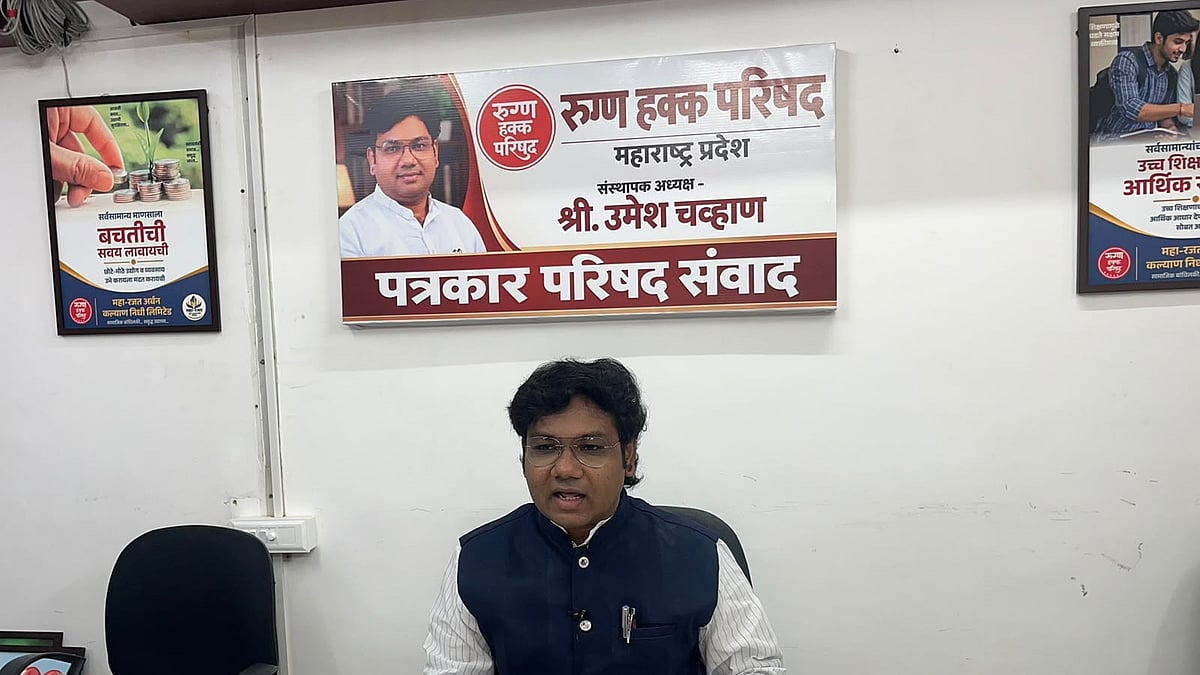
Pune: The Patients’ Rights Council on Saturday demanded urgent reforms to make hospital treatment more transparent and financially accessible, alleging that patients and their families are often pushed into severe financial distress due to rising treatment costs, unclear billing and high prices of medicines and medical consumables.
Addressing a press conference in Pune, Patients’ Rights Council Maharashtra Pradesh founder-president Umesh Chavan said the government must take concrete steps to protect patients’ financial rights and warned of a statewide agitation if its demands were not addressed within 90 days.
Chavan said, “A patient is already vulnerable because of illness. Their financial helplessness should not become a licence for an opaque system of recovery. We are not demanding that treatment should be free, but every patient should get a transparent bill, fair charges and justice against arbitrary recovery.”
The council has demanded a separate Drug Safety Act covering essential and life-saving medicines, with effective monitoring of their prices. It has also called for regular and mandatory audits of hospital bills in government hospitals, particularly in general wards, ICUs, special rooms and other departments.
The organisation has also demanded that hospitals provide patients with itemised bills specifying charges for medicines, diagnostic tests, procedures, bed or room charges, doctors’ fees and other services. It has also sought a mechanism to refund patients where additional charges are found to have been levied without justification or in violation of rules.

Chavan further demanded regular social audits of charitable hospitals to verify whether economically weaker patients are receiving free or subsidised treatment as mandated. The council has also proposed a real-time dashboard displaying information on free and subsidised beds and a Hospital Transparency Portal containing details of hospital charges, facilities and complaint redressal officers.
The council also demanded greater transparency in the pricing of medical devices and consumables and sought measures to rationalise the gap between procurement prices and printed MRPs.
Chavan said, “The government must take immediate action to stop the financial exploitation of patients and ensure justice for them. If concrete decisions are not taken on these demands, we will launch a statewide agitation through public awareness campaigns, representations and democratic means.”
Chavan raises issue after Mundhe flags wide price gaps in hospital consumables
The council’s demands come amid concerns raised by Maharashtra FDA Commissioner Tukaram Mundhe over the gap between procurement prices and printed MRPs of hospital consumables. A Maharashtra FDA survey found an IV infusion set with a trade price of Rs11.05 carrying an MRP of Rs325, while a syringe bought for Rs6.75 had an MRP of Rs57.20. A catheter costing Rs29.41 was found to have an MRP of Rs310.
Mundhe has said patients undergoing treatment generally have little opportunity to compare prices or negotiate the cost of such consumables. According to reports, the Maharashtra FDA has consequently submitted recommendations to the Centre’s National Pharmaceutical Pricing Authority (NPPA) regarding greater price regulation and transparency for frequently used hospital consumables.

