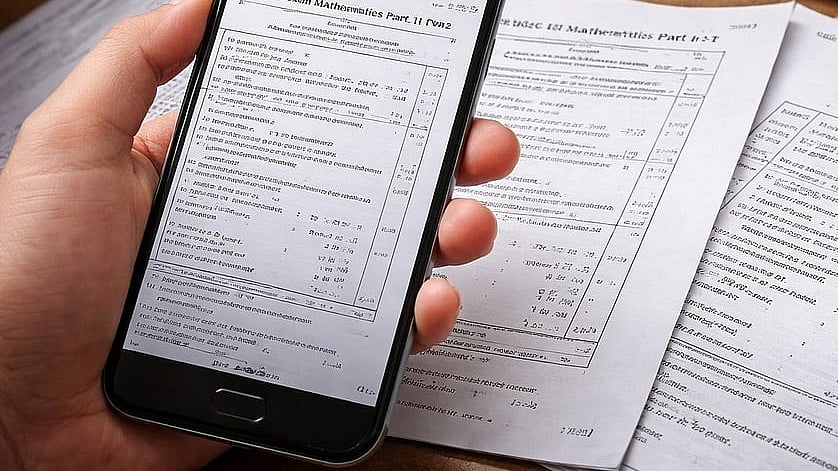
Pune: A major breach in examination confidentiality has come to light after question papers of the Periodic Assessment Test (PAT-3), conducted for school students, were allegedly circulated on social media even before the exams. The incident has led to a case being registered against six YouTube channels at Vishrambaug Police Station.
The complaint was filed by Dr Manisha Tathe from the State Council of Educational Research and Training (SCERT). Based on her complaint, police have booked the operators of six YouTube channels: Learn With Me, GK Tracer Official, NP Returnthings, Academic Education, Priyagharat RZP School, and Kailas Sir Maths.
The PAT-3 examination is conducted annually to assess the academic performance of students from Classes 2 to 8 in subjects such as Marathi, English, and Mathematics. Around 3 million students from government and aided schools across the state appear for this assessment.

As per the official schedule, the Marathi paper was conducted on April 11, Mathematics on April 15, and English on April 22. However, it was found that question papers of all three subjects had already been uploaded and circulated on YouTube before the respective exams.
The question papers are printed at a private press in Pune and distributed across districts under strict confidentiality. Despite these measures, the leak has raised serious concerns about the security and integrity of the examination process.
Following the discovery, an FIR has been registered under Sections 5 and 6 of the Maharashtra Prevention of Malpractices in University, Board and Other Examinations Act, 1982, along with relevant provisions of the Information Technology Act.
Police Inspector Arun Ghodke said an investigation is underway to determine how the question papers were leaked and circulated online. Further inquiry is in progress.
Although two of the exams had already been conducted before the leak came to light, the English paper was held on April 22 as scheduled. Authorities stated that the examination process was not disrupted. However, concerns remain that students who accessed the leaked papers may have gained an unfair advantage, making it difficult to accurately assess their true academic performance.

