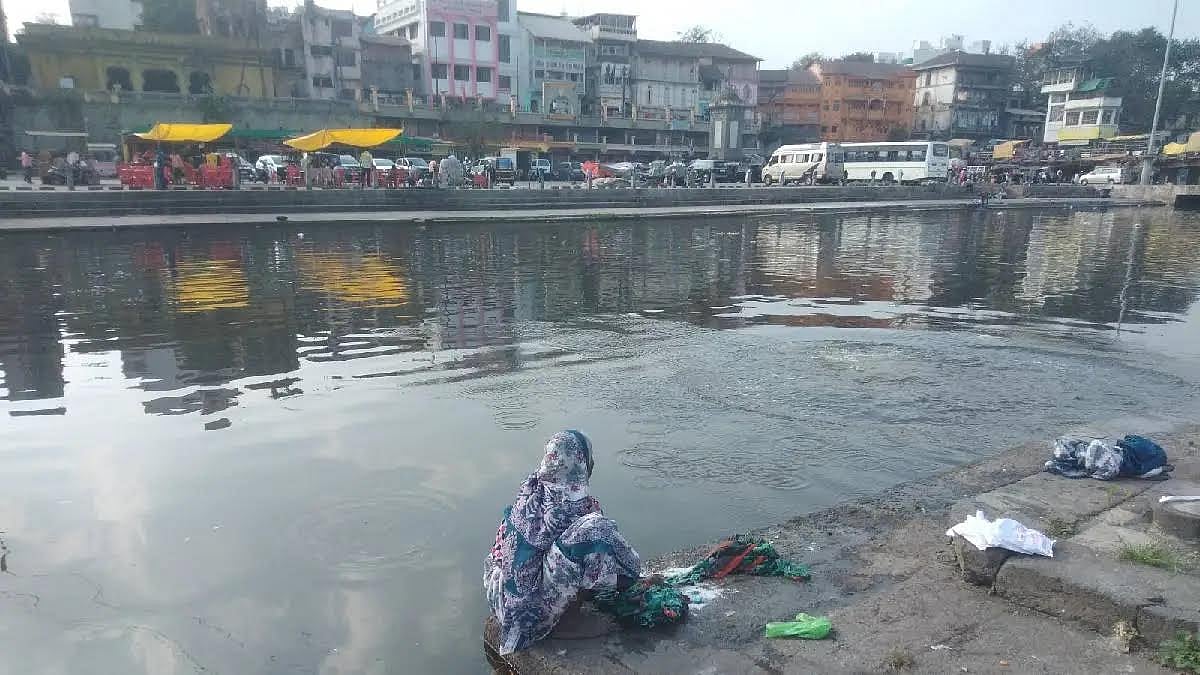
Nashik: The issue of pollution in the Godavari River, the lifeline of Nashik, has taken a significant legal turn ahead of the forthcoming Simhastha Kumbh Mela. The Maharashtra government has submitted to the Bombay High Court (HC) the names of more than 150 officials associated with various departments responsible for preventing river pollution and implementing earlier judicial directives. The list reportedly includes officials from the Nashik Municipal Corporation (NMC), Maharashtra Pollution Control Board (MPCB) and Maharashtra Industrial Development Corporation (MIDC). According to some reports, the affidavit filed by the Chief Secretary mentions as many as 199 officials, bringing administrative accountability into sharp focus.
Officials from three major agencies under scrutiny
The affidavit reportedly identifies officials who held key positions in the departments concerned during different periods. The list includes Municipal Commissioners, Additional Commissioners and Deputy Commissioners associated with the NMC’s Godavari conservation department since 2012. It also covers Joint Directors, Regional Officers, Sub-Regional Officers and field-level officials of the MPCB who served since 2009. The list also includes officials from MIDC’s regional and sub-regional offices.
The exercise aims to identify the administrative responsibility of officials who served during the relevant periods and examine whether the agencies took adequate steps to prevent untreated sewage and industrial effluents from entering the river. However, the inclusion of an official’s name on the list does not, by itself, establish guilt or imply that the authorities have initiated disciplinary action against that individual.
Pollution continues despite repeated court directives
The Bombay High Court issued several directions in 2013, 2017 and 2018 regarding the pollution of the Godavari. However, concerns persist over the inadequate implementation of these directives and the failure of the agencies concerned to bring pollution under control.
During the hearing on Nov 5, 2026, a division bench comprising Justice AS Gadkari and Justice Kamal Khata expressed dissatisfaction with the government’s response. The court stressed the need for concrete action rather than assurances on paper. It asked the state government to submit details of the action plan, its implementation status and the names and designations of officials responsible for the situation.
Water quality reports raise serious concerns
Water quality tests conducted by the MPCB also reflect the seriousness of the pollution problem. On Oct 5, 2026, the board collected water samples from several locations, including the Godavari-Kapila confluence, Tapovan, the Agra Road area, Nandur-Dasak and Samtanagar-Takli.
According to the report published on Oct 19, dissolved oxygen levels were zero in samples collected from three locations. This is a serious concern for the river ecosystem and aquatic life. Such water quality conditions also raise questions about the safety of using river water for bathing, religious rituals and other human activities.
Treatment projects face implementation challenges
The issue of chemical effluents from the Ambad and Satpur industrial estates remains a major concern in efforts to clean the Godavari. Work is underway on a common effluent treatment plant (CETP) to treat industrial wastewater from these areas. According to the government’s submission, the target date for completing the project is Nov 30, 2026, followed by a three-month trial period. The government expects commissioning by the end of February 2027.
A separate sewage treatment project estimated to cost around ₹250 crore has also been proposed for the Ambad-Satpur area. The proposed cost-sharing arrangement requires MIDC to contribute two-thirds of the expenditure and the municipal corporation to bear the remaining one-third. However, MIDC’s reported refusal to provide funds has created uncertainty over the project’s implementation. The project is expected to take at least three years to complete.
Demand for restrictions on bathing and ritual use
The petitioners have also raised concerns over the potential health risks posed by polluted river water. They have sought restrictions on bathing and the use of river water for ritual purposes, including achaman, at Nandini-Godavari Sangam Ghat, Dasak Ghat and Odha Ghat.
Kumbh Mela preparations put administrative accountability to test
With Nashik and Trimbakeshwar expected to witness the arrival of millions of devotees during the Simhastha Kumbh Mela, the continued pollution of the Godavari has emerged as a major environmental and public health concern. The issue is no longer limited to river conservation; it is directly linked to the safety and well-being of pilgrims who will visit the city for religious rituals and holy bathing.
The submission of the names of more than 150 officials has once again raised questions about administrative accountability. Merely identifying officials will not resolve the crisis. Strict action against polluting establishments, timely completion of sewage treatment projects and measurable improvements in river water quality are essential.
The next hearing in the matter is scheduled for Dec 11, 2026. Nashik residents will closely watch the High Court’s observations on the government’s affidavit, MIDC’s reported reluctance to fund the proposed project and the petitioners’ demands as preparations for the Kumbh Mela gather momentum.

