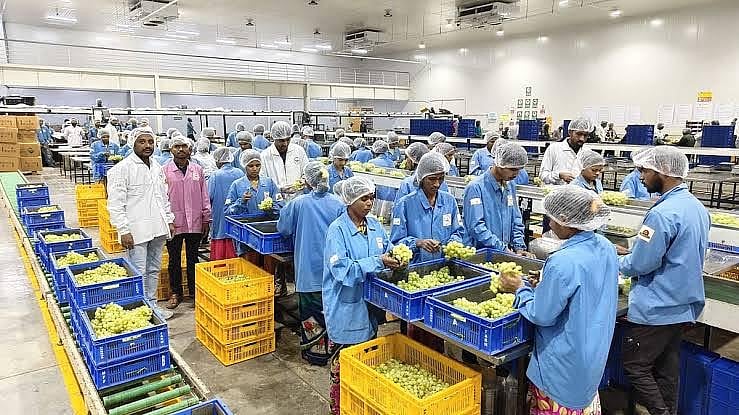
Nashik: Nashik district, known for its grapes, onions, pomegranates and wine, continued to strengthen its position in the international export market in 2026. Agricultural products, particularly fresh grapes, remain the backbone of the district’s export economy, while improvements in packaging, cold-chain infrastructure and air cargo facilities are creating new opportunities for exporters.
Grapes remain biggest export driver
Grapes continue to be Nashik’s most important export commodity. According to APEDA, India exported 224,401.27 metric tonnes of fresh grapes worth $367.99 million during 2025-26. The Netherlands, Russia, the UK, the UAE and Bangladesh were among the major export destinations.
Nashik’s vineyards in areas such as Niphad, Dindori, Sinnar, Yeola and surrounding regions play a major role in this export chain. Export-oriented grape production requires strict compliance with international residue standards, traceability, quality testing and modern pack-house facilities.

Export infrastructure expands
Several APEDA-recognised pack-houses are operational in Nashik district, particularly around Niphad, Dindori, Pimpalgaon, Vani and Sinnar. These facilities handle grapes, pomegranates, vegetables and other fruits for international markets.
The expansion of such facilities is helping farmers and exporters improve post-harvest handling, grading, packaging and cold-chain management.
Ozar airport offers major advantage
The HALCON Air & Sea Cargo Complex at Ozar Airport is an important component of Nashik’s export infrastructure. The facility is capable of handling grapes, pomegranates, mangoes and other fruits and vegetables.
Faster air cargo connectivity can be particularly valuable for perishable agricultural products, allowing Nashik exporters to reach overseas markets in a shorter time.
Lasalgaon onion remains globally significant
Nashik’s onion industry is another major component of the district’s agricultural economy. Lasalgaon, one of India’s best-known wholesale onion markets, plays an important role in onion trade.
Onion exports, however, remain sensitive to government policies, domestic prices and international demand. Export restrictions and changes in duties can directly impact farmers, traders and exporters.

Wine adds value to Nashik’s grape economy
Nashik has also established itself as one of India’s leading wine-producing regions. The inclusion of Nashik Valley Wine under the Centre’s Districts as Export Hubs initiative highlights the district’s potential in value-added agricultural products.
Wine production gives grapes an additional value chain, benefiting wineries, packaging companies, transporters, tourism and allied businesses.
Along with grapes and onions, pomegranates, fruits and vegetables are increasingly being prepared for export markets. The availability of recognised pack-houses and post-harvest facilities is helping exporters diversify beyond a single commodity.
Challenges before exporters
Despite the growth potential, Nashik’s exporters continue to face several challenges:
Strict residue and quality standards in European markets
Climate-related production risks
Rising production and logistics costs
Fluctuations in international prices
Air and sea freight costs
Cold-chain requirements
Currency fluctuations
Outlook
The overall export scenario indicates that Nashik is gradually moving from being primarily a production centre to becoming an integrated export hub. Grapes remain the strongest pillar, while onions, pomegranates, wine and processed agricultural products are expanding the district’s export basket.
Better pack-house infrastructure, cold-chain facilities, air cargo connectivity and direct access to overseas markets could further strengthen Nashik’s position in the global agricultural export sector.

