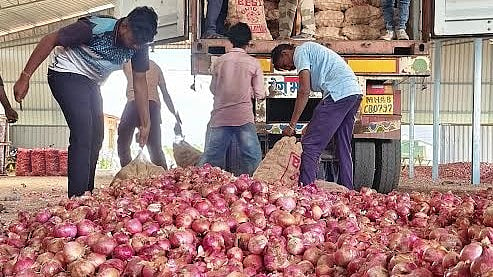
Nashik: Competition in the international onion market is no longer limited to traditional exporting countries. Bangladesh, which was once a major importer of onions, is now exploring export opportunities. The country that purchased large quantities of onions from India is now looking towards overseas markets of its own. In 2023-24, Bangladesh accounted for nearly 40% of India’s onion exports. Now, with Bangladesh preparing to export onions to Sri Lanka, a new competitive challenge could emerge for Indian onions, particularly those from Nashik.
Bangladesh has decided to send a special team to Sri Lanka to assess the feasibility of exporting onions and potatoes to the island nation. The development is significant for onion growers in Maharashtra, including Nashik. Bangladesh’s Commerce Minister Khandker Abdul Muktadir said that a team would be sent to Sri Lanka to examine the potential for onion and potato exports. The issue was discussed during a meeting with Sri Lankan Trade Minister Wasantha Samarasinghe in Hong Kong. Bangladeshi officials said the country has a substantial surplus of onions and potatoes even after meeting domestic demand.
Searching for new export markets
Bangladesh is now looking for new overseas markets such as Sri Lanka for its onion exports. The country plans to examine the possibility of supplying quality produce throughout the year at competitive prices. It will also explore the possibility of establishing warehouses and other infrastructure in Sri Lanka if required. Sri Lanka has also expressed interest in importing onions and potatoes from Bangladesh.

A challenge for Maharashtra’s onion belt?
Indian onions are currently exported to several countries. According to APEDA data, India exported around 1.548 million tonnes of onions in 2025-26, with Sri Lanka, Malaysia, the United Arab Emirates, Nepal and Bangladesh among the major destinations.
If Bangladesh succeeds in taking its onions into the Sri Lankan market, Indian exporters could face increased competition in some overseas markets in the future. This could be particularly significant for onion growers in Nashik, where export demand plays an important role in supporting market prices.
Need for consistency in export policy
For onion growers to receive remunerative prices, domestic demand alone is not sufficient. Maintaining the competitiveness of Indian onions in global markets is equally important. Onion growers and traders therefore emphasise the need for consistency in export policy, reduction in transportation costs, market access based on quality and a long-term export framework as the number of competing onion-exporting countries increases.

What does it mean for India and onion growers?
Bangladesh’s move to explore alternative export markets could increase competition for Indian onion exporters in the future. Bangladesh has traditionally been an important market for onion-growing regions such as Nashik, Lasalgaon and Pimpalgaon Baswant. Its attempt to enter the Sri Lankan market highlights the growing importance of consistent export policies, competitive pricing and diversification of overseas markets for Indian onions.
When onion prices rise in the Lasalgaon market, farmers get much-needed relief. However, sustaining prices depends not only on domestic demand but also on demand in international markets. Against this backdrop, Bangladesh’s growing interest in exporting onions to Sri Lanka could indicate a changing competitive landscape in global onion trade, a development that will be closely watched by the Lasalgaon and Nashik onion belt.

