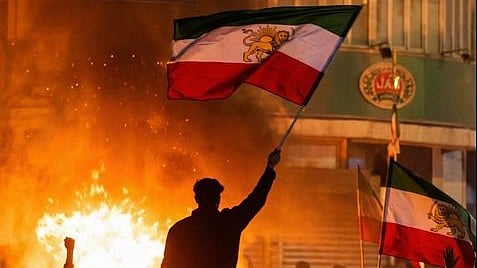
Mumbai: Hundreds of protesters had gathered on the streets of Mumbai over the last two years to protest against the war in Gaza. However, the unrest in Iran, where thousands of people have been reportedly killed during protests against the Islamic regime, has evoked no response in the city.
Media Gaps, Election Focus
Is the indifference because the city was busy with the municipal elections, or is it due to the lack of enough information on the turmoil in Iran? The international mainstream media has been accused of under-reporting the turmoil, either deliberately or due to lack of access to sources of information in Iran, mostly because of the blockade on the internet. Social commentators in Mumbai, however, were of the opinion that it is a combination of the two, along with a skepticism about the people or agencies behind what looks like a leaderless revolt.
Sectarian Divide Factor
The fact that India's Muslims are largely Sunni also could be a factor for the lack of interest in Shia-majority Iran, said a commentator. This may explain why the only notable protest in India—in support of the Iranian government—took place in Kargil, a Shia-dominated district of Ladakh.
Iran Seen as Internal Issue
Maulana Amanullah Raza Shaikh of the All India Ayeema Masjid Council, an association of mosques, said that the unrest in Iran is an internal matter while Gaza was an international crisis. "The people in Gaza were helpless, but the Iranian government is capable of dealing with the riots. We have nothing to do with Iran and the Gaza war has ended," said Shaikh, who declined to elaborate.
Information Access Differences
Unlike Gaza, where the international media had access to information sources, there is no clarity on the happenings in Iran, said Zeenat Shaukat Ali, director general of the Wisdom Foundation, who participated in meetings held in Mumbai to express solidarity with the residents of Gaza.
No Clear Public Mandate
"It is a complex situation and it could be because Iran is a Shia country. However, there is not much information on what the uprising is about: we do not know whether a majority of Iranians want a change or whether Iran is ready for a regime change. The Gaza war went on for two years. The matter is an international issue and has been discussed in the United Nations. There was no gap in information from Gaza. The Iranian unrest is an internal matter. There are no parallels," said Ali, who added that the media has withheld information from Iran on various grounds. "The people of Iran have to take a call about a new regime."

Also Watch:
Suspicion of Foreign Hand
The Mumbai-based Raza Academy, which has led several protests—including one that turned violent—against the Gaza war, said that Muslims in India believed that the United States was behind the protests in Iran. "What was happening in Gaza was injustice. Iran is fighting an internal unrest," said Muhammad Saeed Noori, president of Raza Academy, who added that the crisis in Iran has not been completely ignored. "Our organisation wants to draw attention to the problem. We are yet to decide our plan."
Unrest Linked to Economy
Feroze Mithiborwala of Hum Bharat Ke Log, a left-leaning group that had organised gatherings to express solidarity with Gaza, said that Iran had elected a liberal leader and had rejected an Islamist candidate in the last elections.
"Iran has been conducting a cycle of elections. The first phase of the unrest was sparked by the economic crisis and the crash of the Iranian currency. However, the American and Israeli agencies are behind the current escalation," said Mithiborwala, who expressed views similar to the Iranian regime, which has blamed external agencies for fueling the unrest.
Irfan Engineer, Director of the Centre for the Study of Society and Secularism, has expressed strong solidarity with the Iranian people calling for systemic reforms. Speaking on the current socio-political climate in Iran, Engineer highlighted the historical precedent for change while acknowledging the rigid structures currently in place.
The Role of Reform and the Clergy
Engineer pointed to the presidency of Akbar Hashemi Rafsanjani as evidence that reform is possible within the Iranian system. However, Engineer noted that the democratic process remains heavily restricted.
"Elections in Iran are not a farce, but they are controlled by the clergy," Engineer stated. "The Ayatollah holds veto power. In essence, he is the state."
Despite the desire for change, Engineer clarified that this does not necessarily equate to a desire to return to the past. He noted that those seeking the restoration of the Shah’s monarchy represent only a small minority of the movement.
A significant driver of the current unrest, according to Engineer, is the dire economic situation. While acknowledging the role of international pressure, he placed the burden of improvement on domestic leadership.
Sanctions: Partially responsible for the current economic strain.
Mismanagement: The government is held accountable for failing to navigate these pressures
Wealth Gap: A growing divide where influential traders and the working poor feel alienated by a wealthy minority.
To get details on exclusive and budget-friendly property deals in Mumbai & surrounding regions, do visit: https://budgetproperties.in/

