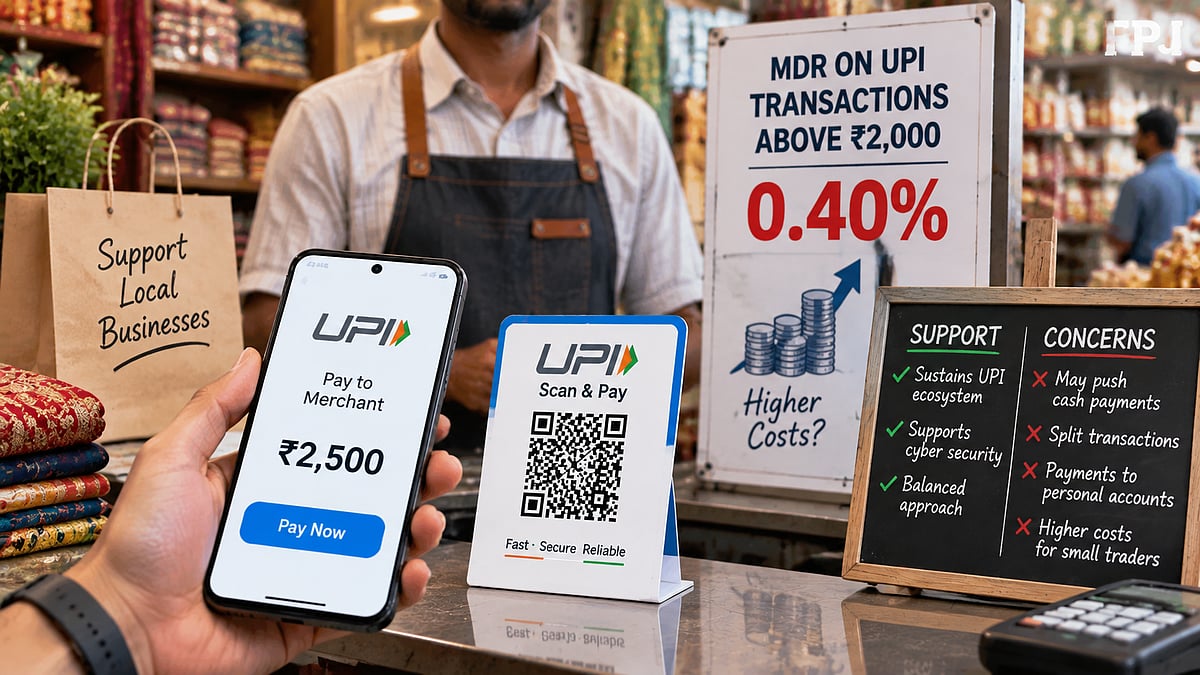
Mumbai: Traders are divided over the National Payments Corporation of India’s (NPCI) decision to levy a 40-basis-point merchant discount rate (MDR) on Unified Payments Interface (UPI) merchant transactions above Rs 2,000, with some industry bodies supporting the move while others warn that it could encourage cash payments, payment splitting, and diversion of business receipts to personal accounts.
CAIT Supports MDR Move, Calls It A Balanced Decision
B C Bhartia of the Confederation of All India Traders (CAIT) supported the new rate, saying the government had taken a balanced view. “I am not justifying the decision, but I think the government has taken a balanced view. On one hand, the government is spending around Rs 20,000 crore on cyber security and to manage UPI transactions,” he said.
The Mumbai-based Federation of Retail Traders Welfare Association (FRTWA), however, has urged Union Finance Minister Nirmala Sitharaman to reconsider the proposed MDR, arguing that transaction charges could eventually become an additional cost for businesses and be passed on to consumers.
FRTWA Warns Of Payment Splitting To Avoid MDR
FRTWA president Viren Shah said the proposed structure could inadvertently encourage merchants and customers to split payments. A Rs 4,000 purchase, for instance, could be divided into two Rs 2,000 transactions to avoid the MDR, he said.
The association also warned that some merchants could encourage customers to make payments directly into a proprietor’s or individual’s personal UPI account rather than the business’s merchant account to avoid transaction charges.
Traders Highlight UPI’s Role In India’s Digital Economy
Shah said UPI had become one of India’s most successful digital initiatives because it was simple, fast, convenient, and transparent. “The common citizen has embraced it because it is simple, fast, convenient, transparent, and, importantly, free for ordinary transactions,” he said.
FRTWA said the proposed charges could make proper accounting and reporting more difficult and create opportunities for under-reporting of business receipts and tax avoidance. It urged the government to consider alternatives to ensure the financial sustainability of the UPI ecosystem without creating incentives to bypass merchant accounts.
Petrol Dealers Demand MDR Exemption For Fuel Retailers
The All India Petroleum Dealers Association (AIPDA) has separately urged the Finance Ministry to completely exempt fuel retailers from MDR on UPI transactions above Rs 2,000.
CAIT, however, maintained that the impact on most retailers would be limited. Bhartia said about 80 per cent of retail transactions were below the Rs 2,000 threshold. He said bulk grocery purchases were often made from proprietary shops where payments were person-to-person and would not attract the charge.
Small Retailers Fear Additional Pressure On Businesses
Local retailers disagreed. Sharad Satardekar, a cloth retailer representing the Matharpacady Vyapari Sangh, said the MDR could put further pressure on small retailers who had already struggled with the shift towards online shopping.
“When an average family shops for festive clothing, the bill will definitely exceed Rs 2,000. I cannot insist on cash because very few people use currency. Even children get their pocket money from parents online,” he said.
Rajiv Daryanani, a retailer in Colaba, said that the move could encourage black money transactions.
Transporters warned that the charges could have a cascading effect on prices of goods. Bal Malkit Singh, adviser and former president of All India Motor Transport Congress, said that while many long-distance vehicles use card payments, others do UPI transactions. "The Gulf war has already affected fuel costs. Cash transactions have totally vanished," said Singh.
Bhartia pointed to the savings from reduced currency printing as a countervailing factor. “The RBI is spending less on printing currency notes because of increased digitised transactions. So that is compensatory,” he said.
To get details on exclusive and budget-friendly property deals in Mumbai & surrounding regions, do visit: https://budgetproperties.in/

