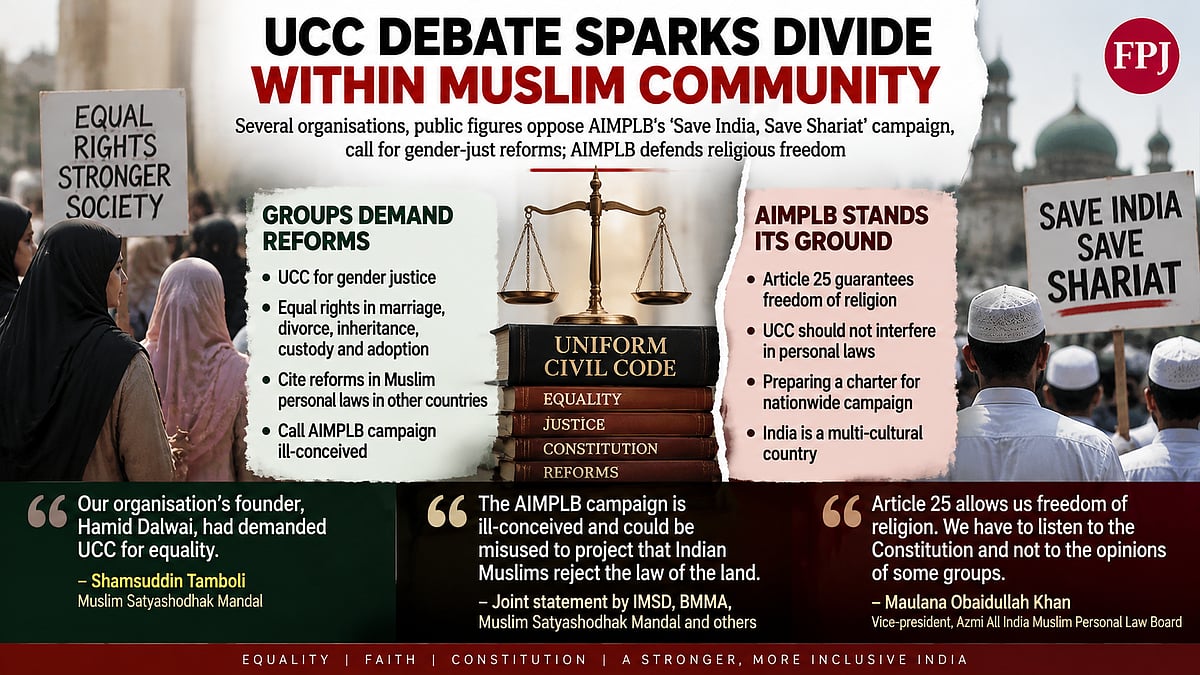
Mumbai: The debate over the proposed Uniform Civil Code (UCC) has created a debate within the Muslim community, with several organisations and public personalities opposing the All India Muslim Personal Law Board’s (AIMPLB) nationwide ‘Save India, Save Shariat’ campaign and calling for gender-just reforms in personal law.
Indian Muslims for Secular Democracy (IMSD), Bharatiya Muslim Mahila Andolan (BMMA) and Muslim Satyashodhak Mandal, along with personalities including Naseeruddin Shah, Zeenat Shaukat Ali, Sultan Shaheen, Teesta Setalvad, Ram Puniyani, Tushar Gandhi, Amol Palekar, Mallika Sarabhai and Ratna Pathak, have signed a statement describing the AIMPLB campaign as ill-conceived.
Groups Question AIMPLB Campaign On Personal Laws
The signatories expressed apprehension that the campaign could provide the BJP and Hindu right-wing groups with an opportunity to propagate the narrative that Indian Muslims reject the law of the land.
Shamsuddin Tamboli of Muslim Satyashodhak Mandal alleged that what is presented as “God-given Shariat Law” in India comprises personal laws shaped by colonial-era legislation and patriarchal interpretations.
Tamboli said the four organisations plan to hold meetings in four cities, including Mumbai, to counter the AIMPLB campaign.
“The AIMPLB is a mainstream organisation, so it is a challenge for us to fight them. But we have support from young people and victims of polygamy and triple talaq. Our organisation’s founder, Hamid Dalwai, had demanded UCC for equality,” he said.
Statement Highlights Articles 14, 15 Alongside Religious Freedom
The statement, jointly initiated by Javed Anand and Feroze Mithiborwala of IMSD, Zakia Soman and Noorjahan Safia Niaz of BMMA, Muslim Satyashodhak Mandal and Bader Saeed of Tamil Nadu-based Roshni, accused the AIMPLB of selectively invoking Articles 25-30 on religious freedom while overlooking the constitutional provisions governing those rights. It said Articles 14 and 15, which guarantee equality before law and prohibit discrimination, must also be considered.
The signatories cited reforms to Muslim personal laws in countries including Pakistan, Bangladesh, Tunisia and Morocco, and called for equal rights for Muslim women in marriage, divorce, inheritance, custody and adoption.
They also referred to the AIMPLB’s affidavit in the 2016 triple talaq case, alleging that the Board had defended unequal divorce rights by invoking patriarchal assumptions such as domestic violence if a man does not get rights to pronounce divorce.
AIMPLB Defends Constitutional Protection For Religious Practices
Maulana Obaidullah Khan, vice-president of the Azmi All India Muslim Personal Law Board, said the organisation was preparing a charter within 10-15 days for an all-India campaign.
“We are saying that Article 25 of the Constitution allows us freedom of religion. We have to listen to the Constitution and not to the opinions of some groups,” Azmi told FPJ.
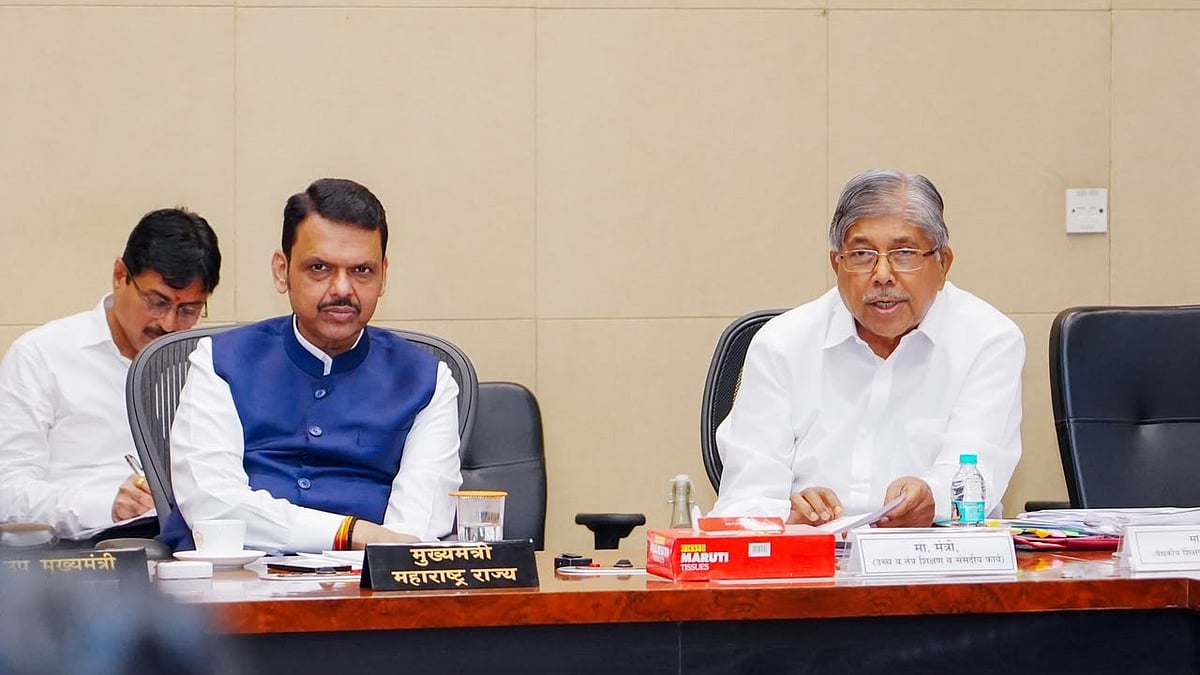
He argued that Article 44, which directs the State to endeavour to secure a UCC, must be read alongside Article 25. “We are asking for Sharia laws only in personal matters, not in criminal matters,” he said.
Maulana Zaheer Abbas, senior vice-president of the All India Shia Personal Law Board, supported the campaign. “We are with them on this common issue. India is a multi-cultural country,” he said.
The opposing groups said socio-economic marginalisation, security, education and employment also required attention, and urged civil society and political parties to ensure that UCC discussions remained focused on equality and human rights.
To get details on exclusive and budget-friendly property deals in Mumbai & surrounding regions, do visit: https://budgetproperties.in/

