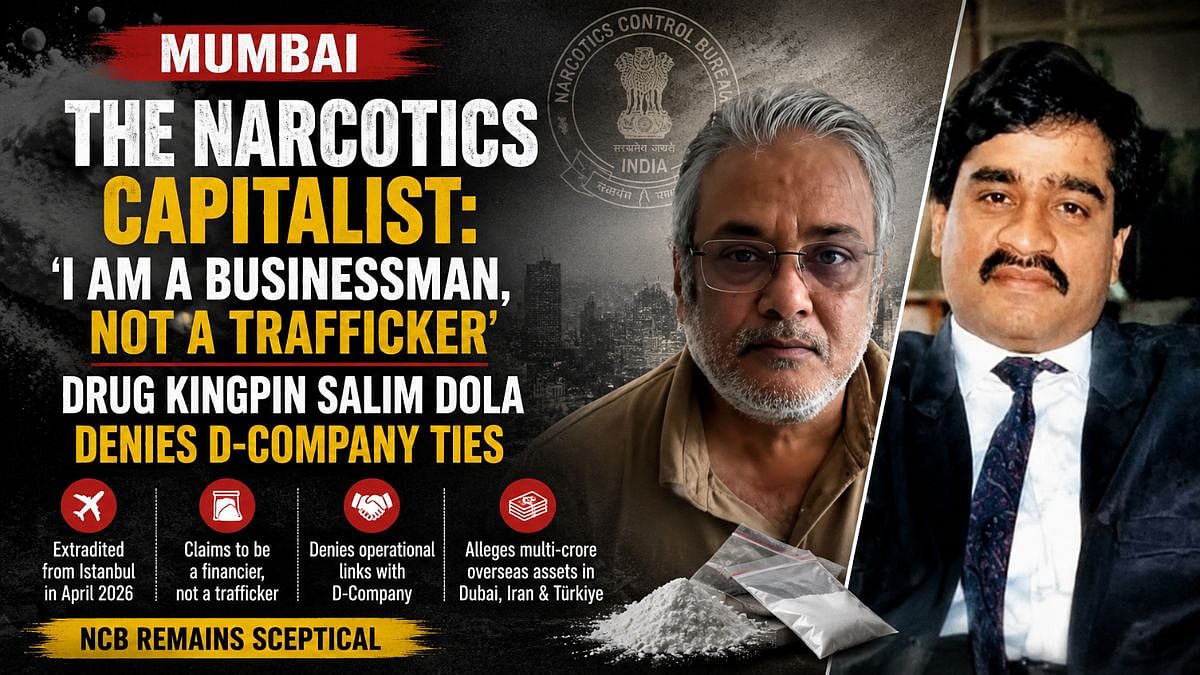
Mumbai, June 24: The Narcotics Control Bureau (NCB) is sceptical of alleged international drug lord Salim Dola (59), alias Hamza's, claim that he operated independently of the Dawood Ibrahim gang. Dola, a former resident of Dongri, was extradited from Istanbul in April this year.
During his custodial interrogation by several central agencies, he categorically denied any operational links with the D-Company or its associates, claiming he has functioned independently for several years.
Sources familiar with the interrogation said Dola told investigators that he saw no reason to associate with organised crime syndicates when he was allegedly generating substantial profits through his own narcotics network. He reportedly described the illicit drug trade as a “free market” in which multiple groups operated independently and sourced consignments through different channels without requiring the protection or oversight of traditional underworld syndicates.
Claims Of Independent Operations
During questioning, Dola allegedly attempted to portray himself as a businessman and investor rather than a conventional drug trafficker. According to sources, he told investigators that he did not directly participate in the manufacturing, transportation or street-level distribution of narcotics. Instead, Dola allegedly described himself as a financier who invested capital in drug-production ventures while operating from overseas locations, leaving the operational aspects to local manufacturers and distribution networks.
Dola reportedly told officials that, like any other businessman, he merely invested money in a commercial enterprise and earned returns on his investment. According to sources, he claimed that once narcotics were manufactured, independent drug cartels purchased the consignments through established distribution channels, from which he received a share of the profits.
He allegedly argued that this business model enabled him to generate substantial earnings without relying on the protection, logistical support or financial backing of underworld syndicates, which, he claimed, was the reason he had no operational association with the D-Company or any other organised crime group.
To support his claims, Dola reportedly outlined the economics of his synthetic drug pipeline to investigators. According to sources, he said he typically invested between Rs 2 lakh and Rs 5 lakh in each production cycle. This capital helped to set up specialised drug manufacturing units by bankrolling the procurement of restricted precursor chemicals, specialised lab equipment and manufacturing inputs through dedicated production networks.
Once synthetic narcotics, including mephedrone (MD), were manufactured, multiple drug cartels operating across Maharashtra, Gujarat, Rajasthan, Madhya Pradesh and Telangana allegedly purchased consignments in bulk through established distribution channels.
Sources said Dola claimed that the relatively modest investment often generated returns running into several crores of rupees, with profits exceeding Rs 10 crore in a single production cycle. Such returns, he allegedly argued, eliminated any need to rely on, collaborate with or share proceeds with organised crime syndicates or underworld groups.
“When the business itself is yielding such massive returns, why would I need anyone else’s support?” he reportedly told investigators.
Agencies Remain Sceptical
Investigating agencies, however, remain sceptical of Dola’s assertions. Officials associated with the probe believe that a narcotics network of such scale and longevity could not have operated without some form of protection from larger organised crime structures. According to sources, investigators feel it would be difficult for a multi-crore interstate drug trafficking network to function for years without attracting the attention of rival international narcotics syndicates, organised crime groups or law-enforcement agencies.
Dola also allegedly disclosed during interrogation that proceeds from the narcotics trade were used to build a multi-crore overseas property portfolio spanning Dubai, Iran and Türkiye. Investigators claim the syndicate’s earnings enabled him to acquire premium properties in Dubai’s Sobha Hartland, Binghatti Creek and Burj Khalifa View developments, besides investments in Iran and Istanbul.
Sources further alleged that Dola coordinated key segments of the network from Istanbul under the alias "Ayhan Sheikh", using overseas bases to manage financial transactions, procurement networks and transnational logistics linked to the syndicate's operations.
Past Links To Mumbai Underworld
While Dola has insisted during interrogation that he operated independently of the D-Company, his questioning has also forced him to recount a past deeply intertwined with Mumbai's underworld, revealing that his association with the syndicate was born out of bitter financial extortion.
In the 1980s and 1990s, he worked as an ordinary employee in a bustling electronics shop in Mumbai’s Manish Market, a notorious hub for smuggled electronics and custom-cleared goods. During this era, Manish Market and the surrounding pockets of South Mumbai were heavily dominated by the rising ranks of the D-Company syndicate.
Dola admitted that top-tier underworld figures, including Dawood Ibrahim, Tiger Memon and Anees Ibrahim, as well as their relatives, frequently visited the shop to procure high-end electronic items. However, Dola downplayed these initial interactions, stating that his relationship with them at the time was limited to basic professional courtesies (salam-dua).
However, Dola alleged that his first direct confrontation with the D-Company's inner circle stemmed from his involvement in the lucrative Transfer of Residence (TR) trade, which was allegedly controlled by D-Company. Dola claimed that Anees Ibrahim allegedly issued threats against him over the TR business dispute. To settle the matter safely and defuse the threat from the gang, Dola’s father was forced to liquidate the family's primary livelihood, a prominent book stall located in the heart of Dongri.
Dola explained to investigators that during the 1990s, the TR sector was completely dominated by D-Company operating out of Dubai and Mumbai. Under old Indian customs guidelines, the TR facility allowed Non-Resident Indians (NRIs) who had lived in Dubai or the Gulf for a specified period to bring back heavy consumer goods, electronic appliances and personal assets to India under significant tax exemptions.
According to Dola, D-Company quickly weaponised this facility into a massive grey-market pipeline. They would identify and sponsor low-income labourers returning to India, utilising their names and legal customs quotas as front covers. The D-Company would then pack these TR shipping containers with high-value smuggled electronics, machinery and hidden contraband, seamlessly clearing them through Mumbai’s ports under the guise of personal household effects.
From Smuggling To Drug Trade
Dola claimed that he entered the TR trade independently after acquiring expertise in shipping documentation, container logistics, customs procedures and international transit routes. However, one of his major TR consignments was subsequently detained by customs authorities. Lacking the backing of an organised crime syndicate to navigate the crisis, Dola was left unable to secure its release, resulting in losses estimated at around Rs 2 lakh to Rs 5 lakh at that time.
The individual who had entrusted Dola with the consignment was closely linked to Anees Ibrahim and held Dola personally responsible for the financial loss. According to Dola, the matter eventually reached Anees Ibrahim, who allegedly issued direct threats against him to recover the amount. The episode, he claimed, marked his first direct encounter with the D-Company's leadership and ultimately forced his family to sacrifice their Dongri bookstore to secure his survival.
According to investigators, Dola claimed his criminal career began around 1991-92 when he operated as a local charas peddler before moving into the synthetic narcotics trade.
Sources said Dola also disclosed details of a past NDPS case that were not fully reflected in the agency's existing dossier. He allegedly told investigators that in July 1998, officers of the Mumbai Police Anti-Narcotics Cell's Azad Maidan Unit intercepted him at Mumbai airport while he was attempting to smuggle 40 kg of Mandrax tablets abroad. Dola reportedly described himself at the time as a minor player in the narcotics trade.
According to his account, he remained lodged in Arthur Road Jail for nearly six months following his arrest. According to him, the prison at the time housed several accused in the 1993 Mumbai serial blasts case, along with shooters, operatives and associates linked to the rival D-Company and Chhota Rajan factions, whose violent feud had spilled into correctional facilities across Maharashtra.
Dola allegedly told investigators that, lacking any organised backing of his own and concerned about his safety inside prison, he relied on contacts from Dongri to cultivate ties with inmates associated with the D-Company. According to sources, he claimed that these relationships continued after his release and later helped him secure financial assistance to start a catering business in Mumbai.
According to officials, Dola claimed that in 1998 he launched Bohri Caterers in Nagpada from premises allegedly linked to Hasina Parkar, the late sister of Dawood Ibrahim, following introductions from individuals linked to the D-Company. He reportedly told investigators that the venture also received financial backing from persons linked to the syndicate and initially performed well. However, mounting debts, delayed recoveries and growing financial liabilities allegedly pushed the business into distress, ultimately forcing its closure.
Extradition And Ongoing Probe
Following the collapse of the catering venture, Dola allegedly returned to the narcotics trade. Investigators believe he gradually expanded his operations over the following years, building a synthetic drug network with interstate and international linkages.
Agency records show that Dola resurfaced prominently on law-enforcement radar in December 2018, when the Mumbai Police's Anti-Narcotics Cell arrested him and three associates from Vakola in Santacruz (East). Acting on specific intelligence, investigators allegedly seized four industrial drums containing 100 kg of suspected fentanyl, a highly potent synthetic opioid. The consignment was believed to be destined for Mexico, with the United States identified as the final market.
Officials said the case later suffered a setback after preliminary forensic examinations reportedly failed to conclusively establish the presence of fentanyl in the seized samples. Dola subsequently secured bail and was released from custody.
Investigators allege that shortly after his release, Dola violated bail conditions, procured fraudulent travel documents and fled India. He is believed to have first travelled to the UAE before relocating to Istanbul, where he allegedly continued to oversee parts of his narcotics network while operating under assumed identities.
Also Watch:
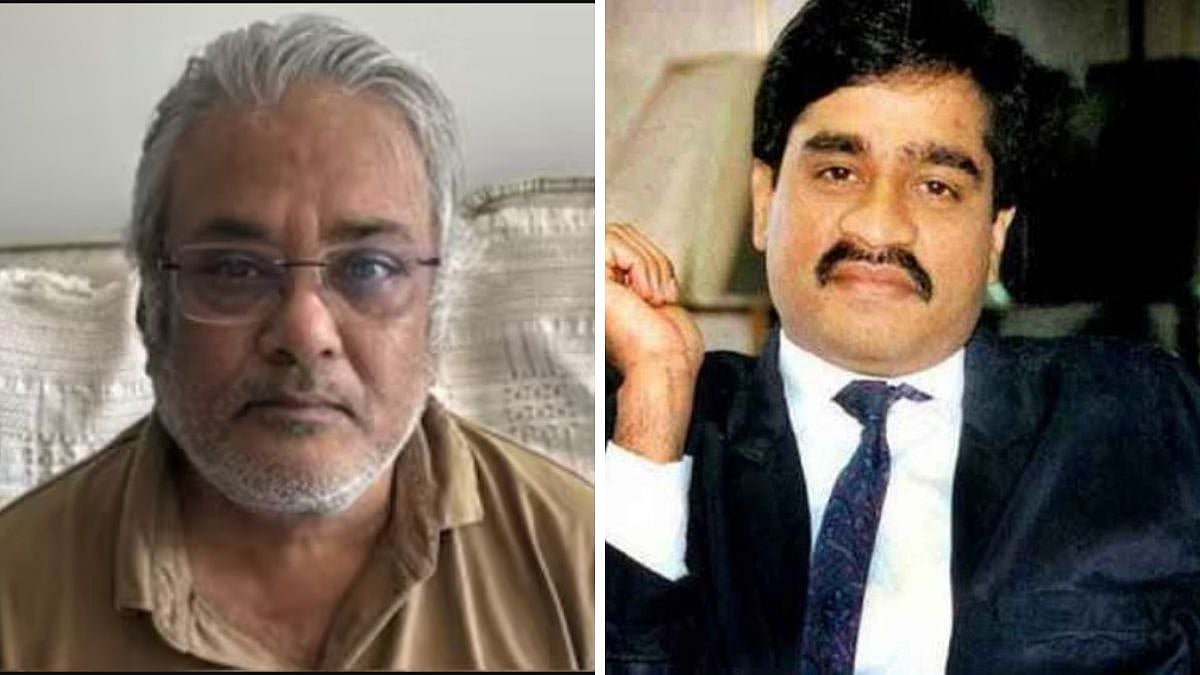
The escape left him as an international fugitive under an Interpol Red Notice for nearly eight years until his arrest and extradition to India under Operation Global Hunt in April 2026.
Despite investigators linking him to multiple transnational narcotics operations and alleged underworld associates, Dola has continued to deny any operational relationship with the D-Company, maintaining during interrogation that he functioned independently throughout his criminal career.
To get details on exclusive and budget-friendly property deals in Mumbai & surrounding regions, do visit: https://budgetproperties.in/

