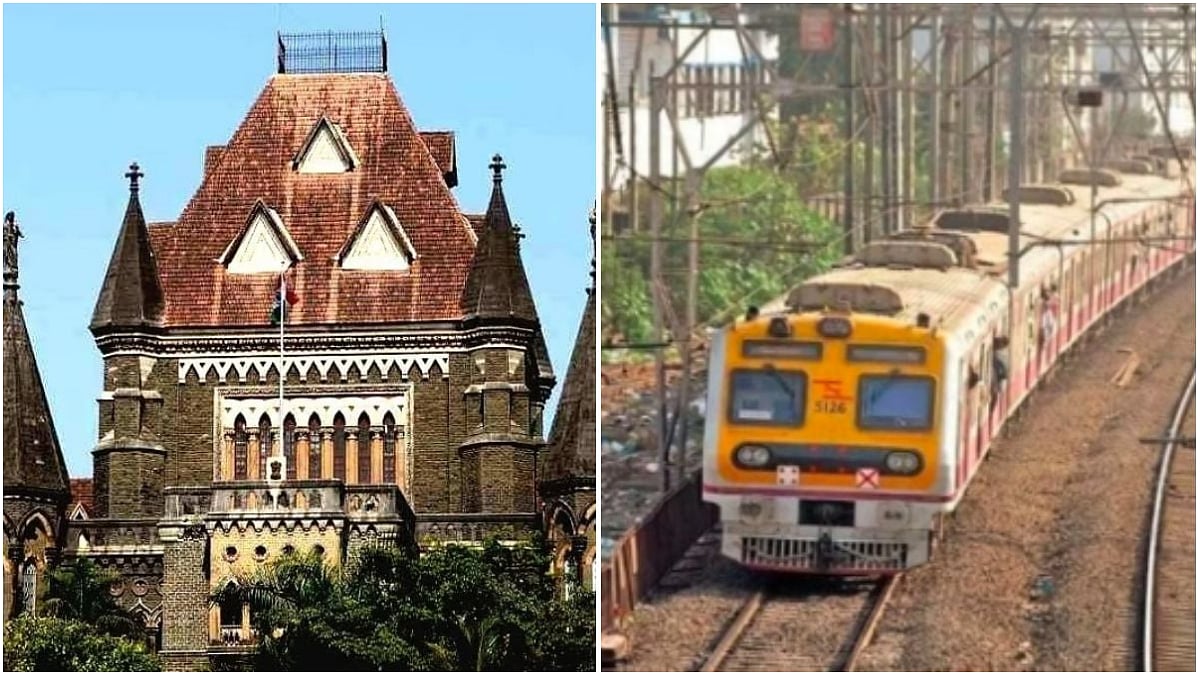
Mumbai: Sitting or standing near the door of a moving train cannot be treated as a “self-inflicted injury,” the Bombay High Court has held. The court set aside an order of the Railway Claims Tribunal that had denied compensation to an injured passenger.
Justice Jitendra Jain allowed an appeal against the tribunal’s January 31, 2018 decision, which rejected the claim on the ground that the passenger’s injuries were self-inflicted, even while acknowledging that he was a bona fide traveller.
Rohidas Bandu Kumavat, a Nashik-resident, was travelling on the Guwahati Express from Manmad to Jalgaon when he fell from the moving train, allegedly after slipping due to a rush near the coach door. He sustained injuries to his head and left leg.
The tribunal rejected his compensation plea reasoning that since the train did not halt at Jalgaon, the passenger must have been attempting to de-board, thereby making himself responsible for the incident. Kumavat then challenged this before the High Court.
Disagreeing with the tribunal’s conclusion, the High Court held that such an assumption was unwarranted. It noted that the mere presence of a passenger near the door cannot be equated with negligence or an intentional act leading to injury. Relying on settled law, the court reiterated that a fall from a train in such circumstances would qualify as an “untoward incident” under the Railways Act, unless it falls within narrowly defined exceptions such as suicide or criminal acts.
Addressing the tribunal’s finding about the non-halting train, the court observed that passengers may act in panic or confusion, especially in long-distance trains where clear announcements about non-halting stations are often lacking. In such situations, attributing fault to the passenger would be unjustified.
“No person in such a situation would do any act to impose upon him ‘self-inflicted injury’ and in some cases, it is also possible that he may go unscathed,” the judge noted.

Also Watch:
Emphasising the beneficial nature of the Railways Act as a social welfare legislation, the court said any ambiguity must be resolved in favour of the claimant.
The judge added a word of caution to the passengers attempting to alight from moving trains and urged railway authorities to improve onboard announcement systems to prevent such mishaps.
“I may end with a caution that the passenger, if he boards a wrong train should not make any attempt to de-board the train at a railway station not having a halt and risk his life,” it said, adding: “The Railway authorities should introduce a public announcement system like that in Vande Bharat train, in all the trains to reduce such incidents.”
Allowing the appeal, the High Court directed the Railways to pay compensation of Rs80,000 with 6% annual interest from the date of the incident until realisation, within 12 weeks.
To get details on exclusive and budget-friendly property deals in Mumbai & surrounding regions, do visit: https://budgetproperties.in/

