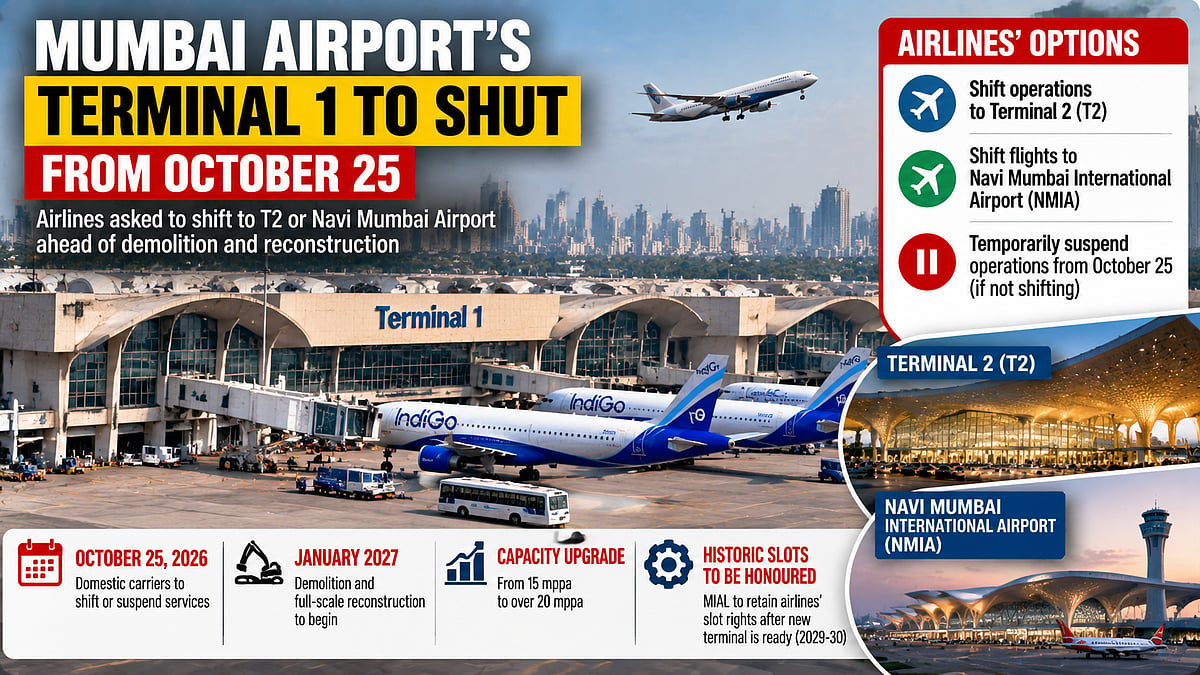
Mumbai: Chhatrapati Shivaji Maharaj International Airport's (CSMIA) operator Mumbai International Airport Ltd (MIAL) has asked domestic carriers operating out of Terminal 1 (T1) to either shift their operations or temporarily suspend services from October 25. The operator has clarified that it will honour the airlines’ historic slots once the terminal building is renovated.
T1 Reconstruction Planned From January 2027
The decision comes as the private operator prepares for the long-awaited demolition and full-scale reconstruction of the legacy terminal at Santacruz, scheduled to commence in January 2027. MIAL has given two primary alternatives as an ultimatum to manage the capacity crunch. It has asked the airlines to either shift operations to Terminal 2 (T2) or shift flights to the upcoming Navi Mumbai International Airport (NMIA) across the bay.
According to MIAL, the redevelopment plan aligns with the Airports Economic Regulatory Authority of India (AERA) tariff order, which earmarked T1 for complete reconstruction during the ongoing control period. While initial plans projected the demolition to start in mid-2025, MIAL “voluntarily deferred due to the absence of an alternative operating facility for airlines."
T1 Demolition Linked To AERA Tariff Plan
The operator noted that the opening of Navi Mumbai Airport fundamentally alters the operational picture for carriers operating in the Mumbai Metropolitan Region as an alternative option. The operator has stated that if the airlines do not wish to shift operations to T2 or NMIA, they can temporarily suspend the operations from October 25 until the new terminal building is commissioned in 2029-30.
However, the airport addressed carrier anxieties regarding valuable historical slots at India's second-busiest hub and clarified that the move will not impact long-term assets. "This is a temporary transition, and MIAL will honour airlines' historic slot rights once the new terminal becomes operational," the spokesperson confirmed.
Historic Airline Slots To Remain Protected
CSMIA’s Terminal 1, an iconic fixture in Indian aviation history that has served domestic passengers for decades, has long suffered from architectural bottlenecks and limited apron expansion room. Current infrastructure limits T1 to handling roughly 15 million passengers per annum (mppa).

Under MIAL’s comprehensive redevelopment blueprint, the entire T1 footprint – starting with the phased teardown of Terminal 1-B’s northern structure – will be completely razed. In its place, MIAL plans to construct an ultra-modern, integrated passenger terminal capable of handling over 20 mppa with seamless underground connectivity to T2 and the Mumbai Metro network.
The directive forces airlines – most notably budget carriers like IndiGo and Akasa Air, which handle significant domestic loads out of T1 – to re-evaluate their schedule stability in Mumbai.
While T2 currently absorbs both international traffic and premium domestic operations, its current apron and terminal capacity are stretched near peak thresholds. However, shifting high-frequency domestic routes to Navi Mumbai Airport is said to provide a relief valve for the region, though it presents carriers with immediate logistical challenges, ranging from repositioning ground handling equipment to managing passenger point-to-point transit habits across the city.
To get details on exclusive and budget-friendly property deals in Mumbai & surrounding regions, do visit: https://budgetproperties.in/

