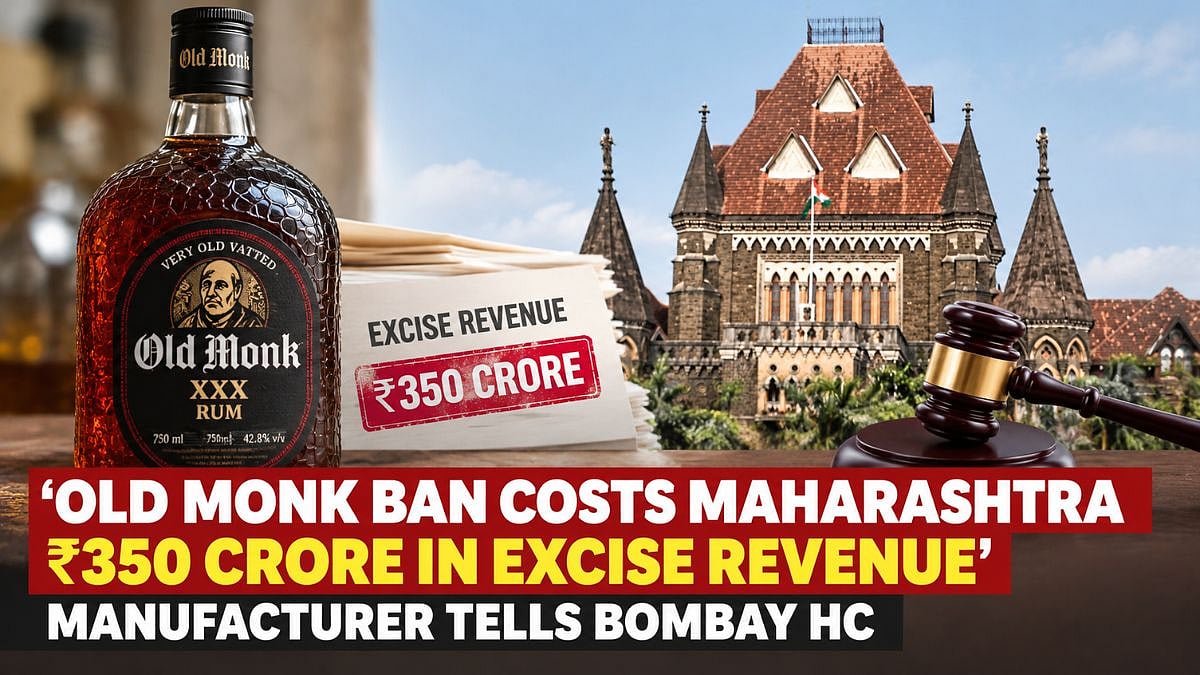
Mumbai, October 13, 2026: The ban on the sale of Old Monk rum from a manufacturing unit in Thane district has cost the Maharashtra government around Rs 350 crore in excise revenue, the liquor maker has told the Bombay High Court. The manufacturer, Mohan Rocky Springwater Pvt. Ltd., said the restrictions had also caused losses of more than Rs 500 crore to the company.
Manufacturer Challenges FSSAI Ban
Senior advocate Venkatesh Dhond, appearing for the manufacturer, made the submission before a bench of Chief Justice MC Tripathi and Justice Advait Sethna while challenging the prohibition imposed by the Food Safety and Standards Authority of India (FSSAI).
“The excise has also lost around Rs 350 crore in revenue,” Dhond submitted.
He also pointed out that the same rum formulation continued to be sold from the company’s other manufacturing units in Maharashtra, questioning the restrictions imposed on the Thane facility.
FSSAI Seeks Revised Product Labelling
Additional Solicitor General Anil Singh, representing the authorities, reiterated that the company could resume sales if it changed the product’s labelling to describe it as ‘rum-like’ rather than ‘rum’.
The dispute centres on FSSAI’s objection to the use of added rum flavouring in spirits marketed under standard product names. The food regulator contends that adding artificial or nature-identical rum flavouring can mislead consumers about the product’s composition unless it is appropriately labelled as a flavoured spirit or a spirit with rum flavour.
The authority has also objected to descriptions suggesting the liquor’s age, including ‘7 years old blended’ and ‘very old vatted’.
Company Questions Prohibition Orders
The company has challenged the prohibition, arguing that regulations permit the use of approved additives in neutral spirits and that other manufacturers follow similar processes without facing comparable restrictions.
It has also questioned the authority of the FSSAI officer to issue the prohibition orders, contending that Section 36(3)(b) of the Food Safety and Standards Act does not independently empower the officer to prohibit the manufacture and sale of products.
Also Watch:
High Court To Hear Matter On October 23
On August 31, the High Court declined to grant immediate interim relief against the ban. The company subsequently offered to submit revised labels removing the disputed age-related descriptions and prominently declaring the addition of flavouring.
However, after the proposed labels were not approved by the FSSAI, the company sought a hearing on the merits of its challenge.
The High Court will hear the matter next on October 23.
To get details on exclusive and budget-friendly property deals in Mumbai & surrounding regions, do visit: https://budgetproperties.in/

