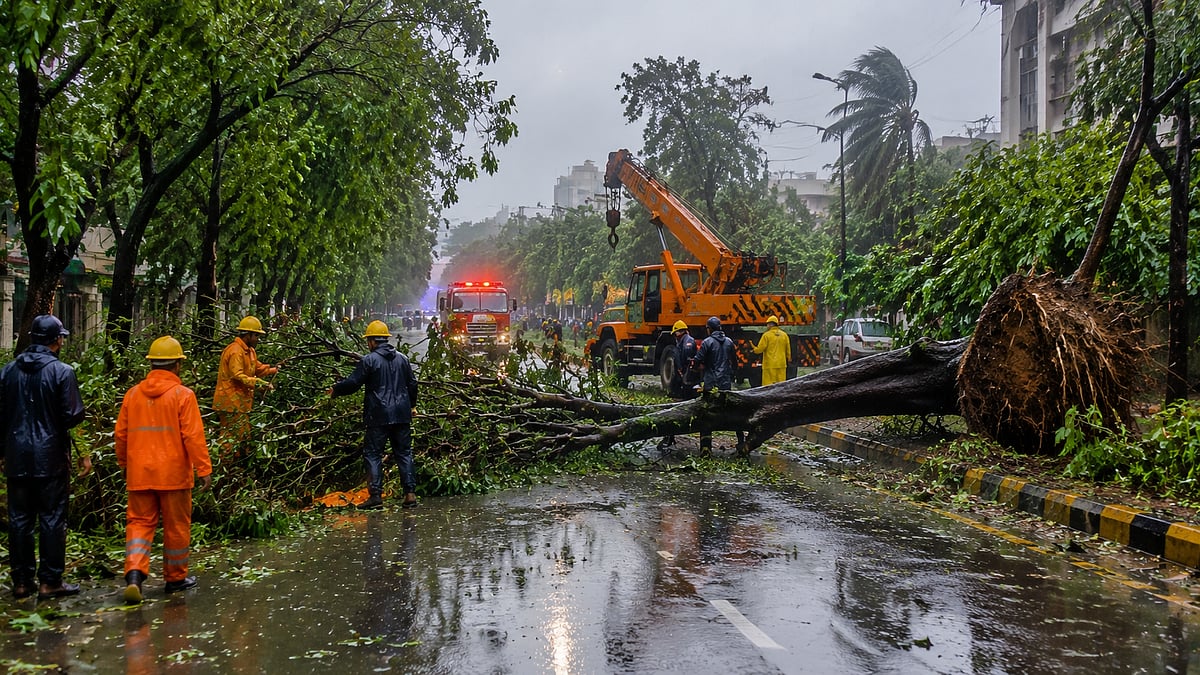
Navi Mumbai: In the wake of the large number of trees uprooted during the heavy rainfall and strong winds that lashed Navi Mumbai in July, the Navi Mumbai Municipal Corporation (NMMC) has decided to implement a scientific standard operating procedure (SOP) for tree management and pruning. The decision was taken at a special meeting chaired by Municipal Commissioner Dr. Kailas Shinde with leading tree experts to identify the causes behind tree falls and recommend long-term preventive measures.
The meeting was attended by Deputy Commissioner (Gardens) Smita Kale, tree experts Shrikant Ingalhalikar, Dr. Chandrakant Salunkhe, Sharvari Barve, Sarang Phale and arborist Vaibhav Raje.
During the meeting, experts conducted a detailed review of trees that collapsed during the recent spell of heavy rain and identified several scientific factors contributing to the incidents.
According to the experts, excessive cement concretisation around trees is one of the primary reasons for tree falls. During road and housing construction, adequate space is often not left for root growth, while repeated excavation for underground utilities such as cables and pipelines damages tree roots, weakening their grip on the soil. More than 90 per cent of trees that fall are located along roads and inside housing societies, whereas such incidents are negligible in villages and slum areas where concretisation is limited.
The experts also pointed to phototropism, where trees lean towards sunlight due to obstruction from nearby buildings, creating an uneven weight distribution and increasing the risk of collapse.
Improper pruning, particularly in housing societies where branches are cut only from one side or from the top without following scientific methods, was identified as another major cause. Such pruning leaves trees structurally imbalanced and more vulnerable during storms.
Heavy rainfall further aggravates the problem as wet foliage increases the weight of trees, while waterlogging loosens the soil around roots. Since Navi Mumbai is a coastal city with a high groundwater table, the risk becomes even greater.
The panel also observed that certain species are naturally more susceptible to damage. Ficus trees are not ideal for roadside plantations because of their growth pattern, while Gulmohar and Copperpod (Peltophorum) have comparatively brittle wood that makes their branches more prone to breaking. In contrast, coconut and palm trees generally withstand strong winds better.
Based on these findings, the civic body has decided to formulate a comprehensive SOP in line with National Green Tribunal (NGT) guidelines and principles of urban forestry.
Under the proposed measures, the municipal corporation will scientifically manage tree crowns to reduce wind resistance, ensure balanced pruning under expert supervision, and schedule pruning before the monsoon, preferably during March and April. Pruning during October will be avoided.
The NMMC will also make it mandatory to photograph trees before and after pruning, prepare documentation of all leaning trees for case-by-case assessment, and conduct visual inspections of recently fallen trees. Officials will also examine past pruning records and, wherever necessary, use advanced technologies for risk assessment.
The civic administration said the initiative follows the widespread tree fall incidents witnessed across the Mumbai Metropolitan Region during the first week of July, when heavy rain accompanied by strong winds caused extensive damage.
"The recent spell of heavy rain highlighted the need to scientifically understand why trees are falling instead of relying on assumptions. Based on the recommendations of experienced arborists and tree experts, the corporation will introduce a scientific and standardised tree management system to improve public safety while conserving the city's green cover," said Dr. Kailas Shinde, Municipal Commissioner, NMMC.
To get details on exclusive and budget-friendly property deals in Mumbai & surrounding regions, do visit: https://budgetproperties.in/

