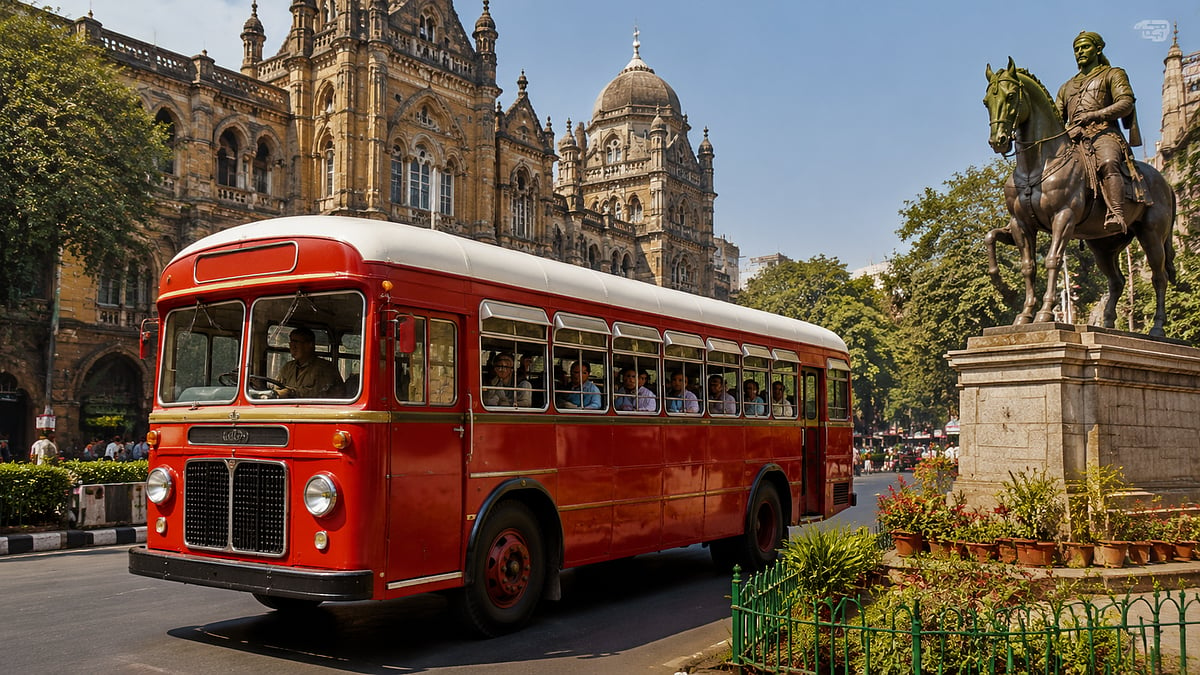
Mumbai: A century after Mumbai's first BEST bus rolled out on the streets, around 40 transport enthusiasts on Wednesday recreated the historic journey to celebrate 100 years of the city's iconic bus service. The commemorative ride retraced the original route from Afghan Church in Colaba to Crawford Market, where the first motor bus service began on July 15, 1926. While the celebration honoured BEST's rich legacy, transport experts used the occasion to highlight the undertaking's financial struggles and shrinking presence, warning that urgent reforms are needed to secure its future.
Historic route retraced
The group hired a single-decker BEST bus and followed the original 'A' route, making stops along the way to document the historic journey. On the return trip, they celebrated the centenary outside the Chhatrapati Shivaji Maharaj Vastu Sangrahalaya by cutting a cake before taking the bus through the Coastal Road, Worli, Dadar and Wadala. Journalist and transport historian Rajendra B. Aklekar said the first BEST bus was a 20-seater A2-class vehicle built by British company Thornycroft, with 45 buses arriving in the first batch. The first service was launched after years of debate over whether Mumbai should introduce trolley buses or motor buses. The company finally chose motor buses in February 1926, citing greater flexibility and lower infrastructure costs. The service was an instant success and gradually replaced the city's tram network, leading to the 'T' in BEST changing from "Tramways" to "Transport."
From a fleet of just 24 buses in 1926, BEST has grown into one of the country's largest public bus operators, carrying around 25 lakh passengers every day on more than 400 routes across Mumbai, Thane, Navi Mumbai and Mira-Bhayander. However, its current fleet of 2,804 buses includes only 249 owned by BEST, while the remaining 2,555 operate under the wet lease model. Transport activist A.V. Shenoy said the undertaking, once regarded as one of the world's finest bus services, now faces serious financial and operational challenges and requires comprehensive administrative and financial reforms. Urban transport researcher Suvedh Jaywant said buses remain essential for first- and last-mile connectivity despite the rapid expansion of Metro services and the rise of app-based taxis. He warned that without sustained investment in BEST, Mumbai risks creating a fragmented public transport system that is less accessible, more congested and increasingly dependent on private mobility.
To get details on exclusive and budget-friendly property deals in Mumbai & surrounding regions, do visit: https://budgetproperties.in/

