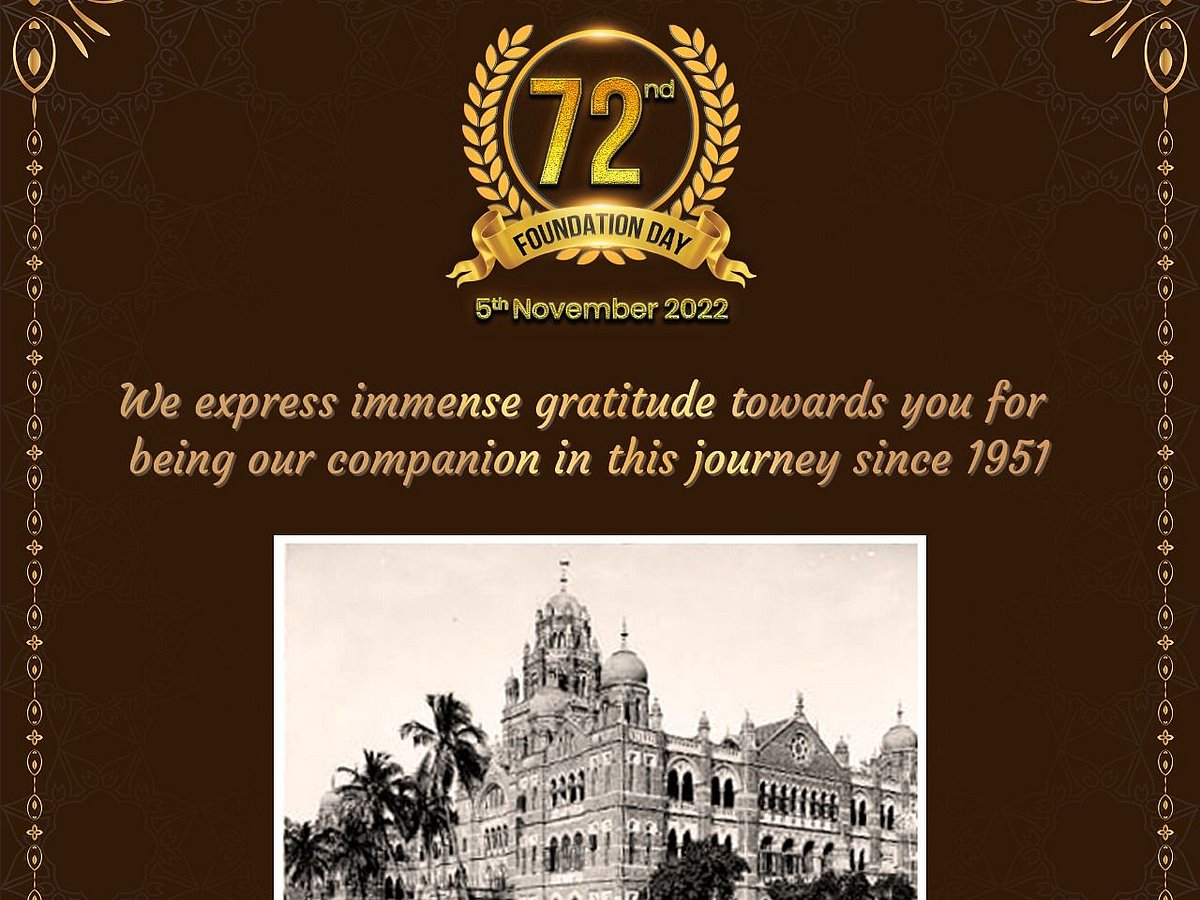
Mumbai: The Western Railway celebrates its 72nd Foundation Day on Saturday, November 5. Since its humble beginning, the railway has achieved several milestones in its 70+ years in service to the nation.
In its present form, the Western Railway came into existence on November 5, 1951, by the merger of its forerunner, the erstwhile Bombay, Baroda and Central India Railway (BB&CI), with other State Railways viz, Saurashtra, Rajputana and Jaipur.
The present jurisdiction of Western Railway is in 6 divisions: Mumbai Central, Vadodara, Ahmedabad, Rajkot, Bhavnagar and Ratlam.
On March 3, 1961, the Western Railway introduced 9-coach suburban trains, owing to the increasing demand of travelers to the cityside. In 1972, Western Railway introduced its prestigious Mumbai – New Delhi Rajdhani Express train, which is one of the most important and busiest lines on the Indian Railways network. This year, this esteemed train completed 50 glorious years and celebrated the Golden Jubilee of its maiden run with great fervor and fanfare.
Continuing in its journey of achieving milestones one after the another, right from the introduction of the World's First Ladies Special train, the first 15-car suburban train and the introduction of the first fully air-conditioned suburban train in India, it has earned many firsts in various fields such as Operations, Safety and in adopting state-of-the-art Technology.
Western Railway recently introduced the country’s third Vande Bharat Express, between Mumbai Central and Gandhinagar Capital. It has time and again proved its mettle, through its long journey, ever since its birth in the British era in 1850s. Through its historical journey of over 70 years, at present, Western Railway has a wide railway network covering 6175.9 km, consisting of Broad, Meter and Narrow Gauge sections in the states of Maharashtra, Gujarat and parts of Madhya Pradesh and Rajasthan.
Prakash Butani, General Manager (In-charge) of Western Railway, congratulated all officers and employees across its six divisions for their dedication towards their work and the bountiful achievements made by Western Railway over all these years.
To commemorate the day, Western Railway’s social media platforms ran a special campaign through an engaging quiz and infographics about the railway’s recent accomplishments and its glorious past.
A look at the Western Railway's history and heritage
The Bombay, Baroda and Central India Railway (BB&CI) was incorporated in 1855, starting with the construction of 29-mile broad gauge track from Ankleshwar to Utran in Gujarat state on the West Coast with Surat as its headquarters then.
Later that year, on November 21, the Company concluded an agreement with the East India Company to construct a railway line from Surat to Baroda and Ahmedabad.
Another contract was signed to start a line from Utran (north of Surat) to Bombay to ensure a plentiful supply of cotton -- grown in Gujarat -- coming into the western port. The work commenced on the line in the following year, and the line from Utran to Grant Road station in Bombay was officially opened on November 28, 1864 – marking the inception of the present day Western Railway.
The process of the actual founding of the BB&CI local line to and within the city of Bombay and the identification of a terminus, particularly south of Grant Road – the first terminus, was a perplexing issue.
Although the inaugural run terminated at Grant Road station, this terminus did not adequately serve the population which lived further south; near the old Fort or the cantonment at Colaba that was now serving a sizeable population.
It was decided to extend the line to the Back Bay, just outside the western side of the old Fort area and alongside the western bay.
This station was subsequently called Churchgate, as it was in close proximity to the old Church Gate of the fortified town – the gate that afforded entry to St. Thomas Church that later became a Cathedral.
Western Railway has grown with the city of Mumbai, and Mumbai city has grown with Western Railway, which has always been the cynosure of the development of the city of Mumbai.
