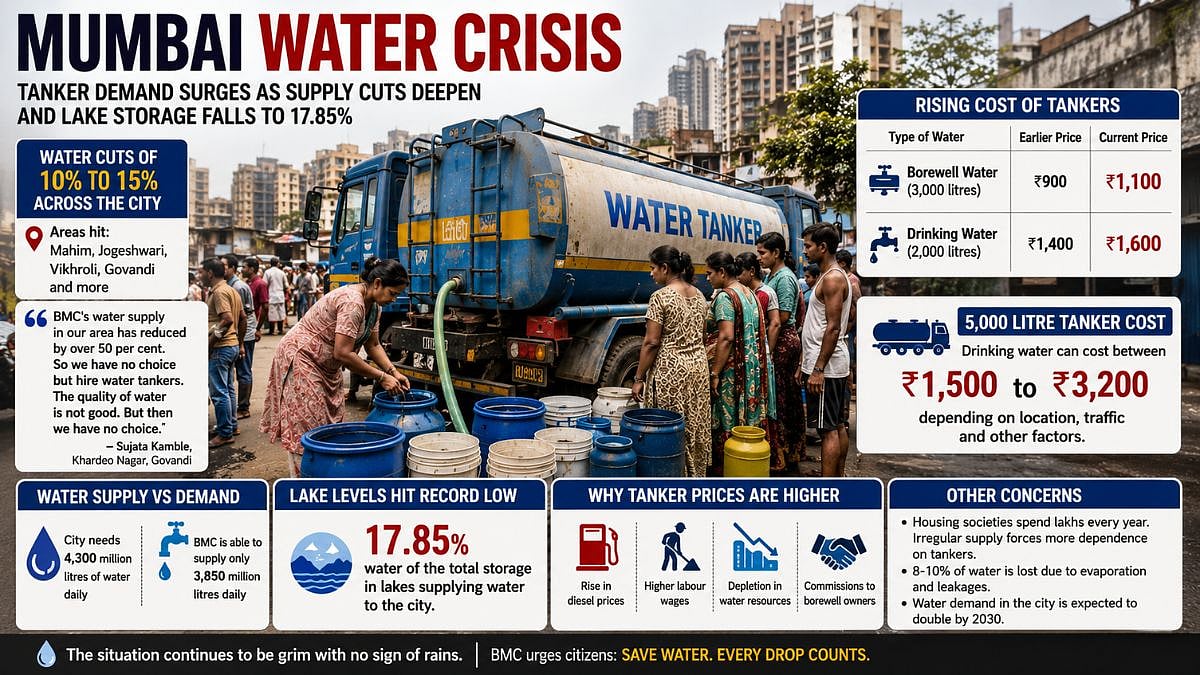
Mumbai, May 28: With the city facing water cuts ranging from 10 per cent to 15 per cent, the demand for water tankers is shooting up, primarily because of the rise in diesel prices.
Mumbaikars in several areas such as Mahim, Jogeshwari, Vikhroli and Govandi have been facing shortages for the past several days. Since there is no normal supply from the BMC, they are contacting water tanker companies for their needs.
Said Sujata Kamble of Khardeo Nagar, Govandi: “BMC's water supply in our area has reduced by over 50 per cent. So we have no choice but to hire water tankers. The quality of water is not good. But then we have no choice.”
Suman Chalke, a domestic help, said, “I am taking clothes for washing to my employer's house in Deonar and using her washing machine.”
Tanker prices rise amid growing demand
Until recently, a tanker with a 3,000-litre capacity used to cost Rs 900, but now it costs Rs 1,100 for borewell water. Drinking water with a 2,000-litre capacity, which used to cost Rs 1,400, is now priced Rs 200 higher.
The price also depends on the distance to be covered by the supplier and the traffic situation. If the traffic is heavy, the tanker turnaround time is longer and hence costs more.
The situation continues to be grim, with no sign of rain. Lakes supplying water to the city have only 17.85 per cent of their total storage. The city needs 4,300 million litres of water daily, while the BMC is able to supply only 3,850 million litres.
A 5,000-litre tanker can cost between Rs 1,500 and Rs 3,200 for drinking water. The cost of a water tanker depends upon the quantity of water, location and traffic conditions.
Water scarcity and infrastructure challenges
The hike in fuel prices is affecting water prices. Other factors include increased labour wages, depletion of water resources and commissions paid to borewell owners. Water tanker suppliers get water mainly from borewells or the BMC supply.
A water supplier in Kalbadevi said he is not able to find enough water to cater to the current demand.
Housing societies are reportedly spending lakhs of rupees each year to fulfil water requirements. Almost all registered housing societies are connected to the BMC water supply, while some receive water supply only for about a quarter of the day. These irregularities increase dependence on water tankers, which often remain unavailable for days due to high demand.
A significant portion of available water goes down the drain during cleaning operations and is wasted due to leakages from old pipelines. Worsening the current situation is water lost through evaporation from reservoirs, estimated at 8 to 10 per cent. If this water is conserved, it can help ease the water cuts.
Also Watch:
The water demand in the city is expected to double by 2030. The BMC continues to urge people to save water, while some are yet to realise the importance of every drop.
To get details on exclusive and budget-friendly property deals in Mumbai & surrounding regions, do visit: https://budgetproperties.in/

