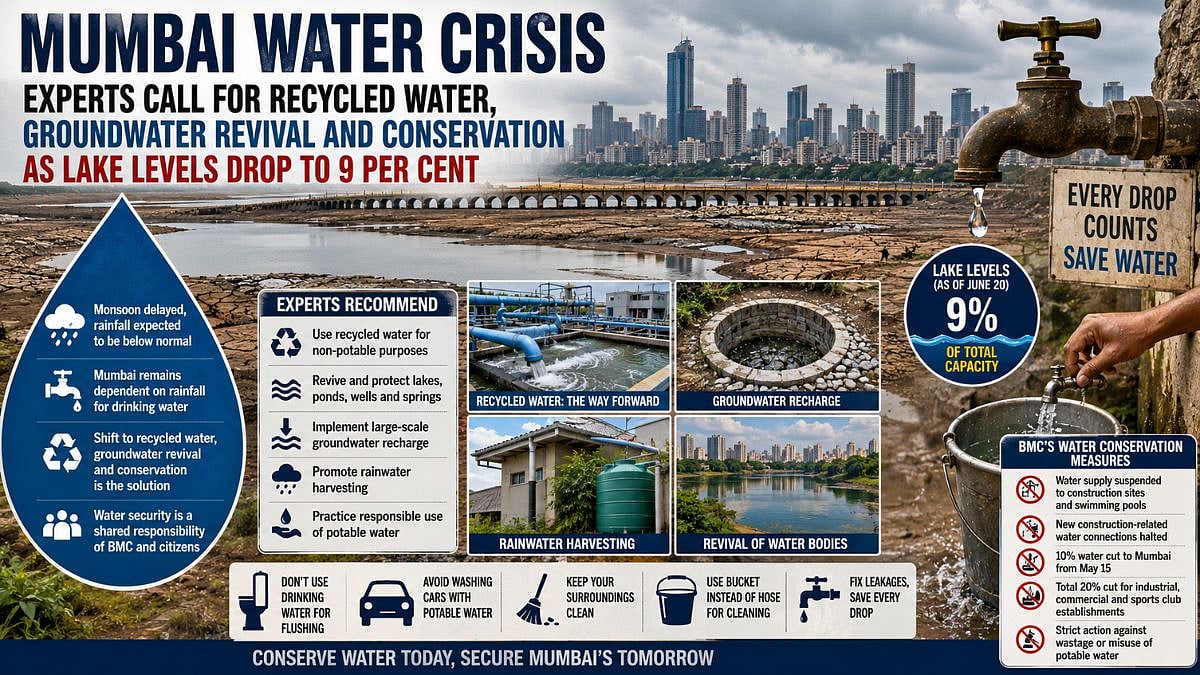
Mumbai, June 20: As Mumbai anxiously awaits the arrival of the southwest monsoon, the city's shrinking water reserves have once again exposed a recurring reality. Mumbai remains dangerously dependent on rainfall for its drinking water.
Experts say the solution lies beyond waiting for the skies to open; it requires an urgent shift towards recycled water, revival of groundwater resources and responsible consumption of potable water.
As the southwest monsoon remains delayed and rainfall is expected to be below normal, experts say Mumbai is at another turning point in its water management. They argue that the city's biggest challenge is not just an erratic monsoon but the continued misuse of treated drinking water for non-potable purposes.
"Every litre of potable water wasted today increases the risk of shortages tomorrow," they say, urging both the BMC and citizens to share responsibility for water conservation.
Experts stress shared responsibility
Dr Subhajit Mukherjee, founder of Mission Green Mumbai, said the city's water crisis cannot be solved by the BMC alone. "Nearly 40% of domestic drinking water is flushed down toilets, which is nothing short of criminal. Mumbai has usable groundwater that may not be fit for drinking but can be used for flushing through scientifically developed borewells. Water conservation is a shared responsibility, and citizens must become active participants instead of treating drinking water as an unlimited resource," he said.
Mukherjee has organised a rainwater harvesting workshop in Malad West on Sunday to encourage citizens to adopt sustainable water conservation measures.
Sitaram Shelar, founder of Pani Haq Samiti (Right to Water), called for a comprehensive audit of Mumbai's water distribution and consumption to ensure equitable use.
He urged the BMC and the state government to revive and safeguard traditional water bodies and groundwater sources—including lakes, ponds, springs, wells and borewells—while stressing that water security is a shared responsibility.
"Citizens must actively conserve and restore local water sources alongside government efforts," Shelar said.
Focus on groundwater and conservation
Godfrey Pimenta of Watchdog Foundation advocated large-scale groundwater recharge measures, including recharge pits, trenches, shafts and percolation wells in public spaces, and making such structures mandatory in future infrastructure projects.
He also urged the BMC to survey, restore and desilt abandoned wells, and rejuvenate lakes, ponds and other water bodies to strengthen Mumbai's long-term water security.
Also Watch:
As of June 20, Mumbai's seven lakes held 1.30 lakh million litres (ML) of water—just 9% of their total capacity, down from 25% on the same day last year. With reserves dwindling, the BMC has enforced stringent water conservation measures, suspending water supply to construction sites and swimming pools, halting new construction-related water connections, imposing a 10% water cut in Mumbai from May 15 and a total 20% cut for industrial, commercial and sports club establishments, and warning of strict action against the wastage or misuse of potable water.
To get details on exclusive and budget-friendly property deals in Mumbai & surrounding regions, do visit: https://budgetproperties.in/

