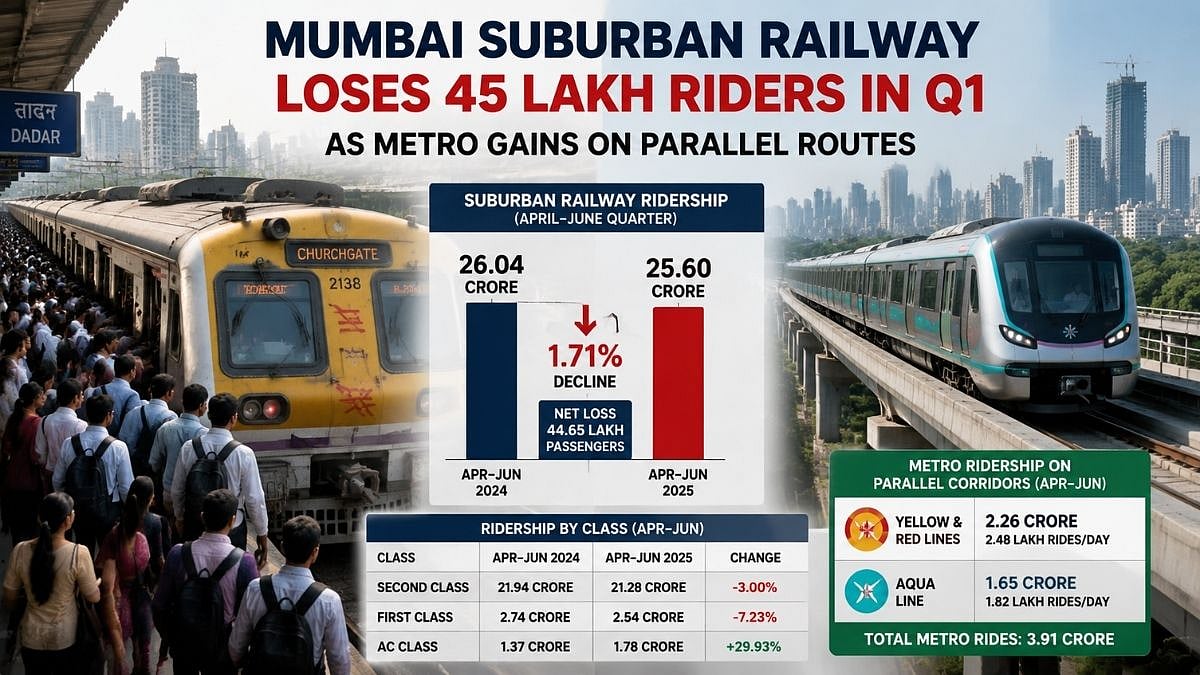
Mumbai, August 31, 2026: Mumbai's suburban railway recorded a net decline of 44.65 lakh passengers in the April-June quarter compared with the same period last year, even as Metro corridors running parallel to parts of the suburban network recorded significant ridership.
An internal Western Railway performance analysis attributes the fall partly to competition from the Metro, particularly on corridors around Borivali-Dahisar and Andheri. However, the data does not establish a direct passenger shift from suburban trains to Metro services.
The analysis, prepared by Western Railway's Mumbai Central Division, compares journey and season ticket sales across Second Class, First Class and AC suburban services for the April-June period.
Total suburban passengers fell from 26.04 crore to 25.60 crore, a decline of 1.71 per cent. Second Class ridership, which accounts for the bulk of suburban travel, fell by 3 per cent from 21.94 crore to 21.28 crore. First Class recorded a sharper decline of 7.23 per cent, from 2.74 crore to 2.54 crore.
AC suburban travel, however, moved in the opposite direction. AC journey and season ticket passengers increased by nearly 30 per cent, from 1.37 crore to 1.78 crore, representing a rise of about 41 lakh passengers during the quarter.
The increase, however, cannot automatically be treated as new passengers entering the suburban system, as some existing First or Second Class commuters could have upgraded to AC. The railway's data does not track individual passengers across classes.
Metro Competition
The Western Railway analysis points to Metro expansion as one of the factors behind the decline. According to the document, the Yellow and Red lines, which run parallel to portions of the Borivali-Dahisar suburban stretch, carried 2.26 crore passengers between April and June, averaging about 2.48 lakh rides a day.
The Aqua Line, which overlaps with parts of the Andheri-Colaba corridor, recorded another 1.65 crore rides, averaging 1.82 lakh a day.
Together, the two Metro corridors recorded 3.91 crore rides during the quarter. The Metro figures cited in the railway analysis, however, are based on media reports rather than official Metro data, making a direct comparison with Western Railway's internal figures difficult.
The railway has specifically highlighted Andheri, where First Class journey ticket sales fell 15.02 per cent and Second Class journey tickets dropped 6.51 per cent.
The analysis links the decline to passengers travelling towards Colaba and Siddhivinayak Temple choosing the Aqua Line. While the pattern is consistent with growing Metro competition, the available figures cannot establish how many suburban passengers actually shifted to Metro services.
Mahalaxmi, Prabhadevi See Sharp Falls
Several stations close to the Aqua Line corridor recorded steep declines. In First Class journey tickets, Mahalaxmi fell 19.18 per cent, followed by Marine Lines at 15.66 per cent, Andheri at 15.02 per cent, Mira Road at 13.32 per cent and Prabhadevi at 12.26 per cent.
Mahalaxmi and Prabhadevi also saw substantial falls in season ticket sales. First Class season tickets declined 28.17 per cent at Mahalaxmi and 27.72 per cent at Prabhadevi.
In Second Class journey tickets, Prabhadevi recorded a 23.02 per cent fall and Mahalaxmi 19.46 per cent. Their Second Class season ticket sales declined 26.57 per cent and 26.70 per cent, respectively.
At the same time, AC ridership grew sharply at several stations. Lower Parel recorded a 175 per cent rise in AC journey tickets, followed by Ram Mandir at 156 per cent, Goregaon at 127 per cent and Khar Road at 115 per cent. Goregaon also recorded a 164.50 per cent increase in AC season tickets.
Railway Pushes AC Services
The contrasting trends have prompted Western Railway to recommend faster expansion of AC suburban services. The internal analysis states that an additional 45,000 passengers are choosing AC EMU services every day and describes adding more AC services as a strategic requirement to retain existing commuters, attract new passengers and limit further erosion in suburban ridership.
The numbers therefore point to a changing Mumbai commuter landscape: while the suburban railway continues to carry the overwhelming share of daily travel, Metro expansion is creating competition on key corridors. For Western Railway, the challenge now is not only to retain passengers but also to understand precisely where and why they are changing their mode of travel.
Also Watch:
Passenger data for April to June 2026 reflects changing mobility preferences among Mumbai’s suburban commuters. While overall suburban journeys declined by around 1.7 per cent compared with the corresponding period last year, AC suburban services recorded significant growth of around 30 per cent, indicating an increasing preference for comfortable and convenient travel. Alternative public transport systems, including Metro corridors running parallel to certain suburban railway sections, are also giving commuters more choices. Western Railway is closely monitoring evolving station-wise and class-wise passenger trends and will continue to optimise its services and resources in line with commuters’ changing requirements. — Vineet Abhishek, CPRO, Western Railway
The decline in suburban railway ridership shows that commuters are increasingly choosing faster and more convenient alternatives such as Metro services, especially on routes where both systems operate in parallel. While the growth in AC local passengers is encouraging, the railways must improve frequency and punctuality to retain and attract more commuters. — Kailash Verma, Secretary, Passenger Association
To get details on exclusive and budget-friendly property deals in Mumbai & surrounding regions, do visit: https://budgetproperties.in/

