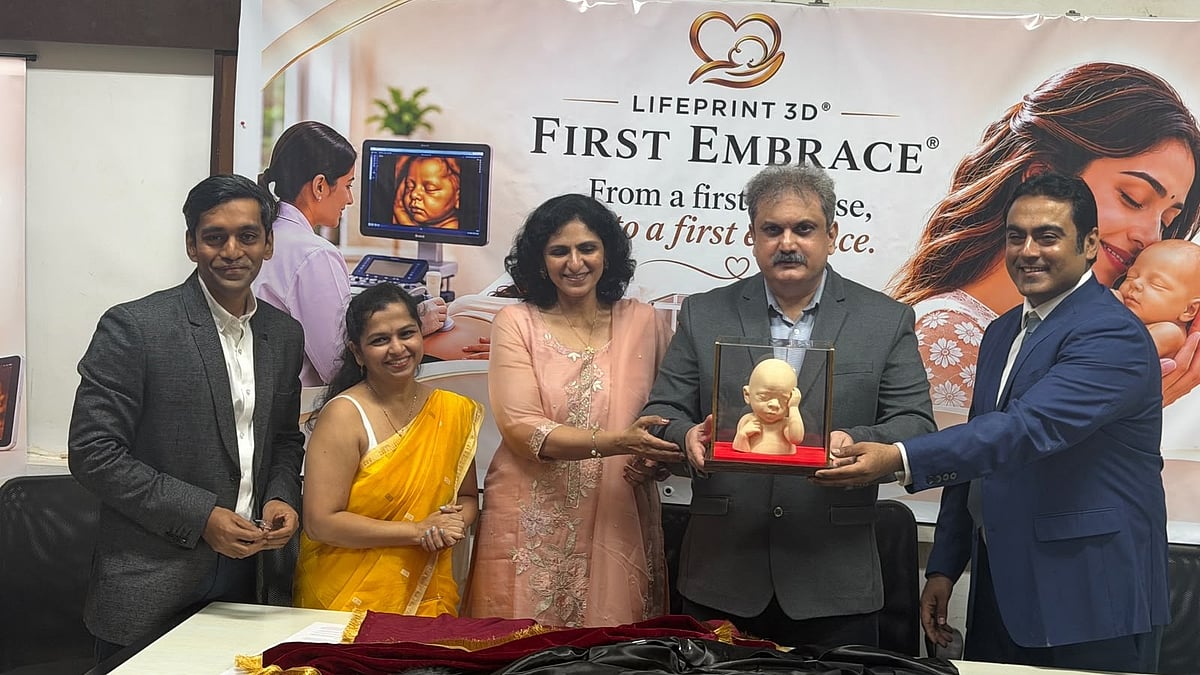
Mumbai: Expectant parents may soon be able to hold a three-dimensional model of their unborn baby's face even before birth. A Mumbai-based medical technology venture, LifePrint 3D, has launched a service that converts existing 3D and 4D ultrasound images into personalised, 3D-printed models of the baby's face and upper body.
FirstEmbrace Uses AI And 3D Printing To Create Pregnancy Keepsakes
The service, FirstEmbrace, combines artificial intelligence (AI), advanced image processing and 3D printing to transform ultrasound images into physical keepsakes that families can preserve as memories of pregnancy.
However, the company has clarified that the models will not reveal or communicate the sex of the foetus and will operate in accordance with the Pre-Conception and Pre-Natal Diagnostic Techniques (Prohibition of Sex Selection) Act, 1994 (PCPNDT Act).
Under Section 5(2) of the Act, communicating the sex of the foetus to a pregnant woman or her relatives through words, signs or any other manner is prohibited. Section 6 prohibits sex selection and the use of prenatal diagnostic techniques for determining foetal sex. Violations can attract imprisonment and fines under Section 23.
Models Restricted To Baby's Face And Upper Body
FirstEmbrace models will be restricted to the baby's face and upper body. The company has also clarified that the product is a non-medical, non-diagnostic keepsake and cannot be used for clinical assessment or medical decision-making.
Co-founded by radiologists Dr Anand Bherwani, Dr Sandesh Rothe and Dr Sheetal Kabra, LifePrint 3D will use scans already performed for medical purposes, subject to the treating doctor's discretion and the radiologist's assessment of image quality. The service does not require additional ultrasound examinations solely to create the keepsake.
'Something Parents Can Actually Hold,' Says Co-Founder Dr Sandesh Rothe
"For parents, these are moments that stay with a family forever. We want to give them an opportunity to preserve that memory in a completely different way, something they can actually hold," said Dr Sandesh Rothe, co-founder of LifePrint 3D.

Converting ultrasound images into physical models involves technical challenges, including image noise, shadows, fetal movements and incomplete anatomical details, said Dr Sheetal Kabra.
Beyond pregnancy keepsakes, the company is also developing 3D anatomical models of organs such as the heart, lungs, liver, kidneys and brain using suitable CT and MRI datasets. These could support medical education and help doctors explain complex conditions to patients.
A 2020 study involving 96 expectant mothers, published in the Journal of Obstetric, Gynecologic & Neonatal Nursing, found greater improvement in maternal-fetal attachment scores among women who received 3D-printed models than those who received ultrasound images alone.
To get details on exclusive and budget-friendly property deals in Mumbai & surrounding regions, do visit: https://budgetproperties.in/

