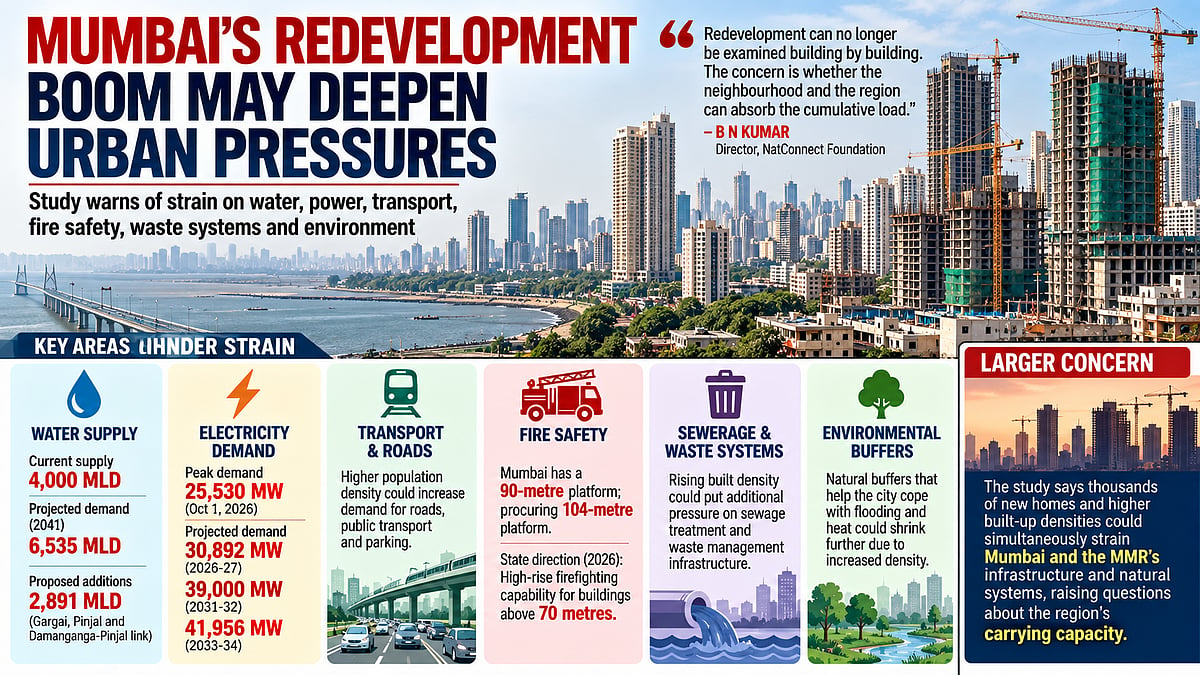
Mumbai and it's Mumbai Metropolitan Region are witnessing an unprecedented redevelopment wave that could end up adding to the very urban pressures it is expected to ease, as the region's infrastructure and natural systems are already under strain, says a study 'The City We Are Rebuilding,' by NatConnect Foundation.
Civic Systems Under Pressure
The massive redevelopment wave is putting water, power, roads, public transport, fire response, sewerage, waste systems and environmental buffers under severe cumulative stress, as rising built density collides with already stretched urban infrastructure and natural systems, the study warns.
"Redevelopment question can no longer be examined building by building. Thousands of new homes and sharply higher built-up densities could simultaneously increase demand for water, electricity, roads, public transport, parking, sewage treatment, waste management and emergency services, while shrinking the natural buffers that help the city cope with flooding and heat. The concern is not whether individual towers meet plot-level norms, but whether the neighbourhood and the region can absorb the cumulative load,” NatConnect director B N Kumar said.
Water Supply Key Constraint
The study identifies water as an immediate constraint. Mumbai’s current municipal supply is about 4,000 million litres a day (MLD) against projected 2041 demand of 6,535 MLD. Proposed additions from Gargai, Pinjal and the Damanganga-Pinjal link total 2,891 MLD.
As per the study, electricity demand could also rise sharply as residential density and cooling requirements increase. Maharashtra’s peak power demand was 25,530 MW on October 1, 2026, while the study cites projections of 30,892 MW in 2026-27, 39,000 MW in 2031-32 and 41,956 MW in 2033-34.
Fire safety presents another challenge as towers rise higher. Mumbai currently has a 90-metre hydraulic aerial platform and is procuring a 104-metre platform, while Maharashtra’s 2026 direction requires high-rise firefighting capability for buildings above 70 metres. The study cautions that aerial reach alone cannot ensure access to every floor, and approach roads, deployment areas, fire lifts, hydrants, pumps, refuge areas, alarms, smoke-control systems and evacuation routes must also be factored into approvals.
Navi Mumbai Nagrik Manch convenor Shrikant Patki said the region was facing a widening mismatch between vertical growth and civic capacity. He called for mandatory and transparent carrying-capacity assessments before further high-density redevelopment, arguing that planning must move beyond FSI and floor-space calculations to include liveability.
To get details on exclusive and budget-friendly property deals in Mumbai & surrounding regions, do visit: https://budgetproperties.in/

