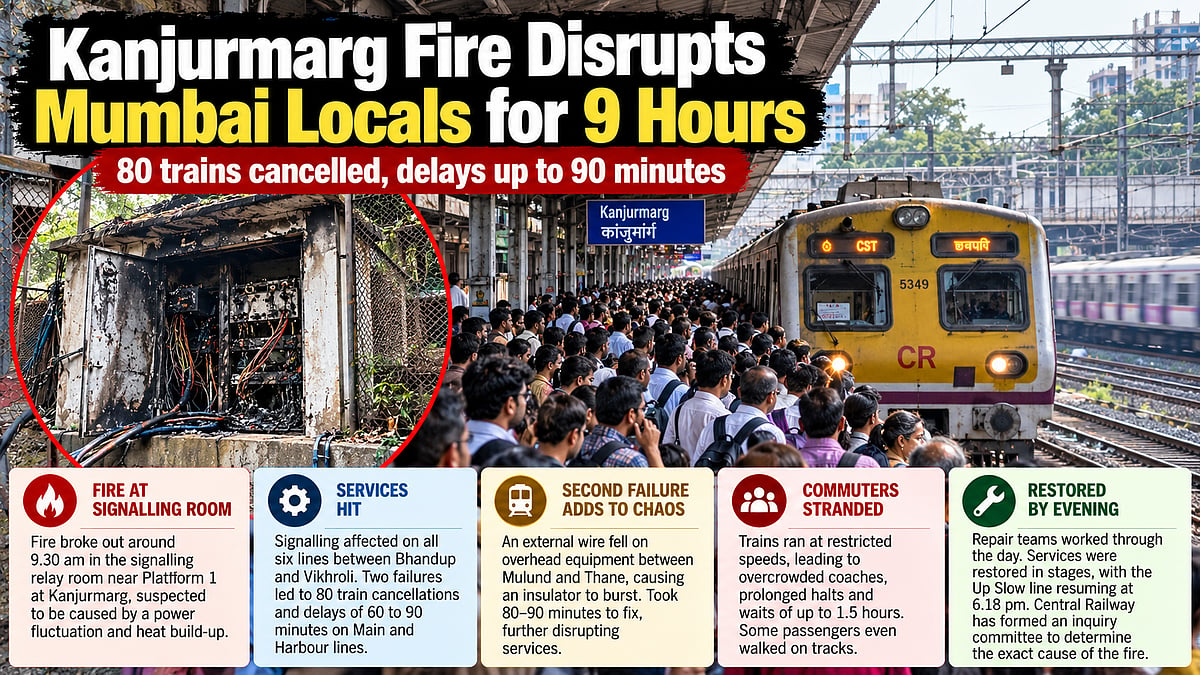
Mumbai: Nearly Nine hours were needed to restore normal train operations after a suspected power fluctuation and heat build-up triggered a fire in a signalling relay room at Kanjurmarg on Monday, disrupting Central Railway’s suburban services for most of the day. The fire affected signalling on all six lines between Bhandup and Vikhroli and was among two separate failures that led to the cancellation of 80 train services and delays of 60 to 90 minutes across parts of the Main and Harbour lines. With trains running at restricted speeds and special operating arrangements in place, commuters faced overcrowded coaches, prolonged halts and difficulties reaching their workplaces. Central Railway has constituted an inquiry committee to establish the cause of the fire.
Fire Breaks Out At Kanjurmarg
The fire broke out at around 9.30 am in the signalling relay room near Platform 1 at Kanjurmarg station. Smoke emerged from the hut as wires connected to the signalling equipment caught fire, affecting signals at Kanjurmarg and on the stretch between Bhandup and Vikhroli. Railway officials suspect a power supply fluctuation, possibly aggravated by heat, may have caused the failure. However, the exact cause is yet to be established.
The situation was further aggravated by a separate failure between Mulund and Thane, where an external wire fell on the overhead equipment on the Down local line, causing an insulator to burst. Officials said the fault took around 80 to 90 minutes to rectify. The two incidents brought suburban operations under pressure during the morning rush, with passenger associations questioning railway maintenance and the arrangements made after the weekend mega block.
Burnt wires cripple signalling
The relay room houses equipment that regulates train movements through signalling systems. The fire damaged several wires, leaving signals blank and forcing railway officials to introduce alternative operating procedures to move trains safely through the affected sections.
“There seems to be some surge in power supply and heat accumulation that might have led to this fire. It burned down the wires that power the signalling system, which led to signals at Kanjurmarg, Bhandup and Vikhroli going blank,” a Central Railway official said.
Equipment Cooling Under Scrutiny
Railway sources said the possibility of excessive heat affecting the equipment and wiring was being examined. The room reportedly had four to six exhaust fans instead of an air-conditioning system generally used to control temperatures in signalling equipment rooms. Sources also pointed to dust and cobwebs around the fans, raising questions about the upkeep of the ageing structure.
The relay room appeared poorly maintained, with debris, overgrown grass and fencing around the structure. Cables running along a nearby wall appeared loosely patched and were hanging in places. The condition of the premises raised concerns about whether the infrastructure was being maintained adequately, although the inquiry will have to establish whether maintenance issues contributed to the fire.
Locked Room Delays Access
Sources said the room was locked when the incident occurred, and the keys were with a railway employee at Bhandup. By the time access was secured and the fire was brought under control, the wires had suffered substantial damage. The extent of the damage made restoration a prolonged exercise.
The failure affected signalling on all six lines between Bhandup and Vikhroli, including the fast, slow and additional lines. Officials had to regulate train movements through special authorities rather than the normal signalling system, with trains proceeding at restricted speeds.
Central Railway introduced A-board authority working at Kanjurmarg and between Vikhroli and Bhandup. The fifth and sixth lines between the two stations were also operated under this arrangement, while absolute block working was introduced on the Up and Down local and through lines.
Commuters bear the brunt
The disruption quickly spread across the suburban network, as trains accumulated behind the affected sections. Several commuters reported waiting for around 30 minutes inside stationary trains, while delays on some services stretched to nearly one-and-a-half hours. Overcrowding increased as fewer trains could move through the affected stretch.
Some passengers reportedly got down from trains and walked along the tracks to reach nearby stations. The situation also raised concerns about the timing of announcements and the availability of information for passengers stranded inside trains and on platforms.
Passenger Association Questions Maintenance
“The railway authorities carried out a mega block just over the weekend and now this incident has happened. The Railways Ministry should take cognisance of this massive failure. People have been severely impacted since trains were running late by more than an hour,” said Siddesh Desai, member of the Mumbai Rail Pravasi Sangh.
Lata Argade of the Federation of Suburban Railway Passengers' Association criticised the railway authorities over maintenance and passenger communication.
Announcements Allegedly Came Late
“This is utter poor maintenance practice by the Railways. They should make announcements inside trains and on platforms immediately, which started quite late after people started walking on railway tracks to reach the nearest station,” she said.
The failures once again highlighted the wider consequences of a signalling breakdown on Mumbai's suburban network, where even a single section operating under restrictions can affect services across multiple routes. For commuters, the disruption meant lost working hours, longer journeys and uncertainty over train timings.
Restoration takes most of the day
Railway teams worked through the day to repair the damaged wiring and restore signalling. The Audio Frequency Track Circuit (AFTC) was made functional on the Up and Down lines as part of the restoration process.
The first signs of recovery emerged in the afternoon, with individual lines being declared fit in stages. The Up Slow line was the last to be restored, at 6.18 pm, bringing the day-long repair effort closer to completion.
Central Railway has formed an inquiry committee comprising senior officials to determine the exact cause of the fire. A preliminary inquiry indicated that sparking may have triggered the blaze, but the final findings are awaited.
“A preliminary inquiry has indicated that sparking may have triggered the fire. The exact cause will be established after the committee submits its report,” said Dr Swapnil Nila, chief public relations officer, Central Railway.
The inquiry will be crucial in determining whether the incident was caused by a power fluctuation, overheating, a short circuit or a combination of factors, and whether any maintenance lapses contributed to the failure.
To get details on exclusive and budget-friendly property deals in Mumbai & surrounding regions, do visit: https://budgetproperties.in/

